A parabolic heater is a specialized type of electric radiant space heater featuring a deeply curved, dish-shaped reflector mirror much like a miniature satellite dish. Instead of relying on a fan to blow warm air across an entire room, an electric parabolic heater uses a concentrated heating element paired with a parabolic reflector to project a focused beam of infrared radiant heat directly toward people and objects sitting in its path.
Before diving in, it is important to clarify that a parabolic heater is designed strictly as a supplemental heating option, not a replacement for your home’s primary heating system. While they excel at keeping an individual warm in a home office, living room chair, or workshop, they are not engineered to heat an entire house or act as a primary furnace substitute. Lets deep dive into “Best Parabolic Heater: Reviews & Buying Guide”
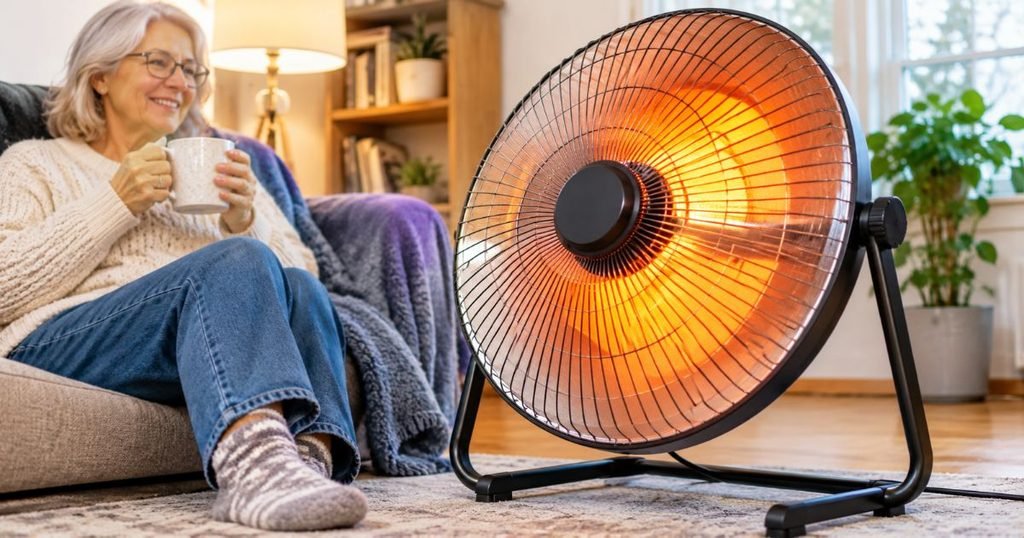
Explain How a Parabolic Heater Works
Understanding the technology behind a parabolic radiant heater helps clarify why it feels so different from traditional convection space heaters. While standard convection heaters warm the air inside a room which then rises, cools, and circulates radiant heaters operate entirely differently.
The Science of Direct Radiant Heating
Radiant heating functions much like the sun. Infrared energy travels in a straight line through the air without heating the air itself. When those invisible infrared rays strike a solid object such as your skin, clothing, or furniture they instantly convert into soothing warmth.
This directional physics explains why users feel warmth almost immediately when sitting within the heater’s effective range, even if the surrounding room air is still relatively cool.
Reflector Design, Wattage, and Distance
The defining characteristic of any parabolic dish heater is its geometric reflector dish. The parabolic curve is mathematically engineered to focus and concentrate the thermal radiation emitted by the central heating element into a tight, beam-like projection.
- Wattage: Most portable models operate between 800 and 1,000 watts, focusing their energy so efficiently that manufacturers often note they can feel as warm as standard 1,500-watt convection heaters while drawing significantly less electrical current.
- Distance and Positioning: Because the heat is directional, your physical distance from the unit matters immensely. Sitting directly in front of the beam maximizes comfort, while moving off to the side reduces the warming effect.
- Reflector Adjustability: Many top-tier models feature adjustable tilt mechanisms or motorized oscillation to sweep the warm beam across a broader arc, preventing any single spot from becoming overly hot.
Limitations in Large Spaces
Because parabolic heaters rely on directional line-of-sight radiation, they have distinct limitations. They cannot effectively warm a sprawling, open-concept living room or a poorly insulated space from a single corner. In large or drafty rooms, obstacles block the thermal rays, meaning anyone sitting outside the direct beam will feel little to no temperature change.
READ MORE: PTC Heater Guide: How It Works, Benefits & Efficiency
Best Parabolic Heaters: Review and Comparison
To help you navigate the market, we evaluated several popular parabolic and radiant dish heaters available to U.S. buyers in 2026. These selections encompass top-rated models recognized for performance, safety, and build quality.
1. Presto HeatDish Plus Tilt Parabolic Electric Heater
- Manufacturer: Presto
- Approximate Price Range: $120.00 – $140.00
- Wattage & Heat Settings: 1,000 watts; single continuous-focus high-efficiency setting with precise electronic or mechanical controls depending on the specific sub-model.
- Reflector Design & Features: Computer-designed parabolic reflector dish; features an adjustable tilt base allowing users to direct the heat beam upward or downward.
- Safety Features: Automatic tip-over switch, thermal overload protection, and sturdy wide base.
- Portability & Controls: Lightweight with a built-in carrying handle; straightforward rotary or push-button operation.
- Pros: Exceptionally fast personal warmth; engineered to deliver high perceived heat output while drawing fewer watts than standard 1,500W heaters; highly durable construction.
- Cons: Lacks built-in digital thermostat control or multi-stage wattage switches; directional heat means it only warms one person effectively at a time.
- Best Suited For: Homeowners seeking the best overall parabolic heater for focused desk work, reading nooks, or single-person supplemental heating.
2. Comfort Zone Parabolic Oscillating Dish Space Heater
- Manufacturer: Comfort Zone
- Approximate Price Range: $45.00 – $55.00
- Wattage & Heat Settings: Up to 1,000 watts with adjustable heat output options.
- Reflector Design & Features: Deep reflective dish paired with a smooth mechanical oscillation function to distribute radiant warmth across a wider angle.
- Safety Features: Built-in tip-over safety switch, automatic overheat protection system, and cool-touch front grille housing.
- Portability & Controls: Compact tabletop or floor footprint with easy manual controls.
- Pros: Budget-friendly price point; oscillation feature solves the narrow-beam limitation of stationary models by covering a wider zone.
- Cons: Build materials feel slightly lighter-duty compared to premium commercial-grade options; fan-driven or mechanical oscillation gears can produce a faint hum.
- Best Suited For: Budget-conscious buyers looking for the best budget-friendly parabolic heater with oscillation.
3. Comfort Glow ERH375 Oscillating Radiant Parabolic-Dish Heater
- Manufacturer: Comfort Glow
- Approximate Price Range: $55.00 – $70.00
- Wattage & Heat Settings: 1,000-watt-max output with variable heat settings.
- Reflector Design & Features: Polished radiant dish with multi-position adjustable tilt and wide-angle oscillation.
- Safety Features: Dual safety protection including tip-over shutoff and automatic thermal cutoff.
- Portability & Controls: Designed for flexible placement in home offices or bedrooms.
- Pros: Excellent balance of adjustable heat controls and reliable oscillation; rapid warm-up time.
- Cons: Availability can fluctuate seasonally at major U.S. retailers.
- Best Suited For: Individuals wanting a versatile portable parabolic heater for medium-sized bedrooms or home offices.
4. BLACK+DECKER BHRO608 14-Inch Oscillating Radiant Dish Heater
- Manufacturer: BLACK+DECKER
- Approximate Price Range: $65.00 – $80.00
- Wattage & Heat Settings: 800-watt-max rating with adjustable heating levels.
- Reflector Design & Features: 14-inch compact parabolic reflector dish with built-in oscillation and tilt adjustments.
- Safety Features: Tip-over switch, thermal overload protection, and insulated housing elements.
- Portability & Controls: Compact 14-inch footprint makes it exceptionally easy to store and reposition.
- Pros: Lower 800-watt ceiling draws less electrical load, making it safer for older home circuits; trusted brand reputation.
- Cons: Lower wattage output means slightly less intense peak radiant heat compared to 1,000W units.
- Best Suited For: Apartment renters and home office users needing a compact, lower-wattage heating solution.
READ MORE: Heat Storm Heater Review & Comparison: Cost, Pros & Cons
Add a Product Comparison Table
| Heater Model | Wattage | Heat Settings | Safety Features | Best For | Approximate Price |
| Presto HeatDish Plus Tilt | 1,000W | Single optimized focus / Tilt adjustable | Tip-over switch, Overheat shutoff | Best Overall Performance | $120 – $140 |
| Comfort Zone Oscillating Dish | Up to 1,000W | Variable settings | Tip-over switch, Overheat protection | Best Budget / Oscillating | $45 – $55 |
| Comfort Glow ERH375 | 1,000W Max | Variable heat levels | Tip-over shutoff, Thermal cutoff | Best Portable Bedroom Heater | $55 – $70 |
| BLACK+DECKER BHRO608 | 800W Max | Adjustable levels | Tip-over switch, Overheat protection | Best for Home Office / Lower Wattage | $65 – $80 |
Choosing the Right Model for Your Space
When evaluating these options, match the unit to your specific environment. If you want maximum raw radiant heat intensity and long-term durability, a stationary 1,000-watt unit like the Presto HeatDish Plus is difficult to surpass. If your seating area moves or you want to share the warmth across two people sitting side by side, an oscillating model like the Comfort Zone or Comfort Glow provides superior versatility.
How to Choose the Best Parabolic Heater
Selecting the right appliance involves looking beyond marketing claims and evaluating core technical specifications.
Heating Performance and Wattage
Wattage dictates electrical draw. While standard space heaters consume 1,500 watts, most parabolic heaters operate between 800W and 1,000W. Because the parabolic reflector focuses thermal energy so efficiently, a lower wattage does not translate to weaker personal warmth. However, verify that your home’s electrical circuit can handle the load, especially if other heavy appliances share the same breaker.
Heating Coverage and Room Layout
Parabolic heaters provide personal, spot heating rather than whole-room ambient heating. When reviewing manufacturer coverage claims, keep in mind that radiant heat only warms objects within a direct line of sight (typically a range of 6 to 10 feet from the dish). Consider your room layout, seating distance, and whether drafts will interfere with the infrared beam.
Safety Features
Safety must be your top priority when purchasing any electric heating appliance. Look for:
- Tip-Over Shutoff: Automatically cuts power if the unit is knocked over.
- Overheat Protection: Shuts the unit down internally if component temperatures exceed safe thresholds.
- Stable Base: A wide, weighted base that resists accidental tipping.
- Protective Grilles: Heavy-duty wire mesh screens preventing direct contact with the hot quartz or metallic heating element.
- Third-Party Certification: Verification from recognized testing laboratories such as UL (Underwriters Laboratories) or ETL (Intertek).
Controls and Convenience
Evaluate whether you prefer simple manual rotary dials or digital thermostats with programmable timers. Features like adjustable vertical tilt, smooth oscillation, and an integrated carrying handle greatly enhance day-to-day usability.
READ MORE: Best DEWALT Propane Heater Review: 3 Models Compared
Parabolic Heater Electricity Cost
A common question among homeowners is how much an electric parabolic heater adds to monthly utility bills. Calculating operating costs is straightforward when you know your local electricity rate and the heater’s wattage.
The Standard Calculation Formula
ElectricityCost=Wattage1,000HoursofUseElectricityRateperkWh
Illustrative Step-by-Step Example
Imagine you are using a 1,000-watt parabolic heater for 5 hours a day in your home office, and your local utility rate is $0.18 per kWh (note: this is an illustrative example, not a national average or guaranteed local rate).
- Convert wattage to kilowatts: 1,0001,000=1.0kW
- Multiply by hours of use: 1.0kW5hours=5.0kWh
- Multiply by the electricity rate: $5.0\text{ kWh} \times \$0.18 = \$0.90\text{ per day}$
Over a 30-day month of consistent daily use, that totals approximately $27.00 in supplemental heating costs. Actual expenses vary depending on your specific power setting, operating hours, local utility pricing, and whether the heater features an automatic cycling thermostat.
Keep in mind that electric resistance heaters convert nearly 100% of the electricity they consume into heat at the point of use. A parabolic heater does not violate thermodynamic laws; rather, it saves money by directing that heat precisely where you are sitting, allowing you to keep your central thermostat lower without freezing.
Parabolic Heater Versus Other Space Heaters
To determine whether a parabolic dish is truly the best fit for your home, it helps to compare it directly against alternative space heater technologies.
| Heater Type | Heating Method | Warmth Distribution | Response Time | Typical Use Case |
| Parabolic Heater | Focused Infrared Radiant | Directional beam (spot heating) | Instantaneous (seconds) | Desk work, reading chairs, single-user spot heating |
| Ceramic Heater | Convection + Fan-forced | Whole-room air circulation | Fast (minutes) | Small bedrooms, bathrooms, general room warming |
| Infrared Panel Heater | Broad Infrared Radiant | Wide zone of radiant warmth | Moderate | Wall-mounted supplemental zone heating |
| Oil-Filled Radiator | Convection & Thermal Mass | Steady ambient room heat | Slow (15–20 mins) | Nurseries, bedrooms, quiet background heating |
While ceramic heaters are fantastic for warming up a small enclosed bedroom by circulating warm air, a parabolic heater is superior when you want instant, sun-like warmth focused entirely on your body without waiting for the entire room volume to heat up.
READ MORE: Best Envi Wall Heater: Review, Cost & Comparison
Who Should Buy a Parabolic Heater?
Parabolic heaters are specialized tools. They are ideal for:
- Remote workers and home office users who sit stationary at a desk for hours and want to warm their legs and core without heating an entire empty house.
- Homeowners in mild-to-moderate winter climates looking to take the chill off a specific seating area.
- Individuals seeking direct, rapid relief upon entering a cold room.
When to Choose an Alternative
You should look elsewhere if you need to heat a large, heavily trafficked family room, if you have toddlers or pets roaming freely where an exposed hot reflector dish poses a burn hazard, or if you require quiet, unattended background heat for an entire living space overnight. Furthermore, indoor parabolic heaters must never be used outdoors, in damp bathrooms, or in wet areas unless explicitly rated by the manufacturer.
Parabolic Heater Safety: Essential Guidance
Space heater safety is critical for U.S. homeowners. Operating high-wattage heating appliances safely requires strict adherence to established safety guidelines:
- The 3-Foot Rule: Keep all combustible materials including curtains, bedding, papers, clothing, and furniture at least 3 feet away from the front, sides, and rear of the heater.
- Stable Surfaces: Always place the unit on a flat, level, hard, nonflammable floor surface. Never place it on plush carpets, beds, or uneven furniture.
- Direct Wall Outlets Only: Plug the heater directly into a standard 120V wall receptacle. Never use an extension cord or power strip, as their thinner wiring can overheat and cause electrical fires.
- Never Leave Unattended: Turn off and unplug the heater whenever you leave the room or go to sleep.
- Water and Moisture Avoidance: Keep the appliance away from sinks, bathtubs, and wet areas to prevent severe electrical shock.
- Inspect Cords Regularly: Stop using any heater with a frayed cord, cracked housing, damaged plug, or abnormal operating behavior.
- Respect Hot Surfaces: Remember that protective wire grilles become extremely hot during operation. A grille prevents direct finger contact with the heating coil, but it will still cause burns if touched.
Common Buying Mistakes to Avoid
- Assuming whole-room heating: Expecting a parabolic heater to warm an entire basement or large living room.
- Shopping on price alone: Buying the cheapest unverified unit without checking for critical safety certifications like ETL or UL.
- Ignoring tip-over risks: Purchasing a top-heavy model lacking an automatic tip-over shutoff switch.
- Overloading circuits: Plugging a 1,000W heater into an overloaded multi-outlet adapter or extension cord.
- Expecting automatic bill miracles: Believing a space heater will magically lower bills while running continuously on high settings without adjusting your central thermostat.
Maintenance and Troubleshooting
Keeping your parabolic heater in top condition requires minimal effort:
- Unplug and Cool: Always unplug the unit and allow the heating element and reflector dish to cool completely before performing any maintenance.
- Dust the Reflector: Gently wipe the parabolic reflector dish with a soft, dry microfiber cloth. Dust accumulation on the reflector diminishes its ability to focus infrared beams efficiently.
- Check Air Vents: Ensure rear and base intake vents remain free of lint, pet hair, and debris.
- Troubleshooting Tips: If the heater fails to turn on, check the wall outlet by plugging in a lamp, ensure the unit’s base is resting fully flat on the floor to engage the mechanical tip-over safety button, and verify that the household circuit breaker has not tripped. Never attempt to dismantle electrical components yourself.
FAQs
What is the best parabolic heater for home use?
The Presto HeatDish Plus Tilt is widely regarded as the top overall choice due to its computer-engineered reflector dish, robust build quality, and efficient 1,000-watt heating performance. For users seeking oscillation and budget flexibility, models from Comfort Zone and Comfort Glow serve as excellent alternatives.
Are parabolic heaters energy efficient?
Yes, in terms of spot heating. Because parabolic heaters use a specialized reflective dish to concentrate infrared radiation directly onto your body, they can produce the sensation of intense warmth using fewer watts (typically 800W to 1,000W) than traditional 1,500W space heaters. However, they are not energy efficient if left running unattended in empty rooms.
How much does it cost to run a parabolic heater?
Running a 1,000-watt parabolic heater typically costs between 15 and 22 cents per hour, depending on your local utility’s kilowatt-hour (kWh) rate. For instance, running the heater for 4 hours daily at an average electricity rate of $0.18 per kWh results in an estimated daily operating cost of approximately $0.72, or about $21.60 per month.
Are parabolic heaters safe to use indoors?
Yes, parabolic heaters are safe for indoor residential use provided you follow fundamental safety guidelines. Always plug them directly into a wall outlet, never an extension cord, maintain a 3-foot clearance from flammable items, place them on a stable, flat surface, and ensure they feature built-in tip-over and overheat shutoff protection.
Is a parabolic heater better than a ceramic space heater?
Neither is universally “better”; they serve different purposes. A parabolic heater is superior if you want instant, directional radiant warmth focused directly on yourself in a drafty room. A ceramic heater is better if your goal is to gently warm the ambient air of a small, enclosed room via fan-forced convection.
Conclusion
Finding the best parabolic heater comes down to recognizing your personal comfort needs. If you spend extended hours at a desk, workbench, or living room chair and want instantaneous, sun-like warmth without heating an entire house, a high-efficiency parabolic radiant dish heater is an exceptional investment.
When shopping, prioritize models equipped with essential safety certifications (such as UL or ETL), automatic tip-over shutoff switches, and stable, wide bases. Always verify current product availability, pricing, and warranty terms before making your final purchase. By pairing a quality parabolic heater with smart placement and strict safety habits, you can stay comfortably warm all winter long while keeping your energy consumption under control.
- Ready to upgrade your home comfort? Compare verified models today and choose the parabolic heater that best fits your workspace, budget, and safety requirements!