When your home’s climate system stops performing during extreme weather, finding fast, expert service becomes an immediate priority. Carrier is recognized across America for engineering reliable, high-efficiency heat pumps. However, mechanical systems experience wear over time. Heavy summer cooling demands, freezing winter defrost cycles, electrical surges, and simple component fatigue can leave you searching online for Carrier heat pump repair near me.
In this guide, you’ll learn how a Carrier heat pump actually works, the warning signs that mean it’s time for service, realistic repair cost ranges, a homeowner-friendly troubleshooting checklist, and exactly what to look for when searching for “Carrier heat pump repair near me” so you end up with a technician who does the job right the first time. Lets deep dive into “Carrier Heat Pump Repair Near Me: Homeowner Guide”
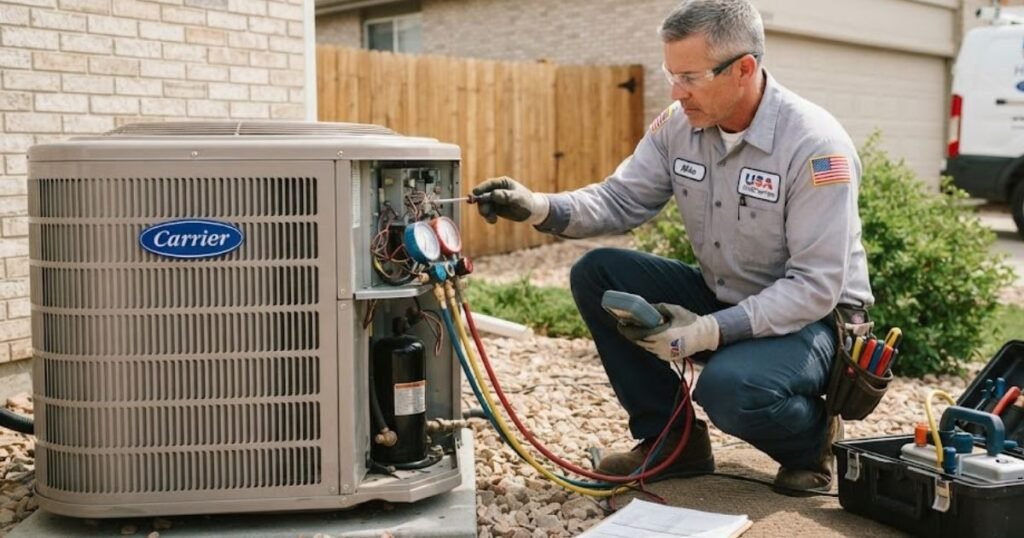
What Is a Carrier Heat Pump?
A heat pump is essentially a two-way air conditioner. Instead of only removing heat from your home in summer, it can reverse the process and pull heat from the outdoor air (even cold air) to warm your home in winter. Here’s how the main components work together:
- Compressor – The heart of the system, located in the outdoor unit. It pressurizes refrigerant and pushes it through the system.
- Reversing valve – Switches the direction of refrigerant flow, allowing the same unit to heat in winter and cool in summer.
- Outdoor condenser/coil – Absorbs or releases heat depending on the mode, with a fan pulling air across it.
- Indoor air handler/blower – Circulates conditioned air through your ductwork and into your living space.
- Thermostat – Tells the system when to run, in which mode, and at what temperature.
- Defrost cycle – In heating mode, the outdoor coil can collect frost in cold weather. The unit periodically switches into a short defrost cycle to melt it off before resuming normal heating.
When any one of these parts underperforms, the whole system can seem “broken,” even if the actual issue is a single failed component.
READ MORE: Best ecobee Smart Thermostat Review: Essential vs Enhanced vs Premium
Signs Your Carrier Heat Pump Needs Repair
Catching problems early almost always saves money. Watch for:
- No heat, or the system blows cool air while set to “heat”
- No cool air during summer operation
- Weak or reduced airflow from vents
- Ice or frost building up on the outdoor unit outside of a normal defrost cycle
- Short cycling (turning on and off repeatedly in short bursts)
- Unusual smells — musty, burning, or electrical
- Loud buzzing, grinding, rattling, or clicking noises
- Noticeably higher utility bills with no change in usage
- A thermostat that won’t hold a set temperature or has a blank display
- Water pooling near the indoor or outdoor unit
- Error codes displayed on the thermostat or control board
- Outdoor fan that isn’t spinning when the system is running
If you notice more than one of these at once, it’s often a sign that a single failed part is causing a chain reaction.
READ MORE: Best 10,000 BTU Portable Air Conditioner: Reviews & Comparison
Common Carrier Heat Pump Problems and Solutions
1. Carrier Heat Pump Not Heating
- Possible Causes: Faulty reversing valve, outdoor coil frozen solid, low refrigerant level, dirty air filter, or malfunctioning thermostat.
- DIY Checks: Verify the thermostat is set to “Heat” mode and temperature is set above room temperature. Inspect and replace dirty air filters. Clear snow or autumn leaves from around the outdoor cabinet.
- Professional Repair: A local Carrier HVAC company can check refrigerant pressures, inspect reversing valve solenoid operation, and test auxiliary heat strips.
2. Carrier Heat Pump Not Cooling
- Possible Causes: Clogged indoor air filter, dirty outdoor condenser coils, weak dual-run capacitor, or low refrigerant due to a leak.
- DIY Checks: Ensure the thermostat is set to “Cool”. Rinse visible dirt off the outdoor unit using low-pressure garden hose water.
- Professional Repair: Technicians perform leak isolation testing, replace blown capacitors, and verify compressor amp draw.
3. Frozen Outdoor Unit
- Possible Causes: Defrost board failure, bad defrost thermostat sensor, low refrigerant charge, or failed outdoor fan motor.
- DIY Checks: Turn the system off or switch to “Emergency Heat” to prevent compressor strain. Clear away snow drift, leaves, or gutter overpour dripping onto the unit.
- Professional Repair: A certified technician tests defrost timers, sensors, and relays to restore automatic defrosting.
4. System Blowing Cold Air in Heat Mode
- Possible Causes: System is currently in active defrost cycle, bad thermostat wiring, or broken reversing valve.
- DIY Checks: Wait 10 to 15 minutes. During defrost cycles, heat pumps temporarily blow cooler air while clearing frost from outdoor coils.
- Professional Repair: If cold air continues past 15 minutes, a technician tests the reversing valve solenoid and auxiliary electric heating elements.
5. Carrier Heat Pump Making Loud Noises
- Squealing / Screeching: Failing motor bearings or worn fan belt.
- Loud Banging / Metal Rattling: Loose fan blade or failing compressor internal components.
- Continuous Buzzing / Hum: Defective electrical contactor or sticking solenoid coil.
- Hissing / Bubbling: Refrigerant escaping under high pressure.
Carrier Heat Pump Symptoms vs. Likely Causes
| Symptom | Primary Causes | Recommended Action |
| No Airflow | Clogged filter, failed blower motor, broken belt | Replace filter; call pro for motor testing |
| Ice on Indoor Coil | Restricted air circulation, low refrigerant levels | Turn off cooling, replace filter, call pro |
| Continuous Running | Extreme ambient temps, worn compressor, leak | Perform basic filter check, call technician |
| Water Leaks Around Indoor Unit | Clogged condensate line, cracked drain pan | Clear drain line trap; consult technician |
| Thermostat Screen Blank | Dead batteries, tripped float switch, open breaker | Replace batteries, check breaker panel |
RAED MORE: 8 Best DREO Smart Tower Fans: Review & Comparison
Carrier Heat Pump DIY Troubleshooting Checklist
Before calling for service, it’s worth running through this list it resolves a surprising number of “no heat” or “no cool” calls:
- ✅ Check that the thermostat is set to the correct mode and temperature
- ✅ Replace thermostat batteries
- ✅ Replace or clean a dirty air filter (a good habit every 1–3 months)
- ✅ Check the breaker panel for a tripped breaker
- ✅ Clean debris, leaves, and grass clippings away from the outdoor unit
- ✅ Clear at least 18–24 inches of open space around the outdoor unit
- ✅ Inspect supply and return vents for blockages
- ✅ Power-cycle the thermostat/system and wait a few minutes before restarting
- ✅ After any power outage, wait 15–30 minutes before restarting the system to protect the compressor
- ✅ Watch a full cycle to see if the system self-corrects (especially during defrost)
When DIY should stop: If you smell burning, see sparking, notice water near electrical components, or the breaker keeps tripping, stop and call a licensed technician. These checks cover the basics Carrier itself recommends homeowners try thermostat settings, filter changes, and clearing debris before scheduling a service call.
When to Call a Professional
Some repairs simply require licensed, EPA-certified expertise and specialized tools. Call a professional for:
- Refrigerant leaks or recharges
- Electrical failures beyond a simple breaker reset
- Compressor issues
- Fan motor replacement
- Defrost control board failure
- Reversing valve problems
- Any burning smell
- Water inside electrical components
READ MORE: Best Convector Heater Review:Best Models & Comparison
Carrier Heat Pump DIY vs. Professional Repair Boundaries
| Task | Homeowner DIY | Licensed Technician |
| Filter Replacement | Green Check | Red X |
| Thermostat Battery Replacement & Programming | Green Check | Red X |
| Clearing Exterior Leaf Debris | Green Check | Red X |
| Electrical Capacitor & Contactor Replacement | Red X | Green Check |
| Refrigerant Leak Repair & System Recharge | Red X | Green Check |
| Compressor Diagnostic & Replacement | Red X | Green Check |
| Reversing Valve & Defrost Board Repair | Red X | Green Check |
Average Carrier Heat Pump Repair Costs in the USA
Nationally, heat pump repairs run $150 to $650 for most standard issues, with the typical homeowner paying around $400. Major component failures can push costs to $2,500 or more. Here’s a more detailed breakdown:
| Repair Type | Estimated Cost Range |
| Diagnostic/service call fee | $90 – $150 |
| Capacitor replacement | $150 – $300 |
| Contactor replacement | $120 – $250 |
| Thermostat repair | $100 – $300 |
| Smart thermostat replacement | $200 – $500 |
| Fan motor replacement | $300 – $800 |
| Blower motor replacement | $300 – $800 |
| Refrigerant leak repair | $200 – $1,000 |
| Refrigerant recharge only | $200 – $500 |
| Defrost control board | $200 – $650 |
| Reversing valve replacement | $400 – $700 |
| Coil replacement (evaporator/condenser) | $600 – $2,500 |
| Compressor replacement | $1,000 – $2,600+ |
| Emergency/after-hours service | +1.5x – 2x standard labor rate |
| Annual maintenance/tune-up | $70 – $200 |
Disclaimer: These are general national estimates compiled from current home-service pricing data. Actual costs vary significantly based on your location, local labor rates, system age and model, refrigerant type, accessibility of equipment, and parts availability. Always get a written estimate from a licensed local contractor before authorizing work.
READ MORE: Best Oscillating Tower Fan: Reviews, Comparison, and Buying Guide
Carrier Heat Pump Repair vs. Replace
| Factor | Lean Toward Repair | Lean Toward Replacement |
| Unit age | Under 10 years | Over 12–15 years |
| Warranty | Still active | Expired |
| Repair cost | Under 50% of new system cost | Over 50% of new system cost |
| Efficiency | Meets current SEER2/HSPF2 needs | Well below current efficiency standards |
| Repair frequency | Rare, isolated issue | Frequent breakdowns |
| Compressor status | Working fine | Failed or failing |
The 50% rule: If a repair estimate exceeds roughly 50% of the cost of a new system, replacement is usually the smarter long-term investment. A new heat pump installed can range roughly from $6,000 to $25,000 depending on home size, ductwork condition, and equipment tier, so a $2,500 compressor replacement on an aging 13-year-old unit may not make financial sense compared to putting that money toward a new, more efficient system.
It’s also worth knowing that federal minimum efficiency standards now require split-system heat pumps to meet at least 14.3 SEER2 and 7.5 HSPF2 (with slightly higher regional minimums in the South and Southwest). If your existing unit predates these standards, replacement can mean a real difference in monthly energy costs, not just fewer repairs.
Most heat pumps last 10 to 15 years on average, with well-maintained systems reaching 20+ years in some cases.
How to Find the Best “Carrier Heat Pump Repair Near Me”
Not every HVAC company is equally qualified to work on your equipment. Look for:
- Carrier Factory Authorized Dealer (FAD) status — these dealers must maintain rigorous technical, business, and training standards, and at least 50% of their technicians must hold NATE certification to keep that status.
- NATE certification — North American Technician Excellence is the industry’s leading technician certification; you can ask for a tech’s NATE ID to verify it.
- EPA 608 certification — legally required for anyone handling refrigerant.
- Proper licensing and insurance — protects you if something goes wrong during the job.
- Strong, recent online reviews across Google, Yelp, and the Better Business Bureau (BBB).
- Written estimates before work begins, not verbal ballpark figures.
- 24/7 emergency availability, especially valuable during extreme summer or winter weather.
- Warranty support, including labor warranties, not just manufacturer parts warranties.
RAED MORE: Best Honeywell Thermostat Models: Buyer’s Guide & Comparison
Questions to Ask Before Hiring an HVAC Company
- Are you a Carrier Factory Authorized Dealer, and are your technicians NATE certified?
- Do you use genuine Carrier parts, or aftermarket substitutes?
- Is the diagnostic fee credited toward the repair if I move forward?
- Do you offer a written warranty on both parts and labor?
- Do you provide emergency or same-day service?
- Is the estimate free, and will it be in writing before work starts?
- How long have you serviced Carrier equipment specifically?
Carrier Heat Pump Preventive Maintenance Tips
A little routine care goes a long way toward avoiding costly breakdowns:
- Replace or clean air filters every 1–3 months
- Keep the outdoor coil clean and free of dirt buildup
- Keep at least 18–24 inches of clearance around the outdoor unit, and trim back vegetation
- Schedule a professional tune-up at least once a year (ideally each spring or fall)
- Have refrigerant levels checked during annual service
- Ask your technician to inspect electrical connections for corrosion or looseness
- Test your thermostat’s heating and cooling modes each season before you need them
- Make sure vents and returns stay unobstructed by furniture or rugs
Common Repair Mistakes Homeowners Should Avoid
- Ignoring strange noises — a $150 capacitor problem can turn into a $1,000+ compressor problem if left alone
- Running a frozen unit — this can permanently damage the compressor
- Attempting DIY refrigerant charging — it’s illegal without EPA certification and can damage the system
- Skipping annual maintenance — the single biggest driver of premature breakdowns
- Buying cheap, non-OEM replacement parts — can void warranty coverage and fail prematurely
- Delaying repairs — small issues rarely stay small
Expert HVAC Maintenance Tips by Season
Routine maintenance helps prevent unexpected breakdowns, improves operating efficiency, and protects warranty coverage.
| Season | Priority Maintenance Checklist |
| Spring Preparation | Clean outdoor coils, check refrigerant levels, inspect condensate drain lines, test cooling modes. |
| Summer Care | Replace air filters monthly, clear vegetation around outdoor units, monitor indoor airflow. |
| Fall Preparation | Inspect electrical contactors, test auxiliary heat strips, clean indoor blower assemblies, calibrate thermostats. |
| Winter Care | Keep outdoor unit clear of snow drifted banks and ice dams; monitor proper defrost cycles. |
Conclusion
A Carrier heat pump is built to handle years of heating and cooling duty, but no mechanical system is immune to wear. Small issues a weak capacitor, a dirty filter, a stuck contactor are inexpensive to fix when caught early, while ignored problems tend to cascade into expensive compressor or coil failures. Repair almost always makes sense for younger systems with isolated issues; replacement becomes the smarter move once repair costs start approaching half the price of a new unit, or once breakdowns become a recurring pattern.
The single biggest factor in a good outcome is who you hire. A Carrier Factory Authorized Dealer with NATE-certified, EPA-certified technicians will diagnose the actual problem instead of guessing, use genuine parts that protect your warranty, and stand behind their work.
If your Carrier heat pump is acting up or it’s simply been a while since its last tune-up schedule an inspection with a qualified local Carrier dealer today. A little attention now is almost always cheaper than an emergency repair later.
Frequently Asked Questions
How much does Carrier heat pump repair cost?
Most repairs fall between $150 and $650, with a national average around $400. Major failures like a compressor or coil replacement can run $1,000–$2,600 or more.
Why is my Carrier heat pump blowing cold air?
It’s often normal during a brief defrost cycle. If the air stays cold, the likely culprits are a stuck reversing valve, low refrigerant, or a thermostat mode issue.
How long do Carrier heat pumps typically last?
Most heat pumps last 10 to 15 years, with well-maintained units reaching 20 years or more.
Should I repair or replace my Carrier heat pump?
If your system is under 10 years old and the repair is a single, isolated issue, repair usually makes sense. If the repair cost exceeds about 50% of a new system’s price, or the unit is over 12–15 years old with frequent breakdowns, replacement is typically the better long-term value.
How do I find the best Carrier heat pump repair near me?
Look for a Carrier Factory Authorized Dealer with NATE-certified, EPA-certified technicians, strong recent reviews, proper licensing and insurance, and a willingness to provide a written estimate before starting work.