Low water pressure in a house is one of the most common and frustrating problems a homeowner can face. It disrupts daily routines, turns simple chores into tedious waiting games, and often leaves you worrying about expensive pipe repairs.
The good news is that weak flow does not automatically mean you are facing a massive plumbing overhaul. In many cases, the issue comes down to a simple clogged fixture, a valve that was not reopened all the way, or a clogged filter. In other cases, it might stem from a failing pressure regulator, a hidden leak, heavy mineral corrosion in older lines, or an issue with your municipal water utility or private well system.
Before you spend money on new fixtures or call in a professional, the first step is to figure out where the restriction is happening. Is the problem isolated to a single faucet, or is low water pressure affecting your entire house? Identifying whether the issue is local or system-wide will save you time, eliminate guesswork, and point you toward the right fix. Lets deep dive into “How to Fix Low Water Pressure: Causes & Easy Solutions”
READ MORE: How to Fix Low Water Pressure in Your Shower— Step-by-Step DIY Guide
What Is Water Pressure and Why Does It Matter?
To fix low water pressure, it helps to understand what is happening inside your plumbing system. Water pressure is the force that pushes water through your home’s pipes and out of your faucets, showerheads, and appliances.
In the United States, water pressure is measured in pounds per square inch (PSI).
Water Pressure vs. Water Flow
Homeowners often use the terms “water pressure” and “water flow” interchangeably, but in plumbing, they refer to two distinct mechanics:
- Water Pressure (PSI): The static force or potential energy of the water standing inside your pipes.
- Water Flow (GPM): The volume of water coming out of a fixture over time, measured in gallons per minute (GPM).
Think of a garden hose. If you put your thumb over the end of the hose, you create a restriction. The pressure behind your thumb builds up, and the water sprays farther, but the actual volume of water (flow) coming out of the hose remains the same or decreases. Conversely, if your pipes are clogged with mineral buildup, you might have adequate static pressure, but when you turn on the faucet, the physical restriction starves the flow.
How Water Reaches Your Home
Whether your supply comes from a city main or a private well, water enters your property through a main supply line.
- Municipal Supply: Your local water utility pumps water into elevated storage tanks or uses booster stations to create pressure. That pressurized water travels through underground mains to your home’s main service line.
- Private Well System: Water is drawn from underground aquifers by a submersible or jet pump, which forces water into a pressure tank inside your home. The tank uses compressed air to maintain pressure across your plumbing system.
Once inside the house, water passes through main shutoff valves, water meters, filtration systems, and often a pressure-reducing valve before branching off into individual supply lines for hot and cold fixtures. Any bottleneck along this pathway from a partially closed valve to narrow, corroded pipes will reduce the available pressure and flow at your tap.
What Causes Low Water Pressure in a House?
Low water pressure can stem from mechanical failures, physical blockages, or utility issues. Here are the primary culprits behind weak water flow.
1. Partially Closed Main Water Shutoff Valve
Your home has at least one main water shutoff valve (and often two if you are on city water, one near the street meter and one where the main line enters the home). If work was recently done on your plumbing, or if someone accidentally bumped the valve, it might be partially turned toward the “off” position. Even a slight restriction at the main valve starves the entire house of adequate water flow.
2. Clogged Faucet Aerator
If you notice low water pressure at one faucet in the kitchen or bathroom, the problem is rarely in the main pipes. Faucet spouts are fitted with aerators, small mesh screens that mix air into the stream to create a smoother, splash-free flow. Over time, sediment, rust flakes, and hard water minerals (like calcium and magnesium) accumulate on these screens, severely choking off water flow.
3. Clogged or Restrictive Showerhead
Similar to aerators, showerheads feature tiny nozzles that are prone to mineral scale buildup, especially in regions with hard water. Additionally, modern showerheads contain internal flow restrictors designed to meet federal water conservation guidelines. If sediment lodges behind this restrictor, your shower stream will drop to a weak spray.
4. Mineral Buildup or Corroded Pipes
Galvanized steel pipes, common in American homes built before the late 1980s, are prone to internal corrosion. Over decades, rust and scale accumulate inside the pipe walls, creating a condition similar to clogged arteries. The outer pipe may look intact, but the inner diameter shrinks significantly, restricting flow. While copper, PEX, and PVC pipes resist corrosion better, hard water minerals can still create scale deposits near elbows, solder joints, and narrow fittings.
5. Plumbing Leaks
A leak anywhere in your plumbing network diverts water away from your fixtures, causing a noticeable drop in overall system pressure. While obvious leaks under a sink or in a basement are easy to spot, hidden leaks inside drywall, under concrete slab foundations, or underground in the main service line can quietly waste thousands of gallons of water while tanking your water pressure.
Common Warning Signs of a Hidden Leak:
- Damp spots or unexplained water stains on walls, ceilings, or flooring.
- The sound of running or hissing water when all fixtures are turned off.
- A sudden, unexplained jump in your monthly water bill.
- Musty odors or sudden mold growth in non-ventilated areas.
- Your water meter dial spinning or changing numbers when no water is actively in use.
6. Faulty Water Pressure Regulator
Many homes connected to municipal water supplies have a pressure-reducing valve (PRV), also known as a water pressure regulator. Usually located near the main indoor shutoff valve, the PRV is a bell-shaped brass fitting that caps high incoming city pressure down to a safe working limit for your home. When internal diaphragms or springs inside a regulator wear out, the valve can fail closed (causing a sudden, drastic drop in pressure house-wide) or fail open (exposing your plumbing to dangerously high pressure).
7. Municipal Water Supply Problems
Sometimes, low water pressure in your house has nothing to do with your home’s plumbing. Municipal utilities occasionally experience supply issues due to:
- Water main breaks or ongoing road repairs nearby.
- Routine fire hydrant flushing or municipal maintenance.
- High neighborhood demand during peak summer hours (e.g., automated sprinkler systems running simultaneously).
- Adjustments to local water supply grids.
8. Well Pump or Pressure Tank Problems
If your water comes from a private well, weak pressure typically points to an issue within the well pump assembly or pressure management system. Common causes include:
- Failing Well Pump: Wear and tear on internal impellers reduces the pump’s lift capacity.
- Pressure Switch Malfunction: The electrical switch that signals the pump to turn on at a set low point (e.g., 30 or 40 PSI) may have dirty contacts or misadjusted springs.
- Waterlog in Pressure Tank: If the internal bladder inside your pressure tank bursts, the tank loses its pre-charged air cushion, leading to rapid pump cycling and erratic pressure drops.
- Low Well Yield: Drought conditions or seasonal shifts can lower the groundwater table, reducing the rate at which your well recharges.
- Clogged Filtration Systems: Whole-house sediment filters, iron removal units, or water softeners can become completely clogged with sediment if media is not replaced regularly.
READ MORE: What to Do When a Toilet Overflows: Step-by-Step Fixes
How to Tell Whether the Problem Is at One Fixture or Throughout the House
Isolating the issue saves time and prevents unnecessary repairs. Use this quick comparison chart to narrow down where your pressure problem originates:
| Symptom | Likely Problem Area | First Step to Take |
| One faucet has weak flow | Clogged aerator, damaged faucet cartridge, or closed localized shutoff valve under the sink. | Unscrew aerator and clean out debris. |
| One shower has weak flow | Clogged showerhead nozzles, dirty shower cartridge, or stuck pressure-balancing valve. | Clean showerhead nozzles in a descaling solution. |
| Several fixtures in one bathroom are weak | Localized pipe restriction, branch line clogged, or hot/cold supply line issue. | Check branch shutoff valves feeding that specific room. |
| Whole house has low pressure | Partially closed main shutoff valve, failing pressure regulator, main line leak, or utility issue. | Test pressure at outdoor hose spigot near main inlet. |
| Pressure drops significantly when multiple fixtures run | Flow restriction in supply line, undersized plumbing, or clogged whole-house filter. | Check water softener bypass valve and whole-house filter cartridges. |
| Pressure suddenly drops house-wide without notice | Burst pipe/major leak, failed regulator, main valve closed, or municipal main break. | Check water meter dial movement and call local water utility. |
How to Check Your Home’s Water Pressure
Before adjusting valves or purchasing booster equipment, you need an accurate pressure reading. Relying on visual guesswork can lead to mistakes such as raising pressure on an already over-pressurized system, which damages appliances and causes leaks.
Using a Water Pressure Gauge
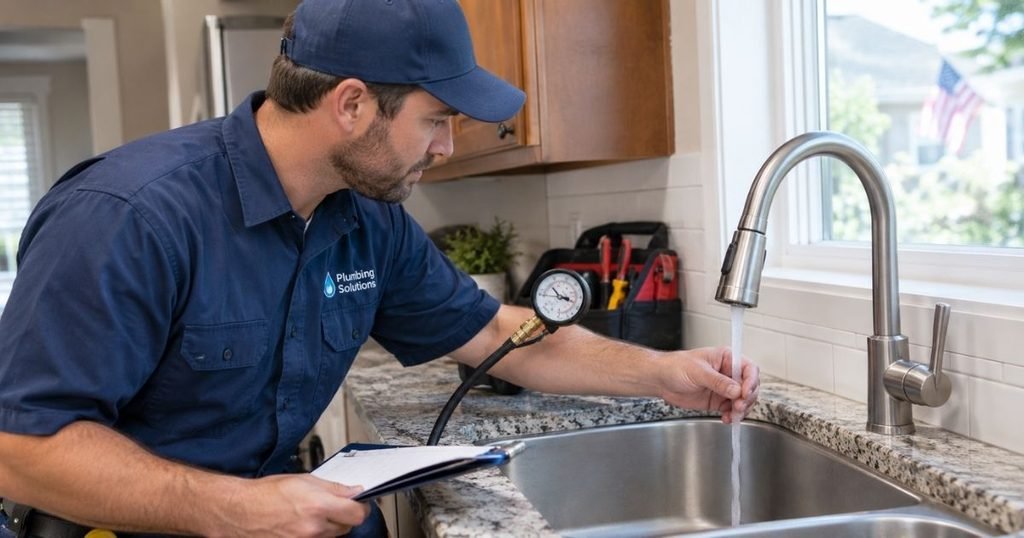
You can check your home’s static water pressure in less than ten minutes using an inexpensive water pressure gauge (available at any home improvement store for around $10 to $15). Look for a gauge that measures up to 100 PSI and features a female garden hose thread connection.
Step-by-Step Procedure
- Shut off all water usage: Ensure washing machines, dishwashers, ice makers, and irrigation systems are turned off. No faucets should be running anywhere in the house.
- Locate a hose spigot: Find an outdoor hose bib (or laundry tub faucet) that is supplied directly from your main supply line. Testing near where the line enters the house provides the most accurate reading of incoming supply pressure.
- Attach the pressure gauge: Thread the pressure gauge directly onto the male threads of the hose spigot. Hand-tighten it firmly, then use pliers to give it a minor quarter-turn seal if necessary to prevent leaks around the gasket.
- Open the valve completely: Turn the spigot handle all the way open. Water will press into the gauge and move the needle.
- Read and record the static pressure: Look at the PSI dial.
- Below 40 PSI: Considered low for standard residential plumbing systems. You may experience weak shower spray and slow appliance filling.
- 40 to 70 PSI: The normal, comfortable operating range for most modern American homes.
- Above 80 PSI: Dangerously high. Pressure above 80 PSI can rupture supply lines, blow out appliance valves, cause water hammer, and void equipment warranties.
- Test dynamic flow (optional): To see how your system behaves under load, leave the gauge open at the hose spigot, then turn on a sink faucet inside. If the gauge needle drops drastically (for example, falling from 60 PSI down to 15 PSI), you have good static pressure but a severe flow restriction in your supply piping.
READ MORE: What Causes Low Water Pressure in One Faucet
How to Fix Low Water Pressure Yourself
Once you have identified the symptoms and checked your PSI, you can perform several safe DIY steps to restore lost pressure.
1. Fully Open the Main Water Valve
Check the main shutoff valve to ensure it is 100% open.
- Ball Valves: These feature a lever handle. When open, the handle sits completely parallel to the copper or PEX pipe. If the handle sits at an angle, the internal ball is partially blocking flow. Turn it until it sits completely inline with the pipe.
- Gate Valves: Common in older homes, these have round, wheel-style handles. Turn the handle counterclockwise until it stops. Caution: Older gate valves can stick or snap off internally. Never force a stubborn or corroded gate valve. If it feels stuck, call a plumber to avoid snapping the stem inside.
2. Clean the Faucet Aerator
If low water pressure is limited to a single kitchen or bathroom sink, clean the aerator screen:
- Unscrew the aerator assembly from the tip of the faucet spout by turning it counterclockwise. Use a rag wrapped around pliers to protect delicate chrome finishes.
- Disassemble the internal parts (mesh screen, rubber washer, flow restrictor), keeping track of the order they go back together.
- Rinse away loose sediment under running water.
- Soak metal and plastic aerator parts in warm white vinegar for 30 to 60 minutes to dissolve hard mineral scale buildup.
- Scrub gently with an old toothbrush, reassemble, and screw back onto the faucet. Test flow.
3. Clean the Showerhead
Mineral buildup in showerheads can be cleaned using a similar descaling process:
- Method A (In-Place): Fill a plastic bag halfway with white vinegar. Submerge the showerhead in the bag, secure it around the shower arm with a rubber band, and let it soak for several hours or overnight. Remove the bag and run hot water to flush out loosened deposits.
- Method B (Removal): Unscrew the showerhead from the shower arm using an adjustable wrench. Soak the entire showerhead in a bowl of vinegar. Use a toothpick or sewing needle to poke open any stubbornly clogged rubber spray nozzles. Wrap fresh PTFE plumber’s tape clockwise around the shower arm threads before reinstalling.
4. Check Individual Fixture Shutoff Valves
Under sinks and behind toilets, look for localized dual-outlet or single-outlet shutoff valves (often called angle stops). Ensure these handles are turned completely counterclockwise to the fully open position. A partially closed valve under a kitchen sink is a frequently overlooked cause of weak faucet pressure.
5. Check Water Filters and Softener Restrictions
Whole-house water filtration units and water softeners process every gallon entering your home.
- Sediment Filters: Replace clogged cartridge filters according to manufacturer intervals (typically every 3 to 6 months). A heavily loaded filter element restricts water flow house-wide.
- Water Softeners: If your pressure drops suddenly, put your water softener into Bypass Mode using the valve bypass assembly located behind the unit. If water pressure immediately returns to normal throughout the house, your softener’s internal resin bed or valve head is clogged and requires maintenance.
READ MORE: How to Fix Clogged Drains: DIY vs Professional Repair
How to Adjust a Water Pressure Regulator
If your whole-house static pressure reading is consistently under 40 PSI, and your home is fitted with a pressure-reducing valve (PRV), adjusting the valve may boost your household pressure.
Locating the Regulator
The PRV is usually installed downstream from your main indoor shutoff valve, typically where the main cold water pipe enters the basement, crawlspace, or utility closet. It is a bell-shaped brass valve featuring a threaded adjustment bolt and a locknut sticking out of the top dome.
Step-by-Step Adjustment
- Attach a pressure gauge to an outdoor spigot as outlined earlier so you can monitor your changes in real time.
- Loosen the locknut on top of the PRV turning counterclockwise with a wrench.
- Turn the adjustment screw:
- To increase pressure, turn the adjustment bolt clockwise (tightening it down increases spring pressure inside the diaphragm).
- To decrease pressure, turn the bolt counterclockwise.
- Make small adjustments: Turn the bolt only a half-turn at a time. Go inside and run a faucet for 10 seconds to relieve line pressure, then turn it off and re-check the pressure gauge reading outside.
- Set to safe limits: Do not adjust static pressure above 68–70 PSI. Higher pressure puts excess stress on dishwasher valves, water heater tanks, and pipe joints.
- Tighten the locknut back down to lock the adjustment screw in place.
Note: If turning the adjustment bolt produces no change in gauge pressure, or if static pressure continually “creeps” back up to unsafe levels after turning off faucets, the internal diaphragm of the PRV has failed. The valve must be replaced by a licensed plumber.
When a Water Pressure Booster Pump May Help
If your municipal supply pressure is naturally low (under 30–35 PSI) due to your home’s elevation on a hill, distance from the municipal main, or long supply runs, adjusting a regulator will not help if there is simply not enough source pressure entering the property.
In these specific scenarios, installing a water pressure booster pump can solve chronic low-pressure problems.
How a Booster Pump Works
A water pressure booster system consists of an electric pump, an expansion pressure tank, and a pressure sensing control unit. Installed on your main incoming water line, the pump turns on whenever water is turned on inside the home, actively boosting water pressure to a set level (e.g., boosting 30 PSI incoming street pressure up to a steady 55 PSI indoor operating pressure).
When a Booster Pump WILL Help
- Homes on hills or elevated topography where municipal pressure is inherently weak.
- Homes at the far end of municipal utility distribution grids.
- Large multistory homes where elevation head loss reduces pressure on upper floors.
- Properties supplied by shallow, low-pressure gravity-fed municipal distribution networks.
When a Booster Pump WILL NOT Help
- Clogged aerators or fixtures: Boosting pressure will not force water through blocked scale deposits.
- Corroded galvanized piping: Forcing high pressure through narrow, heavily corroded rust-filled pipes can blow out weakened pipe joints, causing severe water damage.
- Leaking pipes: Higher pressure will only increase the volume of water escaping through hidden leaks.
- Inadequate well recovery: A booster pump cannot pull water that isn’t present in a dry private well.
READ MORE: Honeywell Water Heater Control: Settings, Fixes & Reset
How to Fix Low Water Pressure on Well Water
Troubleshooting low pressure on a private well system requires looking at different mechanical and electrical components than a city water connection.
Key Components to Inspect
- Pressure Switch: Mounts on a small pipe near the base of the pressure tank. It senses pressure and signals the pump to start (cut-in pressure, usually 30 or 40 PSI) and shut off (cut-out pressure, usually 50 or 60 PSI). If switch contacts get corroded, pitted, or covered in insect debris, the pump may fail to engage reliably.
- Pressure Tank: Contains an internal rubber bladder surrounded by air. If you press the air schrader valve on top of the tank and water spurts out instead of air, the bladder has ruptured. A waterlogged tank causes the pump to short-cycle (turn on and off rapidly every time a faucet is opened), resulting in pulsing water pressure.
- Sediment and Iron Filters: Well water carries suspended silt, iron particles, and minerals. Heavy loading on whole-house media filters will restrict indoor water pressure drastically. Check and replace pre-filters regularly.
- Well Pump Mechanics: Submersible pumps inside the well casing can experience impeller wear over time, gradually dropping pressure output.
- Check Valves: A failing check valve allows pressurized water in the storage tank to bleed back down into the well casing, causing sudden drops in resting system pressure.
Safety Warning: Private well systems rely on high-voltage 220V electrical circuits connected to automated switches. Unless you are experienced with electrical safety, diagnosing well electrical controls or replacing submersible pumps should be left to certified well technicians and plumbers.
Low Water Pressure in Different Parts of the House
Different areas of your home face unique mechanical restrictions. Here is how to target low pressure in specific locations:
Low Water Pressure in the Shower
- Cause: Scaled showerhead nozzles, dirty flow restrictor, or a malfunctioning shower mixing valve.
- Solution: Clean nozzles with white vinegar. If shower pressure remains weak while bathroom sink pressure is strong, replace the shower valve cartridge behind the handle; the pressure-balancing spool inside the cartridge often sticks due to mineral grit, cutting off hot or cold flow.
Low Water Pressure at the Kitchen Sink
- Cause: Clogged aerator, twisted pull-out hose, or clogged cartridge.
- Solution: Clean aerator screen. Check under the cabinet to make sure flexible pull-out faucet hoses are not kinked against storage items. Replace internal ceramic disc cartridges if mineral grit blocks valve openings.
Low Water Pressure in the Bathroom Sink
- Cause: Aerator restriction or partially closed angle stop valves under the vanity.
- Solution: Unscrew aerator screen, clear debris, and confirm both hot and cold shutoff valves underneath are turned fully counterclockwise.
Low Hot Water Pressure Only
- Cause: Issue localized to the hot water delivery system.
- Solution: If cold water pressure is strong throughout the house but hot water is weak at every fixture, check the shutoff valve sitting above your water heater tank. Ensure it is fully open. In older water heaters, heavy sediment accumulation or corroded heat trap nipples at the tank outlet can severely block hot water exit lines. Flushing the tank or replacing corroded nipples restores proper hot water flow.
READ MORE: Why Boiler Pressure Drops: Causes & Fixes
Low Water Pressure vs. Low Water Flow
Understanding the difference between pressure and flow is crucial when deciding how to solve your plumbing problem.
- Water Pressure (PSI): The static push of water against pipe walls when no fixtures are open. You can have 60 PSI static pressure showing on a gauge, which seems perfectly fine on paper.
- Water Flow (GPM): The volume of water moving through the pipe when a faucet is opened.
If your pipes are heavily clogged with mineral buildup or rust, or if a valve is 80% closed, your system will still reach full static pressure (60 PSI) when all taps are closed because the water eventually fills the system. However, as soon as you open a single tap, the restricted passage cannot deliver volume fast enough. The pressure drops instantly, and water trickles out.
When Low Water Pressure Is a Sign of a Bigger Plumbing Problem
While a dirty aerator is an easy DIY task, certain low-pressure symptoms warn of serious structural or system-wide plumbing failures. Stop DIY troubleshooting and take immediate action if you notice any of the following:
- Sudden Whole-House Pressure Loss: If pressure drops from normal to almost nothing across the entire house within minutes, a main line may have burst underground or inside walls.
- Unexplained Water Stains or Wet Spots: Saturated drywall, soggy yard patches over underground water lines, or buckling floorboards indicate severe hidden leaks.
- Deteriorating Galvanized Piping: If rust-colored water accompanies low pressure when fixtures are turned on, internal pipe corrosion has reached advanced stages and requires repiping.
- Sustained Unsafe Pressure (>80 PSI): High pressure causes sudden water heater tank ruptures, leaking washing machine hoses, and blown appliance seals.
When Should You Call a Plumber?
Knowing when to step back from DIY troubleshooting protects your home from accidental water damage.
Call a Licensed Plumber When:
- You cannot find the source of low pressure: If aerators, valves, and filters are clear, but system-wide pressure remains low.
- The pressure regulator needs replacement: Replacing a PRV involves cutting main copper, PEX, or threaded pipe lines, requiring proper pipe-joining equipment and pressure calibration.
- You suspect hidden or underground leaks: Professional plumbers utilize specialized acoustic leak detection equipment and thermal imaging to find leaks without destroying walls or digging up entire yards unnecessarily.
- Main valves are frozen or corroded: Attempting to force stuck main water valves can snap internal stems or split pipe fittings, causing uncontrollable indoor flooding.
- Your home requires repiping: If severe rust and corrosion inside old galvanized pipes restrict flow, whole-house repiping with PEX or copper is necessary.
How Much Does It Cost to Fix Low Water Pressure?
Costs to fix low water pressure vary depending on whether the issue requires a simple DIY component replacement or major structural repairs. Based on current U.S. labor rates and plumbing industry standards, typical costs break down as follows:
| Repair Category | Estimated Cost Range (USD) | Notes |
| DIY Aerator/Showerhead Cleaning | $0 – $15 | Cost of vinegar, brushes, or small replacement aerators. |
| Showerhead / Faucet Replacement | $30 – $250 | Simple DIY or fixture replacement cost. |
| Plumber Diagnostic Service Call | $100 – $250 | Base fee to assess and test plumbing lines. |
| Pressure Regulator (PRV) Replacement | $350 – $850 | Includes parts and licensed plumber labor. |
| Main Shutoff Valve Replacement | $250 – $600 | Requires utility main shutoff during repair. |
| Professional Leak Detection | $300 – $700 | Acoustic or thermal imaging diagnosis. |
| Water Pressure Booster Pump Installation | $1,000 – $2,700 | Includes pump unit, electrical wiring, and plumbing integration. |
| Well Pump or Pressure Tank Repair | $500 – $2,500+ | Depends on well depth, tank size, and electrical controls. |
| Whole-House Repiping (Copper/PEX) | $4,000 – $12,000+ | Varies by house square footage, stories, and material choice. |
Note: Final prices depend heavily on geographic location, regional labor rates, local permit fees, accessibility of existing piping, and material costs.
Common Mistakes Homeowners Make When Trying to Increase Water Pressure
Avoid these common pitfalls when attempting to restore water pressure in your home:
- Increasing pressure without testing first: Crank-adjusting a pressure regulator without attaching a gauge can inadvertently push system pressure above 80 PSI, causing quiet, catastrophic damage to appliances and pipe joints.
- Assuming low pressure requires an expensive booster pump: Installing a booster pump when low pressure is simply caused by a clogged aerator, dirty filter, or partially closed valve wastes money and will not fix the underlying issue.
- Forcing frozen main shutoff valves: Applying excessive force to older brass gate valves often breaks the internal stem or cracks the valve body, turning a minor issue into a major emergency flood.
- Ignoring clogged water filtration media: Forgetting to change sediment filters or bypassing neglected water softeners leads homeowners to misdiagnose systemic pipe problems when simple filter maintenance is all that is required.
- Confusing pressure with flow: Assuming low pressure is always a city water issue when it is actually an internal flow restriction caused by scale-choked supply pipes inside the house.
How to Prevent Low Water Pressure Problems
Routine maintenance prevents scale buildup, avoids unexpected pressure drops, and extends the life of your plumbing system:
- Clean aerators annually: Remove and flush aerator screens on all kitchen and bathroom faucets every 12 months (or more frequently in hard water areas).
- Descale showerheads periodically: Soak showerheads in vinegar at the first sign of uneven or angled spray patterns.
- Replace water filters on schedule: Set recurring calendar reminders to replace whole-house sediment, carbon, and inline filtration cartridges according to manufacturer recommendations.
- Service water softening equipment: Ensure water softeners are topped off with appropriate salt and schedule periodic resin bed cleaning to prevent mineral bleed-through.
- Monitor static pressure semi-annually: Check your water pressure twice a year using a hose-bib gauge to catch failing pressure regulators before high or low pressure damages your plumbing.
- Address minor leaks immediately: Repair dripping faucets, running toilets, and minor pipe weep holes as soon as they appear.
Frequently Asked Questions
How can I fix low water pressure in my house?
Start by identifying whether low water pressure affects one fixture or the entire house. If isolated to one tap, clean the faucet aerator or showerhead with vinegar to clear mineral deposits. If low pressure affects the whole house, verify that your main water shutoff valve is fully open, inspect whole-house water filters for clogs, check your water softener bypass, and measure your static water pressure at an outdoor spigot using a hose pressure gauge.
Why is my water pressure low all of a sudden?
A sudden drop in whole-house water pressure is typically caused by a main water shutoff valve being bumped or closed, a sudden failure of the pressure-reducing valve (PRV), a clogged whole-house filter, a major plumbing leak, or municipal main repairs nearby. If you are on a private well, a sudden pressure drop usually indicates a tripped circuit breaker, a failed pressure switch, or a burst pressure tank bladder.
How do I increase water pressure in my home?
If your static water pressure measures below 40 PSI on a gauge, you can attempt to increase it by turning the adjustment bolt clockwise on your home’s pressure-reducing valve (PRV). If your home does not have a PRV or municipal source pressure is naturally weak in your elevation zone, installing a water pressure booster pump system can permanently raise household pressure to comfortable operating levels.
Why is my water pressure low at only one faucet?
When low water pressure is limited to a single faucet, the issue is almost always local to that fixture. The most common culprit is a clogged aerator screen filled with sediment or hard water mineral scale. Other localized causes include a partially closed shutoff valve under the cabinet, a kinked supply line hose, or a clogged internal ceramic disc cartridge inside the faucet body.
What PSI should my home water pressure be?
Standard residential water pressure in U.S. homes should ideal stay between 40 and 70 PSI. Pressure dropping below 40 PSI is considered weak for modern appliances and showers, while static pressure rising above 80 PSI is dangerously high and can damage appliances, burst supply lines, and void home plumbing warranties.
Final Takeaway
Dealing with low water pressure is frustrating, but solving it doesn’t have to be overwhelming. By systematically isolating the problem—determining whether weak flow affects a single fixture or your entire house—you can eliminate guesswork and avoid wasting money on unnecessary repairs.
Always start with simple, safe DIY inspections first: clean your aerators and showerheads, verify that all shutoff valves are turned wide open, check water filter cartridges, and measure your system’s actual PSI with an inexpensive pressure gauge. If basic troubleshooting reveals a failing pressure regulator, severe pipe corrosion, hidden underground leaks, or complex well-system issues, do not hesitate to reach out to a qualified, licensed plumber.

