When it comes to climate control, Mitsubishi air conditioners have earned a reputation as the “gold standard” of the HVAC world. Known for blending cutting-edge innovation with legendary Japanese reliability, these units are more than just cooling machines—they are long-term investments in home comfort.
In this Mitsubishi AC review, we explore why the brand remains a top contender for homeowners and professionals alike. From their industry-leading inverter-driven compressors and “Hyper-Heating” capabilities to a remarkable 10-to-20-year lifespan, Mitsubishi systems are engineered for peak performance in any climate. Whether you’re prioritizing energy efficiency, whisper-quiet operation, or smart-home integration, let’s see if a Mitsubishi system is the right fit for your space. Lets deep dive into “Best Mitsubishi Air Conditioner Review: Comparison, Cost & Buying Guide”
READ MORE: Weil‑McLain Boiler Reviews (2026) — Models, Costs, Pros & Cons
Mitsubishi Electric HVAC: Innovation Meets Efficiency
Mitsubishi Electric dominates the HVAC market by prioritizing performance, durability, and energy efficiency. Unlike budget-focused brands, they deliver long-term value through precision engineering.
- Patented Inverter Technology: Optimizes power consumption by ensuring the compressor only works as hard as necessary.
- Proven Reliability: Trusted globally for residential, commercial, and industrial applications.
- Eco-Friendly Design: Many models are Energy Star certified, focusing on reduced carbon emissions and superior sustainability.
Experience the benchmark for modern climate control with Mitsubishi’s industry-leading cooling solutions.
Types of Mitsubishi Air Conditioning Systems
Mitsubishi offers a wide variety of air conditioning systems designed to meet the needs of different home and commercial environments. Lets look-
- Mitsubishi Split AC: Quiet and compact, these units are perfect for bedrooms and small offices.
- Ductless Mini-Splits: Ideal for older homes or renovations, providing powerful cooling without the need for expensive ductwork.
- Multi-Zone Systems: Connect several indoor units to one outdoor condenser to enjoy customized temperature control in every room.
- Central Air: Featuring advanced inverter technology, these systems provide consistent, whole-house comfort for larger properties.
Whether you need a single-room fix or a comprehensive commercial setup, Mitsubishi delivers peak performance and cooling flexibility.
READ MORE: Carrier Heat Pump Reviews (2026) — Models, Costs, Pros & Cons
Key Features of Mitsubishi Air Conditioners
- Hyper-Heating Inverter (H2i) Technology While traditional heat pumps often struggle when the temperature drops, Mitsubishi’s Hyper-Heating technology is designed to provide 100% heating capacity even in extreme cold. It ensures your home remains a sanctuary of warmth when other systems might fail.
- Smart Control & Wi-Fi Integration Modern comfort should be effortless. With Wi-Fi-enabled thermostats and smartphone app integration, you can:
- Adjust temperatures remotely from anywhere.
- Program complex cooling and heating schedules.
- Monitor energy usage in real-time to keep your utility bills in check.
- Whisper-Quiet Operation Mitsubishi units are famous for their “barely there” sound profile. Some indoor units operate as low as 19 decibels—which is literally quieter than a human whisper. This makes them the ideal choice for noise-sensitive areas like:
- Nurseries and bedrooms.
- Home libraries or study rooms.
- Recording studios.
- Advanced Energy Efficiency By utilizing inverter-driven compressors, these units use only the precise amount of energy needed to maintain your desired temperature. This avoids the energy-wasting “stop-start” cycle of traditional ACs, leading to significant long-term savings on electricity.
- Dual-Barrier Coating Technology Maintenance is often the “hidden cost” of HVAC ownership. Mitsubishi’s unique dual-barrier coating prevents dust, grease, and oil from building up inside the unit. This technology offers three distinct benefits:
- Cleaner Air: Improves indoor air quality by reducing circulating particles.
- Higher Efficiency: Keeps the internal components running smoothly.
- Low Maintenance: Reduces the frequency and intensity of required deep cleanings.
READ MORE: Air to Water Heat Pump — Complete 2026 Buyer’s Guide (costs, brands, pros & cons)
Understanding Mitsubishi’s Inverter Technology
Mitsubishi’s advanced inverter technology redefines efficiency by replacing outdated “on/off” cycles with a variable-speed compressor. Instead of wasting power with constant restarts, the system adjusts its speed in real-time to match your room’s cooling demands.
Key Benefits of Mitsubishi Inverter Systems:
- Maximum Energy Savings: By consuming only the electricity needed, these units significantly lower monthly utility bills.
- Precision Comfort: The system ramps up quickly to reach your target temperature and slows down to maintain it with pinpoint accuracy.
- Whisper-Quiet Operation: Smooth, continuous operation eliminates the vibrations and noise associated with traditional HVAC cycles.
- Extended Lifespan: Reducing the “shock” of frequent restarts minimizes wear and tear, ensuring your Mitsubishi AC lasts longer.
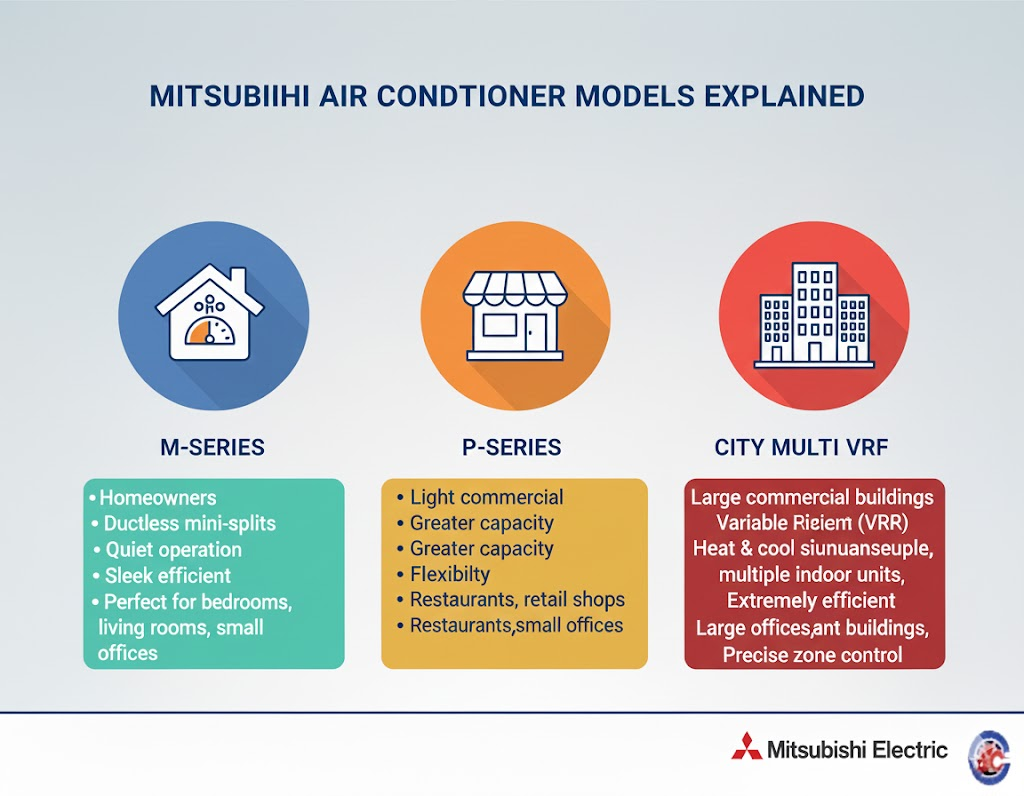
Mitsubishi Air Conditioner Models Explained
1. M-Series: The Residential Gold Standard
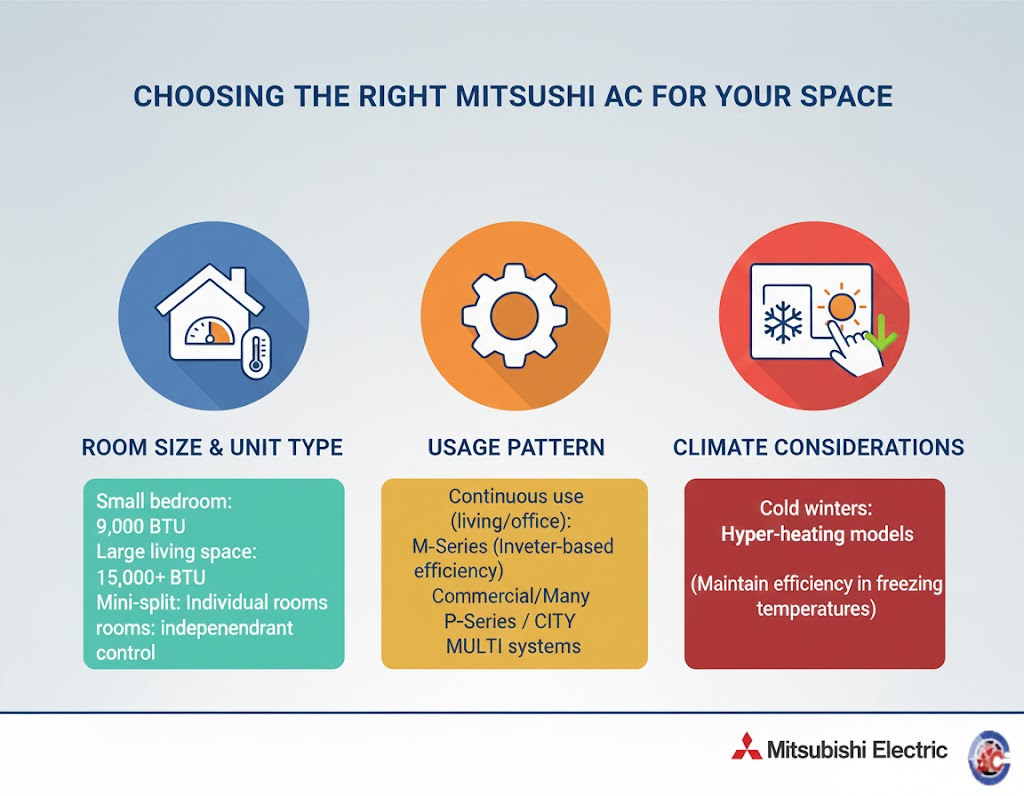
The M-Series is the go-to choice for homeowners. These ductless mini-split systems are famous for being whisper-quiet—perfect for those who want cool air without the “jet engine” soundtrack.
- Best For: Bedrooms, living rooms, and home offices.
- Key Features: Sleek aesthetics, high SEER ratings (energy efficiency), and individual zone control.
- Why Choose It: It’s unobtrusive and easy to install in rooms without existing ductwork.
2. P-Series: The Light Commercial Workhorse
When a standard home unit won’t cut it, the P-Series steps in. Designed for “light commercial” use, these units are tougher, more durable, and built to run for extended periods in high-traffic environments.
- Best For: Restaurants, retail shops, and small-to-medium office spaces.
- Key Features: Higher cooling capacity, long-line piping flexibility, and robust build quality.
- Why Choose It: It bridges the gap between residential comfort and industrial power.
3. CITY MULTI® VRF: The Enterprise Solution
For large-scale infrastructure, the CITY MULTI Variable Refrigerant Flow (VRF) system is the pinnacle of HVAC engineering. It allows for “simultaneous heating and cooling,” meaning one room can be heated while the other is cooled, all powered by a single outdoor unit.
- Best For: Hotels, hospitals, apartment complexes, and large office buildings.
- Key Features: Precise temperature control for dozens of zones and incredible energy savings.
- Why Choose It: It offers premium efficiency and customization for complex architectural layouts.
Quick Comparison Table
| Model Line | Primary User | Best Environment | Top Benefit |
| M-Series | Homeowners | Residential / Small Offices | Quiet & Sleek |
| P-Series | Small Businesses | Retail / Restaurants | High Capacity & Durability |
| CITY MULTI | Building Managers | Hotels / Hospitals | Multi-Zone Efficiency |
READ MORE: Portable AC Unit
READ MORE: Goodman Heat Pump Review 2026 | Efficiency, Cost, Pros & Cons
HVAC Brand Comparison (Mitsubishi vs Carrier vs Goodman vs Midea vs Trane)
| Feature | Mitsubishi | Carrier | Trane | Goodman | Midea |
| Market Tier | Premium / Specialized | Premium / Innovative | Premium / Durable | Budget / Value | Budget / OEM |
| Max Efficiency | Up to 30+ SEER2 (Ductless) | Up to 24 SEER2 (Central) | Up to 22 SEER2 (Central) | Up to 18 SEER2 | Up to 25 SEER2 |
| Warranty | 5–12 Years (Parts)* | 10 Years (Parts) | 10–12 Years (Parts) | Lifetime (Compressor) | 5–10 Years (Parts) |
| Price Range | (High) | (High) | (High) | $ (Low) | $$ (Low-Mid) |
| Key Tech | Hyper-Heating & Inverter | Greenspeed Intelligence | Spine Fin™ Coil | ComfortBridge™ | Smart Inverter / OEM |
| Reliability | Excellent | Very Good | Excellent | Good (Installer-Dependent) | Average |
| Best For | Ductless & Extreme Cold | Smart Home Integration | Harsh/Corrosive Climates | High Value / Rentals | Budget Mini-Splits |
Why Mitsubishi ACs Are the Smart Choice for Your Space
Looking for the perfect balance of comfort and cost-savings? Mitsubishi air conditioners set the gold standard for residential and commercial HVAC. Here is why they are a top-tier investment:
- Precision Cooling: Maintain stable temperatures without annoying fluctuations or sudden “arctic blasts.”
- Legendary Durability: Built with premium components to last 12–20 years—outperforming standard models.
- Low Maintenance: Smart features like dual-barrier coating and built-in diagnostics keep the system clean with minimal effort.
- Energy Efficiency: Advanced inverter technology optimizes power consumption, significantly lowering your monthly electricity bills.
READ MORE: Trane Heat Pump Review 2026 — Comparison, Pros, Cons & Costs
Installation Requirements
Installing a Mitsubishi air conditioner requires careful planning to ensure maximum performance and long-term reliability. Proper installation starts with choosing the right indoor unit placement. Mitsubishi indoor units should be mounted high on the wall, away from direct sunlight or heat-generating appliances. This allows the system to distribute cool air evenly throughout the room. It’s also important to leave enough clearance around the unit so that airflow is not obstructed by curtains, furniture, or decorative items. For multi-zone systems, each indoor unit must be positioned strategically for consistent temperature control across all areas.
The outdoor unit placement is equally important. Mitsubishi outdoor units need adequate ventilation, meaning they should not be installed in tight, enclosed spaces. Ideally, they should be placed on a stable concrete base or mounted securely on brackets. Keeping the outdoor condenser free from debris such as leaves, dirt, or snow helps maintain efficiency. Installers must also ensure proper spacing around the unit, usually at least 12–24 inches from walls, fences, or other obstructions.
Finally, Mitsubishi air conditioners require correct electrical and drainage configurations. A dedicated electrical circuit is often necessary, and wiring must meet local safety codes. The drainage line should be installed at a downward slope to ensure condensation can exit freely. Professional installation is strongly recommended because Mitsubishi’s advanced systems require precise setup. When installed correctly, a Mitsubishi AC performs at peak efficiency, lasts longer, and consumes less energy.
Maintenance Tips for Mitsubishi Air Conditioners
Maintaining a Mitsubishi air conditioner is essential for keeping it running smoothly and efficiently throughout the year. One of the most important tasks is cleaning or replacing the air filters. Mitsubishi systems typically include washable filters that should be cleaned every 2–4 weeks, depending on usage and indoor air quality. Dirty filters restrict airflow, forcing the unit to work harder and consume more power. Clean filters help maintain the AC’s performance and improve indoor air quality.
Another key maintenance task is coil cleaning. Both the indoor evaporator coil and outdoor condenser coil should be checked for dust and debris. When coils get dirty, heat exchange becomes less efficient, reducing cooling performance. Light dust can be cleaned with a soft cloth or brush, but deeper cleaning should be done by a professional. Mitsubishi’s dual-barrier coating helps reduce coil contamination, but regular inspection is still important.
You should also schedule seasonal checkups—ideally once or twice a year. A professional technician can inspect refrigerant levels, test electrical components, clean fan blades, and ensure the system is running at optimal efficiency. Regular maintenance not only keeps your Mitsubishi AC working flawlessly but also prolongs its lifespan and helps prevent costly repairs. A well-maintained Mitsubishi system can easily last over a decade with consistent performance.
READ MORE: Mini Split Air Conditioners
Common Problems and How to Fix Them
Even though Mitsubishi air conditioners are known for their durability and reliability, occasional issues may still arise. One common problem is the AC not cooling properly. This can happen due to dirty filters, low refrigerant levels, or blocked airflow. Cleaning the filters and ensuring the outdoor unit is free from debris often solves the problem. If the issue persists, it may require a professional technician to check refrigerant levels or system settings.
Another common issue is remote control or Wi-Fi connectivity problems. Sometimes the remote may stop communicating with the indoor unit due to low battery power or sensor blockage. Simply replacing the batteries or ensuring nothing obstructs the signal usually resolves the issue. For app connectivity, resetting the Wi-Fi module and reconnecting through Mitsubishi’s smart app often restores proper function.
Noise problems may also occur, especially if the unit has not been cleaned for some time. A rattling or buzzing sound may indicate loose screws or debris inside the outdoor fan. Turning off the unit and checking for obstructions can help. If the sound persists, a technician should inspect the fan motor or internal components.
Energy Consumption and Long-Term Savings
One of the biggest advantages of choosing a Mitsubishi air conditioner is the impressive energy savings you can achieve over time. Mitsubishi systems use advanced inverter technology, which adjusts the compressor speed instead of running at full power all the time. This reduces energy consumption significantly—often by 30% to 60% compared to non-inverter models. Over the lifespan of the unit, these savings can add up to hundreds or even thousands of dollars.
Mitsubishi units are also designed to operate efficiently in a wide range of climates. For example, their hyper-heating models maintain high efficiency even in temperatures as low as –13°F (–25°C). This means lower heating bills during the winter months, especially in regions with cold winters. Many Mitsubishi models carry Energy Star certification, which means they meet strict efficiency guidelines and help reduce carbon emissions while lowering utility costs.
Additionally, Mitsubishi’s multi-zone systems allow you to cool only the rooms you use, rather than the entire home. This targeted cooling approach prevents energy waste and provides even more savings. By choosing a Mitsubishi AC, you’re not only investing in comfort but also reducing long-term operating costs—making it one of the smartest HVAC choices for both residential and commercial applications.
READ MORE: AC Tune-Up
Mitsubishi Air Conditioner Prices
The cost of a Mitsubishi air conditioner varies depending on the model, cooling capacity, and installation requirements. For basic single-room mini-split units, prices typically range from $1,500 to $4,000, including installation. Larger or more advanced systems—such as multi-zone setups—can cost $4,000 to $12,000, depending on the number of indoor units and total square footage being cooled.
Commercial systems like the CITY MULTI VRF units come at a higher price. These systems can range from $10,000 to $40,000 or more because of their zoning capabilities and advanced technology. Installation plays a significant role in total cost, especially for systems that require new electrical circuits, wall modifications, or multi-zone configurations.
While Mitsubishi systems may cost more upfront than some other brands, they offer better energy efficiency and longer lifespan, which leads to lower long-term operating costs. Most Mitsubishi users find that the higher initial investment pays off in the form of reduced electricity bills, fewer repairs, and superior comfort.
Conclusion
Mitsubishi air conditioners stand among the best in the HVAC industry due to their unmatched reliability, energy efficiency, and advanced design. Whether you need a compact mini-split for a single room, a multi-zone system for your entire home, or a sophisticated VRF system for commercial use, Mitsubishi offers a solution tailored to your needs.
Their inverter technology ensures consistent cooling while reducing energy costs, and their quiet operation makes them perfect for any environment. With strong durability, eco-friendly engineering, and innovative features, Mitsubishi ACs deliver long-term comfort and value. For homeowners and businesses seeking dependable, efficient, and smart cooling solutions, Mitsubishi remains one of the most trusted names worldwide.
FAQs
How long does a Mitsubishi air conditioner typically last?
Most units last 12–20 years with regular maintenance.
Are Mitsubishi ACs expensive to maintain?
No, they require minimal maintenance thanks to features like dual-barrier coating and washable filters.
Can Mitsubishi ACs heat as well as cool?
Yes, most models use heat pump technology to provide efficient heating during cold seasons.
Are Mitsubishi air conditioners good for large homes?
Yes, multi-zone and VRF systems are ideal for large spaces and provide excellent temperature control.
Is Mitsubishi better than other AC brands?
Mitsubishi is often considered superior for durability, noise levels, and energy efficiency.