When your hot water vanishes, your mind immediately goes to the worst-case financial scenario: Do I need to buy a brand-new water heater? Fortunately, the issue isn’t always a total system failure. More often than not, the culprit is a burnt-out heating element. If you are trying to budget for this unexpected headache, understanding the total cost to replace heating element in older electric water heater systems will help you make an informed financial choice.
While a completely failed system might force you into looking up a full replacement, a simple component swap can frequently buy your older unit a few more years of reliable service. However, before you search for “water heater element replacement near me” or grab your toolkit, you need to understand what this repair involves, what factors drive the price up, and how to decide between a quick fix and a total system replacement. Lets deep dive into “Cost to Replace Heating Element in an Older Electric Water Heater”
READ MORE: How to Install Heating Element in Water Heater: Step by Step
What a Heating Element Does (and Why It Fails)
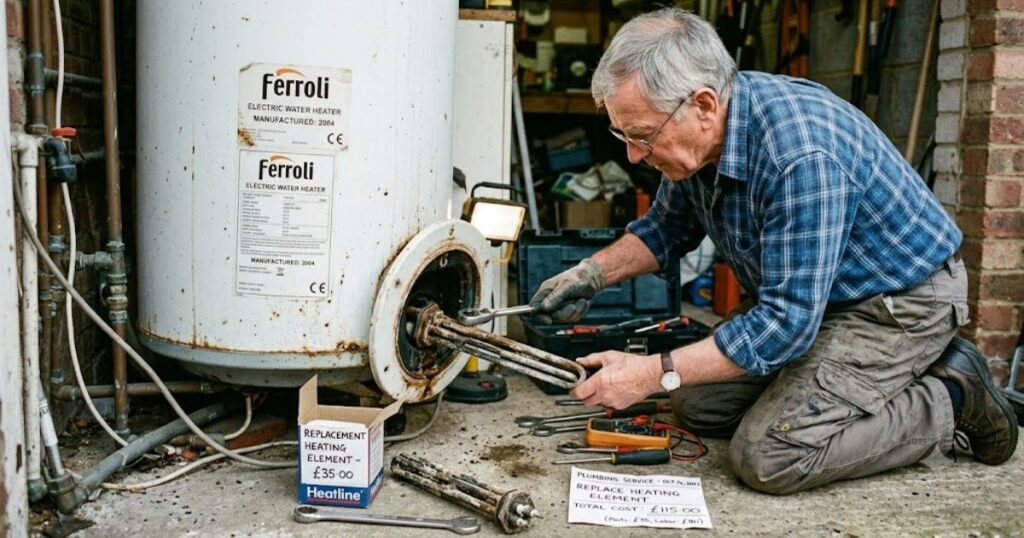
To understand why your water is suddenly lukewarm or freezing, it helps to understand how an electric water heater operates. Unlike gas units that use a burner at the bottom of the tank, electric models rely on internal parts called heating elements. These are long, loop-shaped metal rods that extend directly into the water tank, heating the water via electrical resistance.
Most standard residential electric water heaters feature two separate elements:
- The Upper Heating Element: Located near the top of the tank, this element is responsible for heating the top third of the water supply. Because hot water naturally rises, this upper unit ensures you get hot water quickly when you turn on a tap. It always turns on first when the tank refills with cold water.
- The Lower Heating Element: Located near the base of the tank, this element handles the bulk of the ongoing heating work. Once the upper portion of the tank reaches its target temperature, power shifts down to the lower element to heat the rest of the water.
Because these elements take turns cycling on and off, a failure in just one can completely disrupt your home’s hot water supply.
Why do they fail, especially in older units? Over years of constant operation, mineral deposits like calcium and magnesium naturally settle out of your water supply and sink to the bottom of the tank. This is commonly referred to as sediment buildup.
In older units, this thick layer of sediment completely buries the lower heating element. Instead of direct contact with the water, the element ends up buried in a blanket of minerals. It has to work twice as hard to heat the water through the sludge, causing it to overheat and burn out.
Average Cost to Replace Heating Element in Older Electric Water Heater
Here’s where most homeowners want to start: what will this actually cost?
Professional replacement (labor + parts) typically runs between $200 and $300 for a single element. That price includes the cost of the part itself, which is usually $10 to $60 depending on the wattage and brand, and the plumber or electrician’s time to do the job.
DIY replacement brings the cost way down. If you’re comfortable working around your water heater and feel confident following safety steps, you can replace the element yourself for the price of the part alone — roughly $10 to $60.
Keep in mind that the final price can vary depending on several factors:
- Your location: Labor rates in major metro areas like New York, Los Angeles, or Chicago tend to be higher than in rural or mid-sized cities.
- Access to the unit: If your water heater is tucked into a tight closet, crawlspace, or utility room with limited space, a plumber may charge more for the extra time it takes to work in that area.
- Age and condition of the tank: Older tanks with sediment buildup or corroded fittings can make the job harder and slower.
- Plumber rates: Most plumbers charge by the hour, with rates ranging from $75 to $150 or more per hour in many markets. Some charge a flat rate for simple jobs.
READ MORE: What Size Socket for Water Heater Element
Cost Breakdown by Scenario
Here’s a quick look at what different repairs and related services typically cost:
- One heating element replaced (professional): $200–$300 total (parts + labor)
- Both elements replaced at the same time: $300–$450 (doing both at once saves on a second service call)
- Thermostat replacement only: $100–$200
- Both thermostat and element replaced: $250–$400
- Diagnostic or service call fee: $50–$125 (some plumbers apply this toward the repair if you hire them)
- Emergency or after-hours service: Add $50–$150 or more on top of standard rates
- Full water heater replacement instead of repair: National estimates average around $1,586–$1,843, depending on the unit type, size, and installation complexity
That last number is worth keeping in mind. A $250 repair sounds great — unless your tank is 15 years old and headed for a full breakdown in the next year or two anyway.
Signs the Heating Element May Be Bad
Before calling a plumber, it helps to know what a failing heating element actually looks like in day-to-day life. Here are the most common warning signs:
- No hot water at all: If your tank has completely lost the ability to produce hot water, the upper element is often the culprit.
- Hot water runs out too quickly: If you used to get 20–30 minutes of hot water and now you’re out in 10, the lower element may be failing.
- Only lukewarm water from the taps: Getting water that’s warm but never really hot? That usually points to a partial element failure.
- Circuit breaker keeps tripping: A shorted heating element can draw too much power and trip the breaker repeatedly. This is worth taking seriously — it’s also a safety issue.
- Water heater takes longer than normal to recover: If you have to wait a long time after a shower for the tank to heat back up, an element may be working at reduced capacity or failing gradually.
- Discolored or rusty-looking water: While this can also point to a corroded tank, it sometimes accompanies element problems in older units.
Not all of these symptoms are caused only by a bad element. A failed thermostat, a tripped reset button, or even a wiring issue can produce similar problems. A plumber can run a quick test with a multimeter to confirm which part is actually at fault.
READ MORE: How to Test a Water Heater Element: Easy DIY Multimeter Guide
Is It Worth Repairing an Older Electric Water Heater?
When you are faced with a repair bill for an aging appliance, you have to weigh the immediate cost savings against long-term reliability. Navigating the choice of water heater repair vs replacement requires looking honestly at the age and condition of your tank.
The primary factor to consider is the age of the unit. In typical residential settings, standard tank-style electric water heaters are engineered to last roughly 10 to 15 years. Heating elements themselves share a similar 10- to 15-year lifespan, meaning that if you are replacing the original element on a 12-year-old water heater, the rest of the unit is also entering its twilight years.
The Golden Rule of Appliance Repair: If a repair costs more than 50% of the price of a brand-new appliance, or if the unit is well past its expected lifespan, your money is usually better spent on a replacement.
If your older electric water heater is 7 to 9 years old and the tank itself is dry, clean, and rust-free, spending $200 to $l300 to install a new pair of elements is a highly cost-effective decision that can easily extend the unit’s lifespan by another 5 years.
However, if your water heater is 14 years old, sitting in hard water sediment, and showing signs of structural wear, paying for a professional repair might only buy you a few months of hot water before another internal component fails or the tank itself begins to leak.
When Replacement Makes More Sense Than Repair
There are situations where putting money into an older unit just doesn’t add up. Consider replacing the entire water heater if:
- The tank is over 10–15 years old. You’re near or past the average lifespan, and repair money may be better applied toward a new, more efficient unit.
- You see rust or corrosion on the tank exterior or in your water. A corroding tank can fail suddenly and cause water damage. No element replacement fixes a rotting tank.
- Multiple components are failing at once. If you’ve already replaced a thermostat, and now an element is going, and the anode rod hasn’t been changed in years — you’re likely in a “death by a thousand cuts” situation.
- The unit has needed repeated repairs in the past few years. Frequent failures are a sign the whole system is wearing out.
- The repair estimate is more than half the cost of a new unit. If you’re looking at $800 in repairs on a tank that would cost $1,600–$1,843 to fully replace, replacement makes more financial sense — and you get a fresh warranty too.
Newer electric water heaters, and especially heat pump water heaters, are also significantly more energy-efficient than older models. Replacing an old tank can lower your energy bills, which offsets part of the replacement cost over time.
READ MORE: AO Smith vs. Rheem Water Heaters: Comparison & Expert Reviews
DIY vs. Hiring a Pro: Weighing Your Options
For homeowners who enjoy tackling weekend projects, replacing a water heater element seems like a straightforward task. However, it is vital to balance the potential financial savings against the safety risks involved.
Hiring a Professional Plumber
- Pros: Complete peace of mind, proper tools to handle seized or rusted elements, diagnostic confirmation that the element is truly the problem, and a professional labor warranty if something goes wrong.
- Cons: Higher upfront cost due to professional labor and service trip fees.
Taking the DIY Approach
- Pros: Incredibly inexpensive ($10 to $60 for parts) and can be completed on your own schedule without waiting for a service window.
- Cons: Exposure to high-voltage electrical currents (240 volts can be fatal), potential for major indoor flooding if the tank isn’t drained correctly, and the risk of buying the wrong size or wattage element for your specific tank model.
Absolute Safety Rule for DIYers
If you decide to take on this repair yourself, you must prioritize electrical safety above all else. Never touch a water heater access panel until you have completely turned off the dedicated circuit breaker at your home’s main electrical panel.
Once the breaker is flipped off, use a non-contact voltage tester directly on the water heater’s internal wires to verify with 100% certainty that there is no electrical current running to the unit. Working on a live 240-volt appliance can result in severe electrical shock or death.
How to Save Money on the Repair
If you’re going the professional route, a few smart moves can keep the bill reasonable:
- Get at least two quotes. Plumber rates vary more than you might expect, and even a quick phone call to a second company can save you $50–$100.
- Ask them to check the thermostat at the same time. If a thermostat also needs replacement, doing it during the same visit avoids a second service call charge.
- Confirm the diagnosis before agreeing to repair. Make sure the plumber has actually tested the element with a multimeter, not just assumed it’s bad based on symptoms alone.
- Ask for parts and labor itemized separately. This helps you compare prices and makes sure you’re not being charged excessive markup on a part that costs $20 at the hardware store.
- Factor in age before committing. If the tank is old, ask the plumber honestly whether they’d replace or repair it if it were their own home. A good plumber will give you a straight answer.
READ MORE: Best Tankless Electric Water Heaters: Top 5 Models for U.S. Homes
Step-by-Step Overview of the Repair Process
Here’s a high-level look at how the job gets done, whether by a pro or a careful DIYer:
- Diagnose the problem. Test the element with a multimeter to confirm it has failed, and check both thermostats as well.
- Shut off power. Turn off the dedicated breaker for the water heater. Confirm power is off before touching anything inside the access panel.
- Connect a hose and drain enough water. The tank doesn’t need to be fully drained — just enough to drop the water level below the element being replaced. Direct the hose to a floor drain or outside.
- Remove the bad element. Using a special element wrench (available at any hardware store), unscrew and pull out the failed element.
- Install the new element. Thread in the replacement, making sure it’s seated and sealed properly to prevent leaks. Reconnect the wiring exactly as it was.
- Refill the tank completely before restoring power. This is critical. The element must be fully submerged before it’s energized, or it will burn out immediately.
- Restore power and test. Flip the breaker back on, wait 30–60 minutes, and check that you’re getting hot water again.
Conclusion
When your home’s hot water suddenly vanishes, navigating the cost to replace heating element in older electric water heater systems doesn’t have to be an overwhelming financial stressor. For a professional investment of roughly $200 to $300 or a budget-conscious DIY project cost of under $60 you can easily resolve an electric water heater not heating issue without buying a whole new system.
However, remember to let the overall age and structural health of your water heater be your ultimate guide. If your tank is under a decade old and completely free of external rust or leaks, replacing a failed element is an incredibly smart, money-saving choice. But if your tank is well past its 12th birthday and showing its age, skip the temporary repairs and direct those funds toward a new, energy-efficient system that will keep your household’s showers warm and worry-free for years to come.
Frequently Asked Questions
How much does it cost to replace a heating element in an older electric water heater?
For a professional plumber to handle the replacement during normal business hours, you can generally expect to pay between $200 and $300 per heating element. If you choose to go the DIY route, purchasing the replacement part on your own at a local home improvement store will typically cost between $10 and $60.
Is it worth replacing a heating element in an old water heater?
Yes, it is highly worth it if the water heater tank itself is structurally sound, rust-free, and not showing any signs of water leaks. However, if your electric water heater is more than 12 to 15 years old, or if you notice visible corrosion around the bottom base of the tank, spending money on a repair is usually a temporary fix.
How long does a water heater heating element last?
In most residential settings, a standard electric water heater heating element will last between 10 and 15 years. This timeline aligns closely with the overall lifespan of the water heater tank itself.
Can I replace just one heating element instead of both?
You can absolutely replace just one failed heating element if the other one tests perfectly fine with a multimeter. However, because the system must already be turned off, completely isolated, and partially drained to replace a single element, many professional plumbers strongly recommend replacing both elements simultaneously if your unit is older.
Why is my electric water heater not heating water properly?
While a burnt-out or short-circuited upper or lower heating element is the most common cause of cold or lukewarm water, the issue could also stem from a malfunctioning internal thermostat, a tripped high-limit safety eco switch on the upper thermostat, a tripped dedicated circuit breaker in your home’s main electrical panel, or a heavy accumulation of mineral sediment blanketing the bottom of the tank.

