I’ve spent years around residential hydronic systems, and Bosch’s Greenstar lineup is one of the brands I get asked about most. Homeowners like the compact wall-hung footprint, the quiet operation, and the fact that a Greenstar unit can tuck into a closet instead of eating up half the basement.
There’s also a practical draw: Bosch owns Buderus and has a long history building condensing boiler technology for the European market, where cramped installations and high gas prices have pushed manufacturers to squeeze every bit of efficiency out of a unit.
That said, “German engineering” isn’t a magic phrase that makes a boiler right for every home. In this guide, I’ll walk through the current Bosch Greenstar residential lineup, review the three models homeowners ask about most, break down real installed costs, and compare Bosch head-to-head against Navien, Weil-McLain, and Viessmann — so you can figure out if it’s the right call for your house. Lets deep dive into “Best Bosch Boiler Review 2026: Greenstar Models Rated”
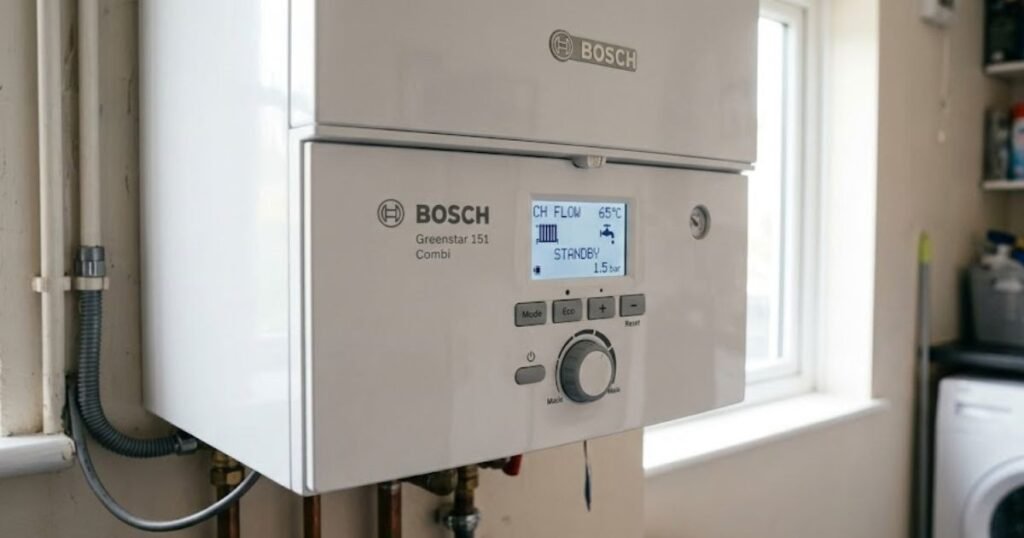
Quick Verdict
| Overall Rating | ★★★★☆ (4.5/5) |
| Best For | Space-constrained homes, tankless-style hot water, quiet condensing performance |
| Pros | High efficiency, compact wall-hung design, quiet operation, strong parts availability in the U.S. |
| Cons | Combi models are sensitive to sizing and venting mistakes, DHW flow rate limits on smaller units, service techs need condensing-boiler familiarity |
| Price Range | Roughly $3,800–$5,600 for the unit alone; $7,500–$14,000+ fully installed |
| Efficiency | Up to 95% AFUE, up to ~98.7% thermal efficiency at part load |
| Warranty | Limited lifetime warranty on the primary heat exchanger; 5-year parts and labor (registration and licensed installation required) |
| Ideal Home Size | 1–4 bathroom homes, roughly 1,000–3,500 sq. ft. depending on model |
READ MORE: Weil‑McLain Boiler Reviews — Models, Costs, Pros & Cons
What Makes Bosch Boilers Popular?
Bosch Thermotechnology has been building condensing heating equipment for decades, and the Greenstar line is the U.S. residential face of that experience (the brand also owns Buderus, another well-regarded German heating name). A few things keep Bosch on homeowners’ shortlists:
- Condensing technology done well. Greenstar boilers use a secondary heat exchanger to recover heat from exhaust gas that older boilers simply vent outside, which is where the efficiency gains come from.
- Compact wall-hung design. Many Greenstar models mount on the wall and fit inside a standard closet or utility space, which matters a lot in older homes without a lot of mechanical room.
- Quiet operation. The fully modulating burner ramps up and down with demand instead of cycling on and off at full blast, which keeps noise levels low enough for a kitchen or hallway installation.
- Smart, simple controls. Outdoor reset control comes built in on most models, adjusting water temperature automatically based on outdoor conditions rather than relying only on a thermostat.
- Combi convenience. Combi models handle space heating and domestic hot water in one box, which can free up a closet that used to hold a separate water heater.
Bosch Boiler Lineup Overview
Bosch’s U.S. residential Greenstar lineup splits along two lines: mounting style (wall-hung vs. floor-standing) and function (heat-only vs. combi).
- Wall-Hung — Compact units designed to mount directly on a wall, ideal for tight mechanical closets.
- Floor-Standing (FS) — Designed to drop into the same footprint as an old cast-iron floor boiler, which can simplify a like-for-like replacement.
- Heat-Only — Handles space heating only; you’ll need a separate water heater or indirect tank for domestic hot water.
- Combi — Handles both space heating and on-demand domestic hot water from a single unit, similar in concept to a tankless water heater bolted onto a boiler.
Across the lineup, Greenstar boilers use an aluminum-silicon (Al-Si) primary heat exchanger and, on combi models, an added stainless-steel plate heat exchanger for hot water. Input capacities in the current U.S. lineup run from roughly 57,000 BTU up to about 151,600 BTU, with AFUE ratings up to 95% and thermal efficiency figures reported as high as 98.5–98.7% under ideal (low-return-temperature) conditions. All models are Energy Star certified and can run on natural gas or propane with the included conversion kit.
READ MORE: Viessmann Boiler Review | Efficiency, Models, Pros & Cons

Best 3 Bosch Boilers Reviewed
1. Bosch Greenstar 100 Combi (ZWB-28-3)
Overview: The Greenstar 100 Combi is the entry point into Bosch’s wall-hung combi lineup and the model most often installed in condos, townhomes, and smaller single-family houses.
Key Features:
- Al-Si primary heat exchanger plus stainless-steel plate heat exchanger for hot water
- Built-in expansion tank, pump, and outdoor reset control
- Wall-hung design that fits a standard mechanical closet
- Includes LP conversion kit for propane installations
Specifications:
- Input: up to ~100,800 BTU (heating output around 79,000 BTU net)
- AFUE: up to 95%
- Max. working pressure: 30 psi
- Max. elevation: 6,000 ft
- Max. DHW flow (72°F rise): approximately 2.65 GPM
- Dimensions: 17.4″ W x 33.5″ H x 13.9″ D
- Weight: ~110 lbs
Pros: Compact, quiet, efficient, and priced lower than the bigger combi models.
Cons: DHW flow rate is on the modest side — fine for a single shower running at a time, but it can get tight in a two-bathroom house with simultaneous demand.
Performance & Noise: Runs quietly thanks to the fully modulating fan; most homeowners describe it as barely audible from an adjacent room.
Installation & Maintenance: Straightforward for a licensed installer familiar with condensing boilers; requires PVC/CPVC or polypropylene venting and a condensate drain.
Ideal Home Size: 1–2 bathroom homes up to roughly 1,500–2,000 sq. ft.
Best For: Homeowners replacing an aging combi or separate boiler/water heater setup in a smaller home.
Expert Opinion: This is the model we recommend most often for condos and smaller houses — it’s sized right for typical single-bathroom demand and doesn’t waste capacity (and money) on a bigger unit than the home needs.
Final Rating: ★★★★☆ (4.6/5)
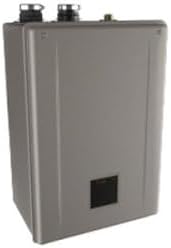
- Product Type: Boiler
- Application: Residential
- Fuel Type: Natural Gas
2. Bosch Greenstar 151 Combi (ZWB-42-3)
Overview: The step-up combi model, built for larger homes or households where two bathrooms might draw hot water at once.
Key Features:
- Same Al-Si/stainless-steel heat exchanger combination as the Greenstar 100
- 3-speed Grundfos integrated pump
- Higher DHW flow rate for larger households
- Built-in outdoor reset and internal expansion tank
Specifications:
- Input: up to ~151,600 BTU (heating output around 117,000–134,000 BTU net, depending on documentation)
- AFUE: 95%
- Max. DHW flow (72°F rise): approximately 4.0 GPM
- Max. elevation: 6,000 ft
- Dimensions: 17.4″ W x 33.5″ H x 13.9″ D
- Weight: ~104 lbs
Pros: Handles bigger heating loads and higher simultaneous hot water demand without breaking a sweat.
Cons: Larger input size means it needs to be sized carefully; an oversized boiler in a smaller home will short-cycle and lose efficiency.
Performance & Noise: Similar quiet, modulating operation to the Greenstar 100, just scaled up.
Installation & Maintenance: Same venting requirements as the 100, just larger diameter in some configurations; annual service is important to keep the higher-output burner running clean.
Ideal Home Size: 3–4 bathroom homes, roughly 2,000–3,500 sq. ft.
Best For: Larger single-family homes or households that regularly run multiple showers or a shower plus dishwasher at the same time.
Expert Opinion: One HVAC forum thread we came across summed it up well this unit tests out efficient and reliable, and because it shares parts with the rest of the Greenstar range, service techs aren’t hunting for obscure components.
Final Rating: ★★★★☆ (4.8/5)
READ MORE: Electric Boiler Cost — Real Prices, Installation & Buying Guide

- Simultaneous domestic hot water and heating
- Superior temperature stability for domestic hot water
- Noritz accessory
3. Bosch Greenstar 79 Heat-Only, Floor-Standing (KBR21-3)
Overview: A floor-standing, heat-only condensing boiler designed to drop into the footprint of an old cast-iron boiler a common scenario in older Northeast and Midwest homes being upgraded from a legacy system.
Key Features:
- Al-Si heat exchanger with corrosion-resistant coating
- Fits the same footprint as many older floor-standing boilers, simplifying replacement
- Built-in pump and outdoor reset control
- LP conversion kit included
Specifications:
- Input: up to 79,200 BTU
- AFUE: 95%
- Efficiency: up to 98.7% under condensing conditions
- Configuration: heat-only (pair with a separate water heater or indirect tank for DHW)
- Dimensions: 17.4″ W x 33.5″ H x 13.9″ D
- Weight: ~100 lbs
Pros: A relatively simple, no-frills swap for an old cast-iron floor boiler — no need to wall-mount or reconfigure the mechanical room.
Cons: No hot water production on its own; you’ll need an indirect tank or standalone water heater alongside it.
Performance & Noise: Quiet, modulating burner operation similar to the wall-hung Greenstar models.
Installation & Maintenance: Simplified control setup with no complex programming; still requires proper condensing venting, which older cast-iron replacements sometimes lack.
Ideal Home Size: 1–3 bathroom homes with radiators or baseboard heat, especially older homes being upgraded from atmospheric cast iron.
Best For: Homeowners replacing an old, inefficient cast-iron floor boiler who want a condensing upgrade without relocating equipment.
Expert Opinion: This is a smart, lower-drama upgrade path for older homes — you get the efficiency jump of condensing technology without the added complexity of also replacing your water heating setup in the same project.
Final Rating: ★★★★☆ (4.5/5)
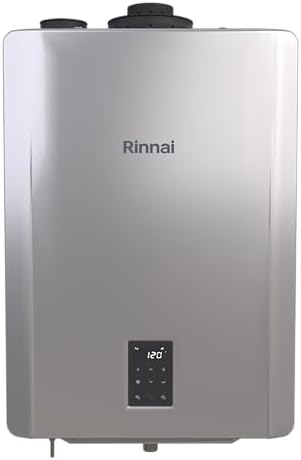
- Hot Water And Home Heating In One Appliance: The Rinnai tankless water heater combines hot water supply with robust indo…
- High Energy Efficiency For Significant Savings: With a 96% AFUE-rating, the natural gas or propane heater maximizes effi…
- Advanced Technology For Constant Comfort: Featuring Smart Sense Gas Valve technology, this combi boiler ensures precise …
Comparison Table: Bosch Boiler Lineup
| Feature | Greenstar 100 Combi | Greenstar 151 Combi | Greenstar 79 Heat-Only |
| Boiler Type | Combi (heat + DHW) | Combi (heat + DHW) | Heat-only |
| AFUE | Up to 95% | Up to 95% | Up to 95% |
| Heating Input | ~100,800 BTU | ~151,600 BTU | ~79,200 BTU |
| Domestic Hot Water | Yes, ~2.65 GPM | Yes, ~4.0 GPM | No (needs separate tank) |
| Best Home Size | 1–2 bathrooms | 3–4 bathrooms | 1–3 bathrooms (radiator/baseboard) |
| Installation Type | Wall-hung | Wall-hung | Floor-standing |
| Smart Controls | Outdoor reset, built-in | Outdoor reset, built-in | Outdoor reset, built-in |
| Warranty | Lifetime heat exchanger / 5-yr parts & labor | Lifetime heat exchanger / 5-yr parts & labor | Lifetime heat exchanger / 5-yr parts & labor |
| Approx. Unit Price | ~$5,300–$5,600 | ~$3,600–$4,700 (varies by retailer) | ~$4,700–$4,900 |
| Pros | Compact, efficient, budget-friendly combi | Handles bigger households | Simple cast-iron replacement |
| Cons | Limited DHW flow for larger homes | Needs careful sizing | No built-in hot water |
| Overall Rating | 4.6/5 | 4.8/5 | 4.5/5 |
Note: unit prices are equipment-only figures from national HVAC supply distributors and fluctuate with promotions, region, and configuration (P-version vs. standard, wall vs. floor). Get an itemized quote from a local contractor before budgeting.
READ MORE: Best 5 Navien Combi Boiler: Review, Comparison & Cost
Bosch Boiler Features Explained
- Aluminum-silicon (Al-Si) heat exchanger: More flexible than traditional stainless steel and designed to resist corrosion over the life of the unit.
- Fully modulating burner: Adjusts flame output to match real-time demand instead of cycling fully on and off, which improves efficiency and reduces wear.
- Outdoor reset capability: Automatically adjusts supply water temperature based on outdoor temperature, so the boiler isn’t working harder than it needs to on a mild day.
- Quiet operation: Sound levels low enough for installation in living spaces, not just basements.
- Smart thermostat compatibility: Works with common third-party thermostats and zoning controls through standard low-voltage wiring.
- Low NOx emissions: Designed to meet strict regional air-quality standards, including South Coast (SCAQMD) NOx limits.
- Condensing technology: Recovers latent heat from flue gas, which is the core driver of the AFUE gains over older non-condensing boilers.
- Easy maintenance access: Front-facing service points and simplified control panels reduce time-on-site for annual tune-ups.
- Freeze protection: Built-in logic that runs the pump or fires the burner briefly to protect against freezing in unconditioned spaces.
Bosch Boiler Efficiency
AFUE (Annual Fuel Utilization Efficiency) measures how much of the fuel you burn actually turns into usable heat over a full year, as opposed to being lost up the flue. A Greenstar boiler rated at 95% AFUE converts about 95 cents of every heating dollar into home comfort, compared with roughly 80–83 cents for an older non-condensing boiler.
That gap adds up. On a typical Northeast heating bill, moving from an 80% AFUE boiler to a 95% AFUE Greenstar unit can translate into meaningfully lower annual gas costs the exact number depends on your climate, home’s heat loss, thermostat setbacks, and gas rates, but a realistic range for a mid-size home is often several hundred dollars a year in fuel savings.
A few things affect whether you actually see AFUE-level performance in the real world:
- Return water temperature. Condensing efficiency depends on the water returning to the boiler being cool enough (generally under about 130°F) to trigger condensation in the secondary heat exchanger. Oversized radiators or a low-temperature system help.
- Proper sizing. An oversized boiler short-cycles, which hurts both efficiency and component life.
- Altitude. Bosch rates these units up to 6,000 ft elevation; higher elevations typically require de-rating.
READ MORE: Best Natural Gas Boilers for Home Heating: Review & Comparison
Bosch Boiler Installation Cost
Installed pricing depends heavily on whether it’s a straightforward swap or a more involved retrofit (new venting, gas line upsizing, electrical work, or converting from a floor boiler to a wall-hung unit).
| Item | Estimated Cost (USD) |
| Boiler Unit | $3,800 – $5,600 |
| Installation Labor | $1,500 – $4,000 |
| Venting (PVC/CPVC/polypropylene) | $300 – $1,200 |
| Additional Labor (gas line, electrical, condensate) | $500 – $2,000 |
| Accessories (indirect tank, zone valves, thermostat) | $500 – $2,500 |
| Total Installed Price | $7,500 – $14,000+ |
Factors that push installed cost higher include:
- converting from a floor-standing to a wall-hung configuration
- running new venting through an exterior wall or roof
- adding an indirect water heater alongside a heat-only model
- upsizing the gas line for a larger BTU model
- difficult access (finished basements, tight mechanical rooms).
Bosch Boiler Maintenance
Annual service is one of the biggest factors in both performance and warranty compliance. A typical annual visit covers:
- Water pressure check — should sit around 12–15 psi cold on a typical residential system.
- Heat exchanger inspection/cleaning — condensing exchangers can accumulate scale or soot over time.
- Condensate trap — needs to be clear; a clogged trap is one of the most common Greenstar service calls.
- Air intake and exhaust vent — checked for blockages, especially after storms or in homes near landscaping that can obstruct sidewall vents.
- Expansion tank — pressure-checked to make sure it’s still holding the correct charge.
- Error code review — the control panel logs fault history, which a tech can use to catch developing issues early.
READ MORE: Tankless Water Heater vs. Combi Boiler: Which Is Right for You?
Bosch Boiler Warranty
Bosch’s U.S. Greenstar warranty structure, per the manufacturer’s limited warranty documentation, is:
- Heat exchanger: Limited lifetime warranty on the primary heat exchanger (some documentation cites a 10-year limited term depending on model and registration).
- Parts and labor: 5-year limited parts and labor warranty.
- Registration requirement: Coverage is generally tied to professional installation and, in many cases, product registration within a set window after install.
- Limitations: Warranty typically excludes multi-family buildings (unless individually metered per unit), non-Bosch components, normal wear items, and damage from improper installation or lack of maintenance.
- Service network: Bosch works through a network of independent licensed HVAC contractors rather than direct-to-homeowner service, so warranty claims are typically initiated through your installer.
Always keep your installation invoice and annual service records most warranty claims ask for proof of both.
Bosch vs. Weil-McLain vs. Navien vs. Viessmann
| Feature | Bosch | Weil-McLain | Navien | Viessmann |
| Build Quality | Strong, German engineering | Rugged, cast-iron heritage | Solid, compact wall-hung focus | Premium, top-tier build |
| Reliability | Good with annual service | Excellent long-term (cast iron models) | Good, but maintenance-sensitive | Excellent |
| AFUE | Up to 95% | 84% (cast iron) to 97% (condensing) | Up to 95% | 95–98% |
| Boiler Types | Wall-hung & floor-standing, combi & heat-only | Cast iron & condensing hybrids | Wall-hung condensing, combi-focused | Wall-hung condensing, premium combi |
| Warranty | Lifetime heat exchanger / 5-yr parts & labor | Strong, often cited as best-in-class | 10-yr heat exchanger / 5-yr parts | Strong, comprehensive |
| Smart Controls | Outdoor reset, third-party compatible | Unity system on select models | NaviLink Wi-Fi | Vitoconnect app |
| Maintenance | Annual service recommended | Simple, widely serviceable | Annual service critical | Annual service recommended |
| Installation Cost | Mid-range | Often lower (especially cast iron) | Mid-range | Highest |
| Parts Availability | Strong in U.S. | Excellent, widely stocked | Good | Can be slower for premium components |
| Best For | Compact, efficient replacements | Large homes, extreme climates, longevity | Small-to-mid homes, wall-hung retrofits | Homeowners prioritizing top efficiency and willing to pay for it |
| Overall Value | Very good | Very good | Good | Good, but priced at a premium |
| Overall Rating | 4.3/5 | 4.4/5 | 4.1/5 | 4.3/5 |
READ MORE: Heat Pump vs. Furnace vs. Boiler: Cost & Efficiency Comparison
How to Choose the Right Bosch Boiler
- Home size and heat loss: A proper Manual J-style heat loss calculation (not just square footage) should drive sizing — oversizing is the single most common Bosch boiler mistake we see.
- Climate: Colder climates favor slightly higher-capacity models and careful attention to outdoor reset settings.
- Existing heating system: Baseboard, radiator, and radiant systems all have different return-temperature characteristics that affect real-world condensing efficiency.
- Fuel type: Natural gas is the default; propane works with the included conversion kit but changes some sizing math.
- Budget: Weigh the higher upfront cost of a combi unit against the convenience of eliminating a separate water heater.
- Combi vs. heat-only: Combi makes sense in space-constrained homes with modest simultaneous hot water demand; heat-only plus an indirect tank makes more sense for larger households.
- Rebates: With the federal 25C credit expired for 2026, check state energy offices and your gas utility for active rebate programs before you budget the project.
- Future maintenance: Confirm a local contractor stocks or can quickly source Bosch parts before you commit.
Who Should Buy a Bosch Boiler?
- Homeowners replacing an old, inefficient boiler in a space-constrained mechanical closet
- Households that want a single unit for both heat and hot water without a large hot water demand
- Anyone prioritizing quiet operation in a boiler located near living spaces
- Homeowners in homes already piped for lower-temperature heating (radiant floors, properly sized baseboard)
Who Should Avoid Bosch Boilers?
- Large households with multiple bathrooms regularly running hot water simultaneously may be better served by a bigger combi (Bosch Greenstar 151) or a heat-only-plus-indirect-tank setup
- Homes with high-temperature cast-iron radiator systems that can’t easily be modified may see less of a real-world efficiency benefit and might do better with a Weil-McLain hybrid
- Homeowners who want the absolute simplest, most tech-agnostic system with the widest possible service network across rural America may find Weil-McLain’s cast-iron lineup easier to service long-term
Common Bosch Boiler Problems
- Low water pressure: Usually a simple repressurization fix; persistent pressure loss can point to a small leak.
- Ignition issues: Often tied to gas supply pressure, a dirty flame sensor, or a blocked air intake usually resolved during routine service.
- Frozen condensate pipe: A common cold-climate issue when the condensate line runs through an unconditioned space; insulating or rerouting the line typically solves it.
- Error codes: The display shows a specific code, which a technician can cross-reference against the manual most are minor sensor or pressure faults rather than major failures.
- Air in the system: Can cause noise or reduced heat output; usually resolved by bleeding the system after installation or service work.
- Maintenance neglect: The single biggest driver of avoidable service calls — skipping annual service lets scale, soot, and clogged condensate traps build up until they cause a shutdown.
Troubleshooting tip: If your Greenstar boiler throws an error code, check the manual for the specific code before calling for service some (like a simple low-pressure fault) can be homeowner-resolved in minutes, while others should be left to a licensed tech.
Expert Buying Recommendation
- Best Overall: Greenstar 151 Combi — the best balance of capacity, efficiency, and features for most mid-size to larger homes.
- Best Budget: Greenstar 100 Combi — strong efficiency at a more accessible price point.
- Best Large Home: Greenstar 151 Combi or a Greenstar 151 heat-only paired with an indirect tank.
- Best Small Home: Greenstar 100 Combi — sized right for one-bathroom demand without paying for unused capacity.
- Best Energy Efficiency: Any Greenstar model in a properly designed low-return-temperature system, where real-world AFUE gets closest to the rated 95%.
- Best Long-Term Value: Greenstar 79 Heat-Only for homes upgrading from cast iron — a simpler, lower-complexity condensing upgrade.
Final Verdict
Bosch Greenstar boilers earn their spot on most “best boiler” lists for good reason: strong efficiency, a compact footprint, and quiet operation that fits well in modern homes. They’re not automatically the right pick for every situation large households with heavy simultaneous hot water demand, or homes with high-temperature cast-iron systems, may be better served elsewhere. But for a huge share of U.S. homeowners replacing an aging boiler in a space-constrained home, Bosch delivers real value.
Frequently Asked Questions
Are Bosch boilers reliable for American homes?
Yes, when properly sized and maintained. Bosch has a long track record with condensing boiler technology, and U.S. parts availability is generally strong. Reliability, like most condensing boilers, depends heavily on annual service.
Which Bosch Greenstar boiler is the best?
For most homes, the Greenstar 151 Combi offers the best balance of capacity and efficiency. Smaller homes are often better served by the Greenstar 100 Combi, while homes upgrading from cast iron may prefer the Greenstar 79 Heat-Only.
How long does a Bosch boiler typically last?
Condensing boilers like the Greenstar line commonly last 15–20 years with regular annual maintenance, though results vary based on water quality, sizing, and service history.
How much does a Bosch boiler cost with installation in the U.S.?
Expect roughly $7,500–$14,000+ fully installed, depending on the model, venting requirements, and whether the job is a straightforward swap or a more involved retrofit.
Is Bosch better than Navien or Weil-McLain?
Not universally — it depends on your home. Bosch tends to edge out Navien on quieter, simpler installs in smaller homes, while Weil-McLain’s cast-iron models often win on sheer longevity and parts availability for larger or older high-temperature.