If you are a U.S. homeowner shopping for a replacement, Rheem tankless gas water heaters are likely top of mind. As one of North America’s largest HVAC and water heating manufacturers, Rheem offers an extensive lineup of gas-fired tankless units. However, navigating their catalog—from non-condensing RTG models to high-efficiency RTGH and top-tier IKONIC lines can quickly become overwhelming.
In this comprehensive guide, we will break down:
- Which Rheem models suit your home’s flow rate and climate.
- The critical differences between RTG, RTGH, and IKONIC product families.
- How to balance flow rates (GPM), heat output (BTU), and energy scores (UEF).
- Realistic installation and operating costs.
- Maintenance schedules to protect your investment.
- How Rheem stacks up against key competitors like Rinnai and Navien.
Lets deep dive into “Best Rheem Tankless Gas Water Heater: Review, Cost & Comparison”
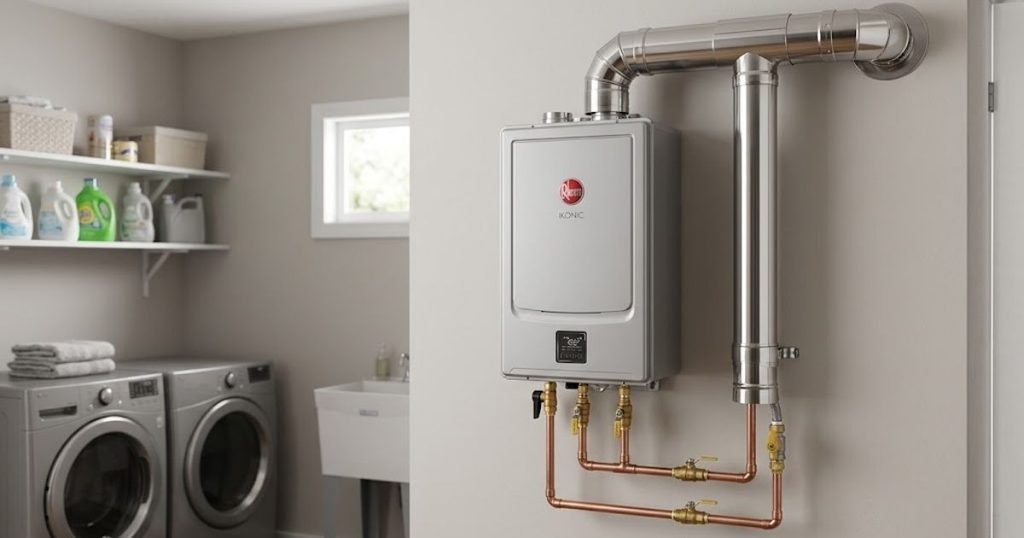
READ MORE: AO Smith vs. Rheem Water Heaters: Comparison & Expert Reviews
How Does a Rheem Tankless Gas Water Heater Work?
Unlike a standard tank that stores and continually heats standing water, a tankless unit operates as a high-output flow-through heat exchanger.
- Tap Activation: A hot water faucet, shower valve, or appliance opens somewhere in the home.
- Flow Detection: Cold water flows into the unit. An internal flow sensor detects this movement (typically requiring a minimum flow threshold of about 0.4 GPM) and signals the control board.
- Ignition & Combustion: The electronic ignition ignites the gas burner. The system draws combustion air either from the room (non-direct vent) or directly from outside via a dedicated pipe (direct vent).
- Heat Transfer: Gas flames heat a heavy-duty copper or stainless steel heat exchanger. As cold water spirals through the narrow passages of the heat exchanger, thermal energy transfers into the water almost instantaneously.
- Modulated Flame Control: Advanced solid-state controls monitor incoming water temperature and incoming flow rate, adjusting (modulation) the gas burner up or down to hold the target output temperature steady.
- Delivery: The heated water travels directly to the open fixture. Once the tap shuts, the flow sensor signals the computer, the gas valve closes, and the burner turns off.
Rheem RTG vs. RTGH vs. IKONIC: What’s the Difference?
Rheem categorizes its residential gas tankless portfolio into three core families: RTG (non-condensing), RTGH (condensing), and IKONIC (super high-efficiency condensing).
The fundamental technical divider is between condensing and non-condensing technology. Non-condensing units exhaust hot flue gases out of the building at high temperatures, requiring specialized Category III stainless steel venting to handle the heat.
Condensing units route flue gases through a secondary heat exchanger. This extracts latent heat from exhaust vapor, cooling the gas to the point where it condenses into an acidic liquid. Because flue temperatures drop drastically, condensing models can use inexpensive, approved plastic venting materials like Schedule 40 PVC or CPVC.
| Feature / Series | RTG / RTG-R Series | RTGH Series | IKONIC Series |
| Technology Class | Mid-Efficiency / Non-Condensing | Super High-Efficiency / Condensing | Super High-Efficiency / Condensing |
| Heat Exchanger | Primary Copper Heat Exchanger | Copper Primary + Secondary Stainless | Dual Stainless Steel Heat Exchangers |
| UEF (Efficiency) | ~0.81 – 0.82 UEF | Up to ~0.93 UEF | Up to 0.96 UEF |
| GPM Output Range | 7.0 – 9.5 GPM | 6.6 – 9.5 GPM | 8.4 – 11.2 GPM |
| Venting Material | Category III Stainless Steel | PVC, CPVC, or Polypropylene | PVC, CPVC, or Polypropylene |
| Best Used For | Warmer climates, budget installs, outdoor setups | Moderate-to-cold climates, high-efficiency swaps | Large luxury homes, high simultaneous demand |
Note: Specific features, warranties, and flow rates vary by individual model number. Modern RTG-R units introduced in recent years integrate built-in recirculation features into non-condensing platforms.
READ MORE: Best Tankless Water Heater— Top Picks, Costs & Buyer’s Guide
6 Best Rheem Tankless Gas Water Heaters Reviewed
Below are detailed reviews of six flagship Rheem tankless natural gas models spanning different capacities, efficiency tiers, and installation styles.
Always check the precise model number suffix (e.g., -N for Natural Gas, -P for Propane, -i for Indoor, -e for Outdoor) prior to purchase.
1. Rheem IKONIC 11.2 GPM Natural Gas Tankless Water Heater (199,900 BTU)
| Feature | Specification |
| Model Series | Rheem IKONIC S-Series (Condensing) |
| Max Flow Rate | 11.2 GPM |
| Max Thermal Input | 199,900 BTU/hr |
| Fuel Compatibility | Natural Gas (Propane models available) |
| Installation Type | Indoor Direct Vent / Condensing |
| Efficiency Rating | Up to 0.96 UEF (ENERGY STAR® Certified) |
| Warranty | 15-Year Heat Exchanger / 5-Year Parts / 1-Year Labor |
The IKONIC 11.2 GPM flagship model represents Rheem’s highest output residential tankless water heater. Engineered around dual stainless steel heat exchangers, this condensing unit handles demanding applications where multiple high-flow fixtures run at the same time.
Equipped with integrated EcoNet® Wi-Fi technology, homeowners can monitor performance, track energy usage, and adjust output temperatures straight from their smartphone. Built-in recirculation capabilities (on select models equipped with integrated pumps) help eliminate water waste by pre-heating the line.
| Pros | Cons |
| • Premium 0.96 UEF max efficiency | • Higher initial equipment cost |
| • Dual stainless steel heat exchangers | • Demands 3/4-inch gas supply line |
| • Handles 3 to 4 simultaneous showers | • Requires dedicated condensate drain line |
| • Integrated EcoNet Wi-Fi control |
- Best For: Large single-family residences, multi-bathroom homes in colder climates, and families demanding maximum flow output.
- Professional Verdict: An outstanding flagship unit. Its high flow rate ensures zero performance drops during peak morning rushes, and the stainless steel heat exchanger construction provides excellent resistance to corrosion.

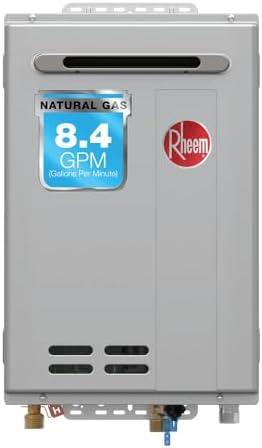
2. Rheem RTG Series 8.4 GPM Outdoor Natural Gas Tankless Water Heater (180,000 BTU)
| Feature | Specification |
| Model Series | Rheem RTG Non-Condensing Series |
| Max Flow Rate | 8.4 GPM |
| Max Thermal Input | 180,000 BTU/hr |
| Fuel Compatibility | Natural Gas |
| Installation Type | Outdoor Only (Wall-Mounted) |
| Efficiency Rating | ~0.82 UEF |
| Warranty | 12-Year Heat Exchanger / 5-Year Parts / 1-Year Labor |
Designed specifically for external mounting, this outdoor RTG model eliminates indoor venting work. Exhaust gases vent directly into ambient air from the front louvers, making installation straightforward and saving indoor square footage.
Outdoor units draw combustion air directly from their environment. Built-in freeze protection heating elements safeguard internal components down to roughly -30°F, provided power remains connected.
| Pros | Cons |
| • Zero indoor venting expenses | • Outdoor mounting only; climate restrictions |
| • Saves interior utility room space | • Vulnerable to power outages in freeze conditions |
| • High-performance 8.4 GPM output | • Lower efficiency compared to IKONIC line |
| • Simple service accessibility |
- Best For: Southern regions, sunbelt states, and retrofit projects in mild climates where indoor venting routes are difficult to execute.
- Professional Verdict: A practical workhorse for southern homes. Skipping indoor venting runs can trim hundreds off installation labor.
3. Rheem RTGH Series 6.8 GPM Natural Gas Tankless Water Heater (120,000 BTU)
| Feature | Specification |
| Model Series | Rheem RTGH Condensing Series |
| Max Flow Rate | 6.8 GPM |
| Max Thermal Input | 120,000 BTU/hr |
| Fuel Compatibility | Natural Gas |
| Installation Type | Indoor Direct Vent |
| Efficiency Rating | ~0.93 UEF |
| Warranty | 12-Year Heat Exchanger / 5-Year Parts / 1-Year Labor |
Higher flow capacity isn’t always necessary for smaller households. This 6.8 GPM condensing heater packs high efficiency into a compact footprint with a lower BTU rating (120,000 BTU/hr).
Because it demands fewer peak BTUs, this model can sometimes share existing 1/2-inch natural gas lines (subject to code verification, pipe length, and total building gas loads). It runs on Schedule 40 PVC venting while delivering low operational costs.
| Pros | Cons |
| • High efficiency (~0.93 UEF) | • Limited capacity for simultaneous usage |
| • PVC/CPVC plastic venting compatibility | • Not suited for 4+ bathroom homes |
| • Lower peak BTU requirement | • Requires condensate drainage line |
| • Excellent value for smaller homes |
- Best For: Condos, townhomes, 1-to-2 bathroom homes, or households with lower simultaneous hot water needs.
- Professional Verdict: A great entry into condensing technology. It offers lower operating costs without requiring extra burner capacity you won’t use.

4. Rheem RTG Series 9.5 GPM Natural Gas Tankless Water Heater (199,900 BTU)
| Feature | Specification |
| Model Series | Rheem RTG High-Efficiency Series |
| Max Flow Rate | 9.5 GPM |
| Max Thermal Input | 199,900 BTU/hr |
| Fuel Compatibility | Natural Gas |
| Installation Type | Indoor Direct Vent (Non-Condensing) |
| Efficiency Rating | ~0.81 – 0.82 UEF |
| Warranty | 12-Year Heat Exchanger / 5-Year Parts / 1-Year Labor |
This non-condensing 9.5 GPM model bridges the gap between high flow demand and classic non-condensing mechanics. Delivering up to 199,900 BTUs, it supplies robust flow for active households without requiring the condensate management components of condensing designs.
Because it operates as a non-condensing system, it requires Category III stainless steel venting. However, its straightforward internal architecture offers simple maintenance over time.
| Pros | Cons |
| • High peak output (9.5 GPM) | • Requires expensive Category III venting |
| • Simplified internal mechanics | • Lower energy efficiency (0.82 UEF) |
| • No condensate drainage setup needed | • Produces hotter flue exhaust gas |
| • Highly reliable heavy-duty construction |
- Best For: Mid-to-large families seeking high flow rates, replacing an existing non-condensing unit with compatible stainless steel venting.
- Professional Verdict: A durable choice for homeowners who want maximum flow rate without complex condensing electronics.

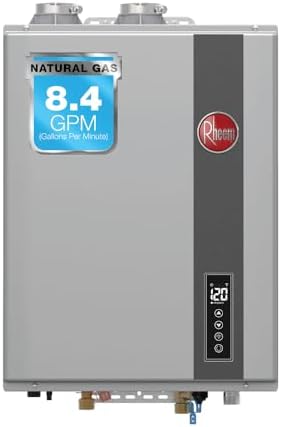
5. Rheem RTGH Series 8.4 GPM Natural Gas Tankless Water Heater (157,000 BTU)
| Feature | Specification |
| Model Series | Rheem RTGH Super High-Efficiency |
| Max Flow Rate | 8.4 GPM |
| Max Thermal Input | 157,000 BTU/hr |
| Fuel Compatibility | Natural Gas |
| Installation Type | Indoor Direct Vent |
| Efficiency Rating | Up to ~0.93 UEF |
| Warranty | 12-Year Heat Exchanger / 5-Year Parts / 1-Year Labor |
The RTGH 8.4 GPM unit sits right in the sweet spot for average American homes. Burning 157,000 BTUs at peak output, it balances high thermal performance with moderate fuel usage.
It features Hot-Start Programming™, which minimizes the “cold-water sandwich” effect (temporary drops in temperature during brief pauses in water usage) by keeping the system primed during frequent tap cycles.
| Pros | Cons |
| • Hot-Start Programming reduces cold bursts | • Higher price point than non-condensing RTG |
| • PVC venting reduces installation expenses | • Requires annual filter checks |
| • ~0.93 UEF delivers steady utility savings | • Requires condensate line run |
| • EcoNet smart technology compatible |
- Best For: Average 2-to-3 bathroom homes seeking high operating efficiency and steady temperature delivery.
- Professional Verdict: A reliable workhorse model. The combination of PVC venting support and Hot-Start tech makes it a solid choice for standard home conversions.
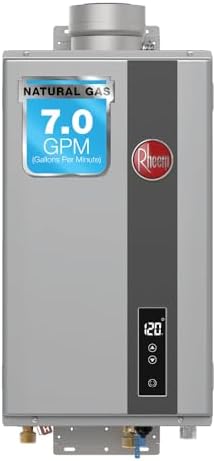
6. Rheem RTG Series 7.0 GPM Natural Gas Tankless Water Heater (160,000 BTU)
| Feature | Specification |
| Model Series | Rheem RTG Mid-Efficiency |
| Max Flow Rate | 7.0 GPM |
| Max Thermal Input | 160,000 BTU/hr |
| Fuel Compatibility | Natural Gas |
| Installation Type | Indoor Direct Vent |
| Efficiency Rating | ~0.82 UEF |
| Warranty | 12-Year Heat Exchanger / 5-Year Parts / 1-Year Labor |
The RTG 7.0 GPM unit serves as Rheem’s value-focused, entry-level indoor option. Designed to replace standard gas water tanks cleanly, it delivers reliable continuous hot water for small-to-medium households at an accessible price point.
While it lacks the top-tier UEF ratings of condensing units, its lower purchase price offers a faster return on investment for homes with modest daily water demand.
| Pros | Cons |
| • Affordable upfront purchase cost | • Non-condensing (requires Category III vent) |
| • Compact wall-mount design | • 7.0 GPM limits simultaneous peak usage |
| • Simple operational controls | • Lower energy efficiency score |
| • Proven, long-standing system reliability |
- Best For: Budget-conscious buyers, smaller homes, or rental properties looking for space-saving designs and continuous hot water.
- Professional Verdict: A reliable, low-cost tankless model. Just factor in the cost of Category III stainless steel venting when calculating your installation budget.
READ MORE: Best Tankless Gas Water Heater Reviews & Comparison
Model Comparison Summary Table
| Model Name | Max GPM | Max BTU Input | Class | Condensing? | Fuel | Install | Efficiency | Heat Exchanger Warranty | Best Use Case |
| IKONIC S-Series | 11.2 | 199,900 | Premium | Yes | Natural Gas | Indoor | 0.96 UEF | 15 Years | Large multi-bath homes |
| RTG Outdoor | 8.4 | 180,000 | Value | No | Natural Gas | Outdoor | 0.82 UEF | 12 Years | Sunbelt / mild climates |
| RTGH Compact | 6.8 | 120,000 | High-Eff | Yes | Natural Gas | Indoor | 0.93 UEF | 12 Years | Apartments / 1-2 bath homes |
| RTG High-Demand | 9.5 | 199,900 | Mid-Eff | No | Natural Gas | Indoor | 0.81 UEF | 12 Years | High flow without condensing |
| RTGH Mid-Demand | 8.4 | 157,000 | High-Eff | Yes | Natural Gas | Indoor | 0.93 UEF | 12 Years | Standard 2-3 bath homes |
| RTG Entry | 7.0 | 160,000 | Value | No | Natural Gas | Indoor | 0.82 UEF | 12 Years | Budget replacement |
READ MORE: Best Rinnai Tankless Water Heater Reviews — Models, Specs & Prices
How Many GPM Do You Need?
A common mistake when buying a tankless water heater is selecting a unit based solely on the maximum flow rate printed on the box. Tankless capacities are dynamic; the flow rate depends on your home’s incoming groundwater temperature.
Step 1: Calculate Simultaneous Flow Rates
Add up the total Gallons Per Minute (GPM) of every fixture you plan to run at the exact same time.
| Household Fixture Type | Average Fixture Flow Rate |
| Modern Water-Saving Showerhead | 1.5 – 2.0 GPM |
| Standard High-Flow Showerhead | 2.5 GPM |
| Bathroom Sink Faucet | 0.5 – 1.5 GPM |
| Kitchen Sink Faucet | 1.0 – 2.2 GPM |
| Residential Dishwasher | 1.0 – 2.0 GPM |
| Automatic Washing Machine | 1.5 – 2.5 GPM |
Step 2: Factor in Incoming Groundwater Temperature
The real output capacity of a heater depends on the temperature of the cold water entering your home:
- Southern U.S. (Warm Groundwater: 65°F – 75°F): Heating water to a comfortable 120°F requires only a 45°F to 55°F temperature rise. A unit rated at 8.4 GPM can easily run at full output.
- Northern U.S. / Canada (Cold Groundwater: 35°F – 50°F): Heating 40°F water up to 120°F requires an 80°F temperature rise. This extra workload reduces effective flow rate output by 30% to 50%.
What Does BTU Mean on a Rheem Tankless Water Heater?
BTU stands for British Thermal Unit, a standard measurement of heat energy. One BTU is the amount of heat energy required to raise the temperature of one pound of water by 1°F.
On a tankless gas system, the BTU rating reflects maximum burner input capacity per hour:
- Standard Gas Tank Heater: 30,000 to 50,000 BTU/hr.
- Tankless Gas Water Heater: 120,000 to 199,900 BTU/hr.
Because a tankless system must heat cold water instantly as it flows through the pipes, its burner requires a high peak BTU output. Advanced modulation technology allows a 199,900 BTU burner to drop its energy use down to roughly 15,000 BTUs when you are only running a low-flow bathroom faucet.
READ MORE: Noritz Tankless Water Heater Buying Guide: Sizing, Reviews & Prices
Condensing vs. Non-Condensing Rheem Tankless Water Heaters
| Factor | Non-Condensing (RTG Series) | Condensing (RTGH & IKONIC) |
| Efficiency (UEF) | 0.81 – 0.82 UEF | 0.93 – 0.96 UEF |
| Primary Exchanger Material | Copper | Copper or Stainless Steel |
| Secondary Exchanger | None | Stainless Steel |
| Flue Gas Temperature | Hot (Up to 300°F+) | Cool (~100°F) |
| Venting Material | Specialized Category III Stainless Steel | Schedule 40 PVC, CPVC, Polypropylene |
| Condensate Drain Required? | No | Yes (Requires acid-resistant drain run) |
| Upfront Purchase Cost | Lower equipment cost | Higher equipment cost |
| Venting Installation Cost | Higher material cost | Lower material cost |
Rheem Tankless Gas Water Heater Installation Cost
While exact pricing varies based on local labor rates and home layout, installing a tankless gas system involves several standard budget items.
Note: Below are approximate, national ranges for general budgeting. Always secure multiple local plumbing quotes.
Key Installation Cost Factors
- Equipment Costs ($900 – $2,300): Varies based on GPM size, condensing technology, and integrated Wi-Fi or recirculation pumps.
- Gas Line Upgrades ($300 – $1,200): Standard tank heaters often use a 1/2-inch gas feed. A high-BTU tankless unit may require upgrading to a 3/4-inch supply line back to the main meter.
- Venting Runs ($200 – $800): Non-condensing units require high-temp stainless steel venting, while condensing units require two plastic vent pipes through a side wall or roof penetration.
- Electrical Work ($150 – $400): Tankless gas units require a dedicated 120V electrical outlet nearby to power the computer board, digital displays, and electronic ignition.
- Plumbing Modifications & Isolation Valves ($200 – $500): Installing service isolation valves allows technicians to flush and descale the system without shutting off water to the entire house.
- Condensate Line Setup ($100 – $250): Condensing models generate acidic wastewater that must be neutralized and routed safely to a drain.
How Much Does It Cost to Run?
Operational expenses depend on local natural gas rates, family size, and incoming water temperatures. Rheem models boast high Uniform Energy Factor (UEF) ratings compared to older standard tanks.
TYPICAL ANNUAL OPERATING COST SAVINGS
Standard Tank (~0.60 UEF) ──► ~$350 – $450 / year
Rheem Tankless (0.95 UEF) ──► ~$180 – $260 / year
——————————————————–
Estimated Energy Savings ──► ~$150 – $250 / year
Actual energy savings vary depending on household water consumption habits and regional gas utility prices.
Rheem Tankless Gas Water Heater Installation Requirements
To ensure safe operation and preserve manufacturer warranty coverage, every installation must follow strict mechanical standards:
- Gas Supply: Adequate pressure (typically 3.5″ to 10.5″ W.C. for NG)
- Venting: Approved Category III or PVC/CPVC per manufacturer spec
- Electrical: 120V 60Hz grounded outlet nearby for control boards
- Condensate Drain: Acid-resistant drain line with neutralizer if needed
- Isolation Valves: Service valves for annual descaling and maintenance
Safety Warning: Gas line sizing, combustion calibration, and high-temperature venting should always be performed by a licensed, certified plumbing and heating professional to prevent gas leaks or carbon monoxide hazards.
READ MORE: Best 5 High Efficiency Condensing Boiler: Review, Cost & Comparison
Rheem Gas Water Heater Maintenance Checklist
- Daily
- System Monitoring: Check the display board for active error codes.
- Every 6 Months
- Inlet Filter: Unscrew the cold-water inlet filter screen, rinse away trapped sediment, and reinstall.
- Annually
- Heat Exchanger Descaling: Flush using food-grade white vinegar or an approved descaling solution.
- Venting & Intake: Clear dust, leaves, and debris from outdoor air intake and exhaust vents.
- Condensate Trap: Inspect condensate drain lines to ensure unobstructed flow.
Heat Exchanger Flush Procedure
- Isolate System: Turn off power to the unit and close the main isolation valves.
- Setup Pump: Submerge a small pump into a bucket of white vinegar (or descaling solution) and attach the hoses to the service valves.
- Circulate Solution: Turn on the pump to circulate the vinegar through the heat exchanger.
- Descaling Cycle: Run the flush cycle for 45 to 60 minutes to dissolve calcium and mineral deposits.
- Rinse: Turn off the pump and flush the heat exchanger with clean water to clear remaining solution.
- Restore Power & Flow: Disconnect hoses, re-open the main isolation valves, and restore electrical power.
Rheem vs. Competitor Brands
| Brand | Key Advantage | Flagship Efficiency | Signature Feature | Best For |
| Rheem | Value & Smart Controls | Up to 0.96 UEF | EcoNet® Wi-Fi & Integrated Recirculation | High performance with smart tech |
| Rinnai | Scale Protection Tech | Up to 0.96 UEF | ThermaCirc360™ Recirculation Pumps | Long-term reliability |
| Navien | Condensing Tech | Up to 0.96 UEF | ComfortFlow® Buffer Tank & Dual Stainless | Cold climates / High demand |
| Noritz | Heavy-Duty Construction | Up to 0.95 UEF | Commercial-grade heat exchangers | Durability & hard water areas |
| Bosch | Compact Space Savings | Up to 0.95 UEF | OptiFlow Automated Combustion | Minimalist utility layouts |
Is a Rheem Tankless Gas Water Heater Worth It?
For many households, switching to a tankless gas system is a major upgrade, but it isn’t an automatically correct choice for every single home. Weighing the advantages against the mechanical requirements helps determine if the investment makes financial and practical sense.
The Upfront Reality vs. Long-Term Payoff
A traditional 40- or 50-gallon atmospheric gas tank water heater is relatively simple and inexpensive to swap out. A tankless unit requires a higher initial investment. The heater itself costs more, and the conversion often involves upgrading gas supply lines, installing dedicated venting, and running electrical lines for digital control boards.
However, the long-term payoff comes from efficiency and longevity:
- Continuous Hot Water: You won’t run out of hot water during back-to-back showers.
- Space Savings: Tankless units mount directly onto a wall, freeing up roughly 9 to 12 square feet of floor space.
- Extended Service Life: While standard tank heaters last 8 to 12 years, a well-maintained tankless water heater can last 15 to 20 years or more.
- Reduced Standby Losses: Standard tanks continually reheat stored water even while you sleep or go on vacation. Tankless units only burn gas when a tap opens.
When a Tank Might Still Make Sense
If your household consists of one or two people with minimal hot water usage, or if your home’s electrical and gas infrastructure requires tens of thousands in retrofits, staying with a standard tank heater may offer a faster payback period. Furthermore, tankless systems demand strict adherence to annual maintenance, particularly in hard-water zones.
Frequently Asked Questions
Is a Rheem tankless gas water heater worth the extra money?
Yes, for households with high hot water demands or limited utility space. While upfront equipment and conversion costs are higher than standard tank replacements, long-term energy savings, a 15-to-20-year lifespan, and continuous hot water deliver strong long-term value.
How long does a Rheem tankless gas water heater last?
A properly maintained Rheem tankless gas water heater typically lasts 15 to 20 years or more. This is nearly double the expected 8-to-12-year lifespan of a standard glass-lined storage tank water heater.
How many GPM do I need for my house?
Multiply your peak simultaneous fixture demands. A standard 2-bath home running a shower and a sink concurrently needs around 4.5 to 6.0 GPM. In colder climates, choose a model rated higher (such as 8.4 to 11.2 GPM) to compensate for cold incoming groundwater.
Is Rheem as good as Rinnai or Navien?
Yes. While Rinnai and Navien hold strong market share in specialized installer networks, Rheem’s IKONIC condensing lineup matches their top specifications with 0.96 UEF ratings, dual stainless steel heat exchangers, and integrated EcoNet smart connectivity.
How often should I flush my Rheem tankless water heater?
Flush your system once every 12 months with food-grade white vinegar to dissolve calcium scale. If you live in an area with extremely hard water (over 10–12 grains per gallon) without a home water softener, flush every 6 months.
Final Verdict: Which Model Wins?
Choosing the right Rheem tankless gas water heater comes down to household demand, regional climate, and budget limits:
- Best Premium & Large Home Pick: Rheem IKONIC 11.2 GPM. Top-tier efficiency (0.96 UEF), dual stainless steel heat exchangers, and unmatched flow rates.
- Best Value Condensing Pick: Rheem RTGH 8.4 GPM. Excellent balance of high efficiency (~0.93 UEF) and PVC venting support for average 2-to-3 bath homes.
- Best Warm Climate / Outdoor Pick: Rheem RTG 8.4 GPM Outdoor. Eliminates indoor venting requirements while freeing up internal utility room space.
- Best Budget / Entry-Level Pick: Rheem RTG 7.0 GPM. Affordable non-condensing continuous hot water for small homes and modest demands.


Pingback: How to Flush a Rheem Tankless Water Heater: Step-by-Step Guide - Plumbing Guider
Pingback: Rheem Water Heater Installation: Step by Step - Plumbing Guider
Pingback: Rheem Performance Platinum Gas Water Heater: Review & Buying Guide - Plumbing Guider
Pingback: A. O. Smith Gas Water Heater Review: 5 Tankless Models Compared - Plumbing Guider