A humidifier for furnace systems commonly known as a whole-house humidifier solves this problem at the source. Instead of forcing you to refill small, portable room units every morning and evening, a furnace-mounted humidifier connects directly to your home’s existing heating and cooling system. It introduces controlled moisture directly into the supply ducts, distributing balanced, comfortable air to every single room.
In this comprehensive guide, we will break down how furnace humidifiers work, compare the primary types available today, analyze installation and real-world costs, and provide detailed, professional evaluations of five top models on the market. Whether you are battling winter static or looking to protect your home’s interior, this guide will help you choose the ideal system for your household. Lets deep dive into “Best Whole-House Humidifier for Furnace: Review, Comparison & Installation”
READ MORE: Furnace Replacement Cost in USA
What Is a Humidifier for a Furnace?
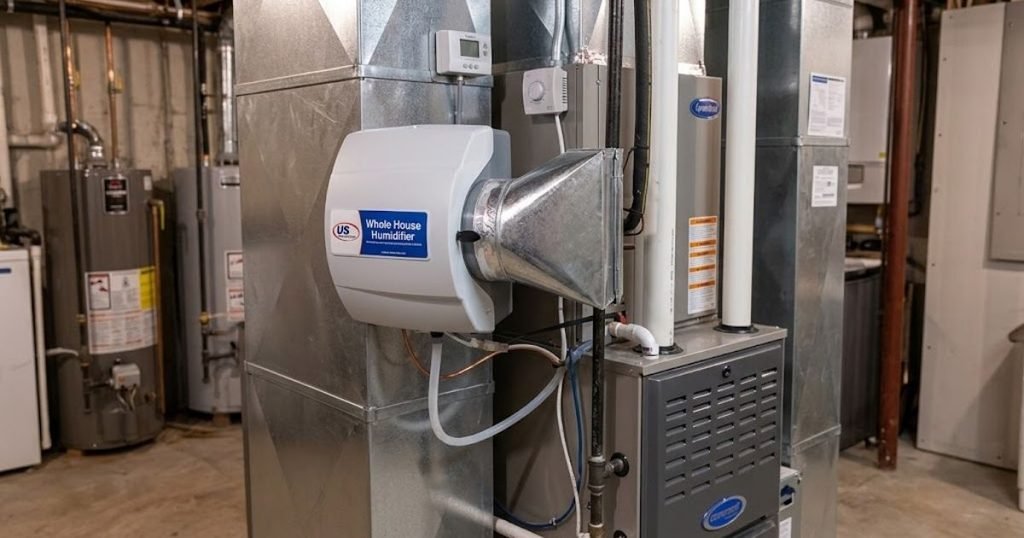
A furnace humidifier is a integrated indoor air quality appliance installed directly onto your central forced-air HVAC system. Rather than treating a single bedroom or living room, it works in tandem with your furnace blower to humidify all the air circulating through your home.
The unit is typically mounted onto either the supply plenum (the ductwork delivering warm air out into the home) or the return plenum (the ductwork drawing air back into the furnace). It connects to your home’s fresh water line and is monitored by a control device called a humidistat.
Here is the basic process of how moisture is added to your living space step-by-step:
- Heat Generation: The furnace ignites and produces warm air, while the furnace blower fan begins circulating air through the system.
- Humidistat Activation: The humidistat measures the relative humidity within your home or return duct. If the humidity falls below your target setpoint, the control signals an electric water solenoid valve on the humidifier to open.
- Moisture Transfer: Water flows into the top of the unit and trickles down through an evaporative pad (often called a water panel or vapor pad) or, in the case of a steam unit, injects pure steam directly into the airflow.
- Evaporation: Warm, dry air passing through or across the wetted panel picks up water vapor via natural evaporation.
- Distribution: The furnace blower pushes this newly humidified air through your duct network, distributing consistent moisture evenly across every room.
- Regulation: Once the humidistat detects that the home has reached the desired relative humidity, it shuts off the water valve until moisture levels drop again.
Why Put a Humidifier on Your Furnace?
Adding a whole-house humidifier to your central HVAC system offers several distinct practical and lifestyle benefits over relying on dry heat alone or using localized portable appliances.
Better Winter Comfort
Dry winter air pulls moisture from everything it contacts, including your skin, lips, eyes, and respiratory tract. By restoring relative humidity to a healthy range, warm air feels less abrasive and significantly more comfortable on your skin and breathing passages.
Helps Reduce Static Electricity
Static shocks are a classic symptom of dry winter air. When relative humidity drops below 30%, electrical charges easily build up on surfaces, fabrics, and carpets. Maintaining proper indoor moisture neutralizes static charges, keeping your home shock-free and preventing accidental electrostatic discharge from damaging sensitive electronics.
Protects Wood and Household Materials
Wood is a hygroscopic material, meaning it constantly absorbs and releases moisture to stay in equilibrium with the surrounding environment. In ultra-dry conditions, hardwood floors can shrink, warp, or gap; solid wood furniture can crack; and musical instruments like guitars or pianos can go out of tune or suffer structural damage. Controlled humidity protects these long-term investments.
More Consistent Humidity Throughout the House
Portable room units only humidify the immediate space around them, leading to drastic humidity variations between bedrooms, hallways, and living rooms. A whole-home system treats the air centrally, ensuring that every square foot fed by your ductwork receives the exact same balanced moisture level.
Less Daily Maintenance
Portable humidifiers require daily refills, frequent cleaning to prevent slime and mold growth in open water basins, and constant monitoring. A whole-house furnace humidifier is plumbed directly into your home’s water system and drains automatically, requiring only seasonal inspection and an annual pad replacement.
Potential Heating Comfort Benefits
Air that holds moderate moisture feels perceptually warmer on human skin than bone-dry air at the exact same ambient temperature. While raising relative humidity does not reduce the literal BTU output required from your furnace, many homeowners find they can set their thermostat a degree or two lower during winter without sacrificing personal warmth, leading to a more comfortable living environment overall.
READ MORE: Best Honeywell Thermostat Models: Buyer’s Guide & Comparison
Types of Humidifiers for Furnaces
Understanding the structural differences between furnace humidifiers ensures you select an architecture compatible with your ductwork layout, available electrical capacity, and budget.
1. Bypass Evaporative Humidifier
Bypass units are the most common and traditional whole-house humidifiers. They rely on a flexible or rigid metal duct (the “bypass pipe”) running between the supply and return plenums.
- How it Works: The difference in air pressure between the supply and return ducts forces a portion of warm supply air through the humidifier body, across a saturated water panel, and back into the furnace return to be recirculated.
- Advantages: Highly reliable, few moving parts, lower initial cost, quiet operation, and energy efficient.
- Disadvantages: Requires space on both supply and return ducts for duct connections; slightly lowers overall HVAC airflow efficiency due to air recirculation.
- Best For: Mid-sized homes with accessible ductwork on both sides of the furnace plenum.
2. Fan-Powered Evaporative Humidifier
Fan-powered units are mounted directly on the supply plenum and feature an internal electric fan that actively pulls air from the furnace stream through the wetted panel.
- How it Works: Rather than using a bypass duct, the unit’s onboard fan draws warm air straight out of the supply duct, drives it through the internal water pad, and returns it directly into the airflow path.
- Advantages: High efficiency, no bypass duct required (saving space), provides higher output than comparable bypass units, ideal for larger homes.
- Disadvantages: Requires a dedicated electrical outlet near the unit; slightly higher initial cost; fan motor introduces a small, secondary mechanical component that can eventually wear out.
- Best For: Larger properties or tight utility rooms where there is no space to run a secondary bypass pipe between ducts.
3. Steam Humidifier
Steam units generate moisture independently by heating water electronically to boiling point inside an internal canister, then injecting pure vapor directly into the supply plenum.
- How it Works: Electric heating elements or electrodes boil water inside a internal chamber. The resulting steam travels through a distribution tube directly into the supply airflow.
- Advantages: Maximum humidification capacity; operates independently of furnace heat output (can humidify even when furnace burner is off, running only the blower); zero wasted water in optimized setups.
- Disadvantages: Higher equipment cost; requires dedicated high-voltage electrical connections (often a dedicated 120V or 240V circuit); higher electrical operating consumption.
- Best For: Sprawling homes, structures with heat pumps (which produce lower supply air temperatures), or regions with extreme winter dryness.
4. Flow-Through Humidifier
A flow-through design is the operational standard for modern evaporative units (both bypass and fan-powered). Water trickles down through a porous aluminum panel under gravity. Warm air evaporates a portion of the water into vapor, while the remaining unevaporated water flows down a bottom drain line, continuously rinsing away dissolved minerals.
- Key Benefit: Prevents stagnant water basins, virtually eliminating the risk of standing water algae or bacterial growth inside the system.
5. Drum-Type Humidifier
An older evaporative technology where a foam-covered wheel or drum rotates through a pan filled with standing water.
- Current Status: Generally phased out in modern residential installations due to high maintenance requirements. If the water pan is not cleaned frequently, stagnant water leads to rapid mineral buildup, bacterial sludge, and unpleasant odors. Flow-through designs have largely replaced drum units in current HVAC standards.
READ MORE: Central Heat Pump Installation Cost: Homeowner Price Guide
Best 5 Humidifiers for Furnace — Reviewed
When choosing a specific furnace-mounted model, specs matter. Capacity is measured in Gallons Per Day (GPD), representing the volume of moisture the unit can inject into your home over a 24-hour cycle under standard operational conditions.
1. AprilAire 500M Whole-House Humidifier
The AprilAire 500 series represents an industry benchmark for bypass evaporative humidification in small-to-medium residential spaces. Designed specifically for homes with targeted heating footprints, the “500M” designation features a manual humidistat control system, offering straightforward operation without complex sensor wiring.
- Type: Bypass Evaporative
- Capacity: 12.0 Gallons Per Day (GPD)
- Coverage: Up to 3,000 sq. ft. (Tight construction)
- Control Type: Manual Humidistat (Included)
- Replacement Pad: AprilAire Water Panel Model 10
- Power Req.: 24VAC (Transformed from furnace control)
Detailed Evaluation
From an HVAC engineering standpoint, the AprilAire 500M excels through structural simplicity. Utilizing a flow-through design, water flows across the AprilAire Model 10 Water Panel, evaporating into the air stream driven by the pressure differential created between supply and return ducts. Un-evaporated water drains out the bottom port, carrying away mineral deposits.
The manual humidistat included with the “M” variant is installed either on the return duct or on a living area wall. Homeowners manually adjust the control knob as outdoor temperatures shift to prevent window condensation. For homeowners seeking set-it-and-forget-it automated adjustment based on outdoor sensors, AprilAire offers the automated 500 series variant, but the 500M remains highly popular due to its robust, straightforward wiring requirements.
Installation & Maintenance
Installation requires cutting a cutout into either the supply or return plenum, running a 6-inch bypass duct to the opposite plenum, tapping into a cold or hot water line (hot water yields higher output), and routing a drain tube to a nearby floor drain or condensate pump. Replacement of the Model 10 panel is an easy, tool-free 2-minute process recommended once per heating season.
- Pros:
- Highly reliable flow-through architecture prevents stagnant water problems.
- Simple, straightforward manual humidistat wiring interface.
- Widely available replacement water panels nationwide.
- Compact footprint fits tight mechanical closets.
- Cons:
- Requires manually adjusting the dial when extreme temperature drops occur.
- Evaporative efficiency drops if plumbed solely to cold water on low-temp heat pumps.
- Best For: Homeowners with homes under 3,000 sq. ft. seeking a dependable, budget-conscious bypass system with simple controls.
- Who Should Skip It: Owners of sprawling homes (>3,500 sq. ft.) or those who do not want to adjust their humidistat manually during severe winter cold snaps.
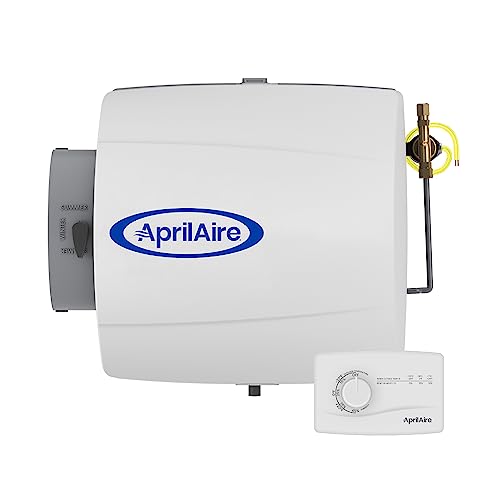
2. Honeywell Home HE200A1000 TrueEASE™ Large Basic Bypass Humidifier
Resideo’s Honeywell Home TrueEASE HE200A1000 focuses on versatile installation geometry and reduced water consumption compared to traditional legacy bypass units. Designed with user-friendly serviceability in mind, it is tailored for small to mid-sized ducted heating systems.
- Type: Bypass Evaporative
- Capacity: 12.0 Gallons Per Day (GPD)
- Coverage: Up to 3,000 sq. ft.
- Control Type: H8908 Manual Humidistat included
- Replacement Pad: Honeywell Pad HC22A / AgION Antimicrobial
- Power Req.: 24VAC
Detailed Evaluation
The TrueEASE series introduces a distinct design element: a snap-lock manifold frame that allows simple, quick access to the internal evaporative pad without requiring full disassembly of the outer cabinet housing. In practical HVAC applications, this design significantly speeds up routine seasonal maintenance.
The unit utilizes an optimized water distribution tray that meters water flow evenly across the pad, reducing excess water waste into the drain compared to older bypass models. Its integrated mechanical bypass damper allows easy seasonal changeover: homeowners can flip the damper to “OPEN” for winter humidification and “CLOSED” for summer central air conditioning operation to prevent air from bypassing the cooling coil.
Installation & Maintenance
The HE200A incorporates reversible mounting options, allowing it to be configured for left-hand or right-hand bypass ducting without modifying the physical frame assembly. Routine pad replacement utilizes Honeywell’s antimicrobial-treated filter pads, which slow down mold and mineral buildup during active operation.
- Pros:
- Quick-change pad tray design makes seasonal maintenance exceptionally clean and easy.
- Versatile mounting orientation fits asymmetrical mechanical room layouts.
- Included manual humidistat is robust and easy to calibrate.
- Cons:
- Antimicrobial replacement pads can be slightly more expensive than generic standard pads.
- Frame plastic requires careful handling during winter installations in cold basements to avoid snapping clips.
- Best For: DIY-leaning homeowners or HVAC installers looking for a bypass unit that simplifies routine pad swaps.
- Who Should Skip It: Homes requiring massive daily water output exceeding 15–18 GPD.
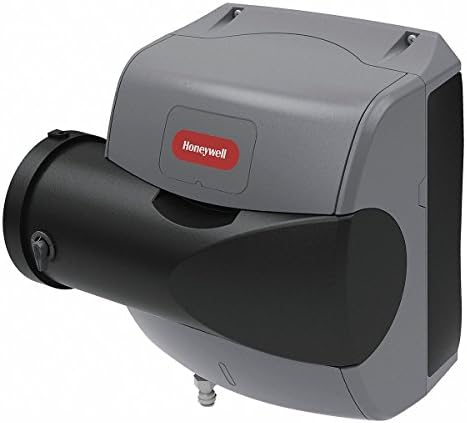
3. Large Bypass Evaporative Whole-House Humidifier by AprilAire (AprilAire 600 Series)
For larger residential properties, AprilAire’s high-capacity bypass line headlined by the AprilAire 600 series serves as the flagship standard for large-scale evaporative humidification without transitioning to a fan-powered or steam platform.
- Type: Large High-Output Bypass Evaporative
- Capacity: 17.0 Gallons Per Day (GPD)
- Coverage: Up to 4,000–5,000 sq. ft. (Depending on tightness)
- Control Type: Automatic Digital or Manual (Model dependent)
- Replacement Pad: AprilAire Water Panel Model 30
- Power Req.: 24VAC
Detailed Evaluation
The AprilAire 600 series expands daily moisture delivery to 17 GPD by utilizing a larger physical surface footprint and the larger Model 30 Water Panel. This increased surface area allows a higher volume of furnace supply air to evaporate water efficiently as it bypasses through the unit.
Depending on whether you choose the automatic control package (600) or manual variant (600M), the automated version utilizes an outdoor temperature sensor mounted on the exterior of the home. The digital controller monitors ambient outdoor temperatures and continuously calculates the optimal indoor relative humidity, automatically lowering the setpoint during extreme cold fronts to eliminate indoor window condensation without requiring manual home intervention.
Installation & Maintenance
Due to its physical size, the 600 series requires adequate flat surface area on the furnace plenum (minimum 15″ x 15″ clearance). The drainage routing must handle peak flow runoff effectively. Maintenance involves replacing the Model 30 panel once a year and verifying that the internal water distribution tray remains free of heavy lime scale buildup.
- Pros:
- Substantial 17 GPD output covers large family homes efficiently.
- Automatic digital humidistat option completely eliminates manual setting adjustments.
- Industry-proven long-term durability and structural rigidity.
- Cons:
- Requires a larger cabinet cutout space on the duct plenum.
- Running an outdoor temp sensor wire for automatic models adds installation time.
- Best For: Mid-to-large single-family residences (up to 4,000+ sq. ft.) needing higher moisture capacity while maintaining bypass reliability.
- Who Should Skip It: Tiny homes, apartments, or mechanical closets with limited duct face surface area.
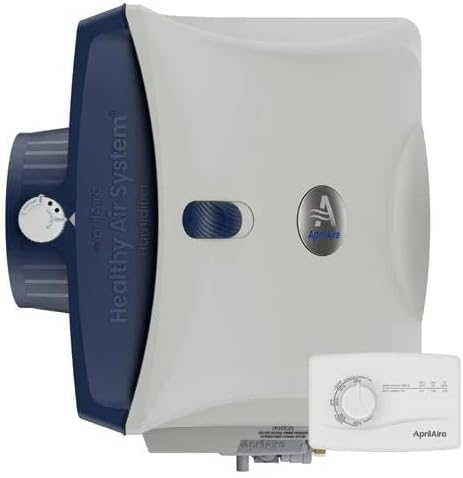
4. GeneralAire Humidifier Unit 1042-LH, Furnace Mount Bypass Type
The GeneralAire 1042-LH is a time-tested, heavy-duty flow-through bypass unit widely utilized in commercial and residential HVAC projects. Known for its durable metal components and high delivery rate, it stands out for its straightforward industrial design.
- Type: Flow-Through Bypass Evaporative
- Capacity: 17.0 Gallons Per Day (GPD)
- Coverage: Up to 3,000–4,500 sq. ft.
- Control Type: MHX3 Manual Humidistat included
- Replacement Pad: GeneralAire 990-13 Vapor Pad
- Warranty: 5-Year Limited Manufacturer Warranty
Detailed Evaluation
The GeneralAire 1042-LH (“LH” designating Left or Right hand bypass flexibility) relies on a high-efficiency aluminum alloy Vapor Pad housed inside a durable chassis. With a rated capacity of 17 GPD under standard 120°F plenum supply conditions, it effectively delivers moisture across large spaces.
The system utilizes a 24V solenoid valve coupled with a precision water distribution trough to distribute water evenly across the top of the pad. Excess water drains cleanly out the base. GeneralAire backs this model with a robust 5-year limited warranty, reflecting confidence in its heavy-duty mechanical frame and solenoid assembly.
Installation & Maintenance
The 1042-LH mounts directly onto either the supply or return air plenum. It includes the MHX3 manual humidistat, which can be duct-mounted or wall-mounted. Homeowners are instructed to replace the 990-13 Vapor Pad annually and wipe down the distribution trough to clear mineral deposits left behind by hard water.
- Pros:
- Excellent 17 GPD capacity output at a competitive price point.
- Reversible housing design simplifies installations on left or right duct configurations.
- Long-standing track record of industrial-grade component durability.
- Cons:
- Uses a traditional manual humidistat out of the box (requires manual winter adjustments).
- Requires solid, rigid duct face for mounting due to unit weight when wet.
- Best For: Homeowners prioritizing metal chassis construction, high GPD evaporative performance, and simple mechanical controls.
- Who Should Skip It: Homeowners with unstable or thin sheet-metal ductwork that cannot support larger bypass assemblies without extra bracing.
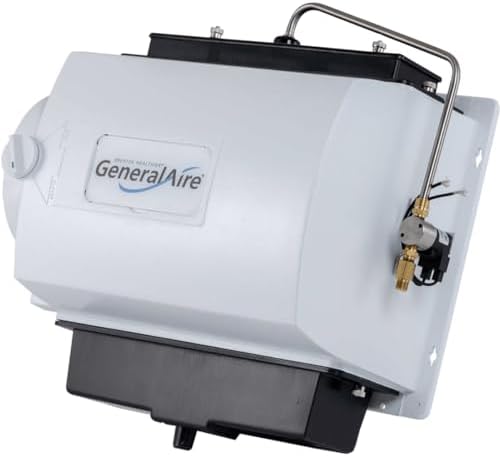
5. Evaporative Duct Mount Whole House Furnace Humidifier (Generic/Unbranded Category)
When shopping online, homeowners often encounter unbranded or white-label “Evaporative Duct Mount Whole House Furnace Humidifiers.” These units are manufactured as universal replacement options or budget-tier offerings sold across various digital marketplaces.
- Type: Duct-Mounted Evaporative (Bypass or Direct-Mount)
- Capacity: Varies typically from 10 to 14 GPD
- Coverage: Varies (Typically rated for 1,500–2,500 sq. ft.)
- Control Type: Basic mechanical humidistat (Usually included)
- Replacement Pad: Universal fit pads (Verification Required)
- Power Req.: 24VAC Transformer included or required
Detailed Evaluation
Generic duct-mounted evaporative humidifiers operate on the exact same core thermodynamic principles as name-brand units: a solenoid introduces water over a porous mesh pad, and forced air from the furnace picks up moisture vapor.
However, from an installation and long-term ownership perspective, buying an unbranded unit requires careful consumer verification. While upfront equipment costs may be lower, long-term performance hinges heavily on component quality—specifically the durability of the electric solenoid valve, the plastic housing’s resistance to thermal fatigue, and the future availability of matching replacement water panels.
What Homeowners Must Verify Before Buying Unbranded Units:
If considering a generic duct-mounted furnace humidifier, check these key technical parameters prior to purchase:
- Exact Manufacturer & Model Number: Ensure there is an identifiable manufacturer responsible for warranty claims.
- Replacement Pad Availability: Confirm that standard, universal replacement water panels (e.g., standard AprilAire or Honeywell pad dimensions) physically fit the cabinet.
- Verified GPD Output: Verify output under realistic supply plenum temperatures rather than inflated theoretical maximums.
- Solenoid Valve Voltage: Ensure the solenoid matches standard HVAC 24VAC control power.
- Duct Compatibility & Template: Confirm the unit includes a physical mounting template and duct collars.
- Pros:
- Low initial entry cost.
- Simple, bare-bones mechanical function.
- Cons:
- Replacement pads may be hard to find if custom dimensions are used.
- Limited or difficult warranty coverage if sold via grey-market importers.
- Build quality of plastic housings and solenoids may be lower.
- Best For: Budget-constrained situations where an exact generic clone matches standard name-brand pad dimensions.
- Who Should Skip It: Homeowners seeking long-term warranty support, automatic outdoor-temperature tracking, or easy part replacement.

READ MORE: Heat Pump vs. Furnace vs. Boiler: Cost & Efficiency Comparison
Comparison Table — 5 Furnace Humidifiers Compared
| Product Name | Humidifier Type | Approx. Capacity (GPD) | Approx. Coverage | Control Included | Maintenance Interval | Best For | Overall Take |
| AprilAire 500M | Bypass Evaporative | 12.0 GPD | Up to 3,000 sq. ft. | Manual Humidistat | Replace pad 1x / season | Small-to-mid homes | High reliability, industry-standard bypass performance. |
| Honeywell TrueEASE HE200A | Bypass Evaporative | 12.0 GPD | Up to 3,000 sq. ft. | Manual Humidistat | Replace pad 1x / season | Easy maintenance | Quick-swap pad tray makes seasonal service exceptionally simple. |
| AprilAire 600 Series | Large Bypass Evaporative | 17.0 GPD | Up to 4,000–5,000 sq. ft. | Automatic or Manual | Replace pad 1x / season | Mid-to-large homes | Premium output capacity with automated outdoor sensor options. |
| GeneralAire 1042-LH | Flow-Through Bypass | 17.0 GPD | Up to 3,000–4,500 sq. ft. | Manual Humidistat | Replace pad 1x / season | Metal construction | High-output, heavy-duty build with proven longevity. |
| Generic Duct Mount | Evaporative Duct Mount | Varies (10–14 GPD) | Varies (1,500–2,500 sq. ft.) | Basic Mechanical | Varies by pad fitment | Tight budgets | Requires careful verification of replacement pad availability before purchase. |
Key Takeaways From the Comparison
When evaluating these options, output capacity (GPD) and Control Type represent the two biggest practical distinctions. The AprilAire 500M and Honeywell HE200A deliver 12 GPD, making them ideal for standard mid-sized single-family properties. The AprilAire 600 and GeneralAire 1042-LH step up to 17 GPD, delivering the extra moisture volume needed for larger floor plans or homes with higher ceiling volumes.
Which Furnace Humidifier Is Best for Your Home?
Every home presents a unique combination of square footage, layout, mechanical space, and budget. Here is how to match a unit to your specific scenario:
- Best for Smaller or Mid-Sized Homes: The AprilAire 500M or Honeywell HE200A. Both produce 12 GPD, which is ideal for efficiently managing relative humidity in homes under 3,000 sq. ft. without over-saturating air volume.
- Best for Larger Homes: The AprilAire 600 Series or GeneralAire 1042-LH. Delivering 17 GPD, these high-capacity units ensure sufficient water vapor delivery across large floor plans or multi-story structures fed by a single heating plant.
- Best Budget-Friendly Option: The AprilAire 500M. Its widely available replacement parts and simple design make it cost-effective both up front and over years of reliable service.
- Best for Easy Maintenance: The Honeywell Home TrueEASE HE200A. Its snap-lock frame assembly lets homeowners pop out the old pad and slide in a new wetted pad in seconds without wrestling with cabinet doors.
- Best for Homeowners Who Want Simple Controls: Any model featuring a classic Manual Humidistat (such as the “M” series from AprilAire or Honeywell’s basic package). They require zero complex sensor wiring, operating off a straightforward mechanical dial setup.
- Best Overall: AprilAire 600 Series (Automatic Version). Combining a strong 17 GPD capacity, durable flow-through design, nationwide part availability, and an automatic outdoor-temperature-compensating control system, it represents the most complete, hassle-free whole-house humidification investment on the market today.
READ MORE: Furnace Control Board Replacement Cost: U.S. Guide
What Humidity Level Should Your Home Have in Winter?
When managing indoor humidity during cold weather, more is not always better. Homeowners must balance personal comfort with structural protection. Setting your humidistat too high during sub-freezing weather will cause warm, moist indoor air to condense against cold window glass and poorly insulated exterior walls, potentially leading to window frame rot, paint peeling, and indoor mold growth.
Relative humidity (RH) is the percentage of moisture air can hold at a given temperature relative to its maximum capacity. Because cold outdoor air holds very little moisture, indoor RH targets must adjust dynamically based on outdoor temperatures.
The following table provides a standard, conservative practical baseline for winter indoor humidity settings in typical American homes:
| Outdoor Temperature (°F) | Approximate Indoor RH Starting Point |
| 40°F and above | 35% – 40% |
| 30°F | 30% – 35% |
| 20°F | 25% – 30% |
| 10°F | 20% – 25% |
| 0°F | 20% – 25% |
| Below 0°F | 15% – 20% (Lower as needed to eliminate window fogging) |
Note: These ranges serve as general guidelines. Homes with modern triple-pane windows and high-performance wall insulation can often sustain slightly higher humidity levels without condensation, whereas older homes with single-pane glass or drafty framing may need lower targets to keep windows clear.
How Does a Furnace Humidifier Work?
To understand whole-home moisture control, it helps to take a closer look at the interaction between heating cycles, airflow dynamics, and fluid dynamics within a forced-air HVAC system.
When cold air enters your furnace return, the burner assembly heats it to high temperatures (often between 110°F and 140°F supply plenum temperatures). Heating air expands it, which dramatically lowers its relative humidity. Even if outdoor air has 70% relative humidity at 20°F, warming that exact same air up to 70°F inside your home drops its relative humidity to below 15%—drier than most natural deserts.
The furnace humidifier counteracts this through a regulated cycle:
- Demand Call: The humidistat continually samples air moisture. When indoor RH drops below the set target while the furnace is actively heating, the humidistat sends a 24-volt electrical signal to the humidifier’s solenoid valve.
- Water Supply: The solenoid valve opens, allowing water from your home’s plumbing line to flow through a tiny orifice strainer into the distribution tray at the top of the unit.
- Distribution & Evaporation: Water flows evenly across the textured aluminum water panel. Warm supply air driven by the furnace blower sweeps across this wetted mesh. As air passes through the grid, heat causes water droplets to evaporate instantly into invisible gas (water vapor).
- Air Delivery: The warm, vapor-rich air flows throughout your home’s duct system, balancing humidity levels in every room.
- Drainage: Residual un-evaporated water cascades down the bottom pan into the drain tube, washing away hardness minerals like calcium and magnesium to prevent clogging.
READ MORE: Best 6 Infrared Heater Indoor: Reviews, Cost & Compared
Where Is a Humidifier Installed on a Furnace?
A whole-house humidifier must be correctly integrated into your HVAC ductwork to function safely and efficiently. Proper placement ensures maximum evaporation without damaging electrical controls, heat exchangers, or air filters.
Key Location Options
- Supply Plenum (Preferred for Efficiency): Mounting the unit on the warm supply side exposes the water panel to the hottest air leaving the furnace, maximizing the evaporation rate per gallon of water used.
- Return Plenum: If space on the supply plenum is blocked by A/C evaporator coils or tight duct transitions, bypass units can be mounted on the return air plenum, with the bypass collar connected back to the supply duct.
Critical Clearance Requirements
- Evaporator Coil Clearance: The humidifier must be mounted so that mounting screws or cutouts do not puncture the A/C cooling coil located inside the supply plenum.
- Filter Protection: Never place a humidifier upstream of a paper furnace air filter where water runoff or high humidity could saturate and collapse the filter medium.
- Service Access: Ensure at least 12 to 18 inches of clear space in front of the unit cabinet so homeowners can comfortably remove the front cover for seasonal pad replacements.
- Plumbing and Drainage Access: Placement must allow a continuous downward slope on the drain line to a floor drain or condensate pump, along with access to a cold or hot water pipe connection.
Furnace Humidifier Installation — What Homeowners Should Know
Installing a whole-house furnace humidifier involves cutting into sheet metal ductwork, tapping into home plumbing lines, running continuous low-voltage electrical wiring, and connecting to furnace control boards.
High-Level Installation Process Overview:
- Duct Surface Prep: Select an unobstructed flat surface on the plenum, tape the manufacturer’s paper template to the sheet metal, and cut out the opening using metal tin snips.
- Cabinet Mounting: Secure the main humidifier housing into the sheet metal opening using self-tapping sheet metal screws, ensuring a tight air seal.
- Bypass Duct Connection (If applicable): Cut a 6-inch circular hole in the opposite plenum collar and connect flexible or rigid metal bypass pipe between the collars.
- Plumbing Attachment: Install a saddle valve or dedicated ball valve onto a nearby copper/PEX water line. Route 1/4-inch copper or plastic tubing to the inlet of the solenoid valve.
- Drain Line Setup: Clamp a 1/2-inch clear vinyl drain hose to the drain spigot at the base of the humidifier and route it with a downward pitch to a drain.
- Humidistat & Electrical Wiring: Mount the humidistat, step down 120V to 24V using a transformer (if not drawing off existing 24V furnace terminals), and wire the control circuit in series with the furnace blower interlock terminals.
- System Commissioning: Turn on water supply, initiate a heating cycle, check for water leaks, verify solenoid operation, and adjust the humidistat.
Safety Warning for Homeowners: While skilled DIY enthusiasts with sheet-metal and low-voltage experience may handle basic bypass installations, it is strongly advised to hire a licensed HVAC professional. Improper installation can cause water leaks into furnace control boards, puncture refrigerant lines, compromise furnace combustion venting, or create electrical shorts.
READ MORE: Best 5 High Efficiency Condensing Boiler: Review, Cost & Comparison
How Much Does Furnace Humidifier Installation Cost?
The total investment required to equip your home with a whole-house humidifier includes both equipment costs and professional labor expenses.
Cost Factors Breakdown
| Cost Factor | Typical Cost Range (USD) | Primary Variables |
| Humidifier Unit (Bypass) | $150 – $350 | Capacity rating, manual vs automatic controls |
| Humidifier Unit (Fan-Powered) | $250 – $500 | High capacity, internal fan construction |
| Humidifier Unit (Steam) | $600 – $1,500+ | Advanced steam canister technology |
| Professional Labor | $300 – $800 | Regional labor rates, job complexity |
| Plumbing/Electrical Modifications | $100 – $300 | Need for dedicated outlets or long plumbing runs |
| Annual Maintenance (DIY) | $15 – $40 | Annual water panel/pad replacement cost |
| Total Typical Installed Range | $450 – $1,200 (Evaporative) $1,200 – $2,500+ (Steam) | Varies by home design and local contractor pricing |
Key Factors Influencing Total Installation Price:
- Ductwork Modifications: Tight mechanical rooms requiring custom sheet metal offset fittings increase installation labor time.
- Electrical Upgrades: Steam humidifiers require high-amp 120V or 240V circuits, requiring dedicated breaker installations by an electrician.
- Accessibility: Easily accessible basement installations cost significantly less in labor than tight attics or crawlspaces.
Furnace Humidifier Maintenance
Proper seasonal maintenance is essential to keep your furnace humidifier working reliably, protect your indoor air quality, and prevent scale buildup.
- Replace Evaporative Water Panel (1x per heating season)
- Flush & Clean Water Distribution Trough
- Inspect & Clear Drain Hose of Mineral Scale
- Test Solenoid Valve Operation & Check for Seepage
- Set Bypass Damper to “OPEN” in Winter / “CLOSED” in Summer
- Inspect Humidistat Calibration & Sensor Connections
What Size Furnace Humidifier Do You Need?
Sizing a furnace humidifier depends on more than just home square footage. To calculate the required Gallons Per Day (GPD) capacity, HVAC professionals evaluate several key variables:
- Home Construction Tightness:
- Tight (Modern insulation, vapor barrier, tight windows): Requires ~0.5 gallons per day per 1,000 sq. ft.
- Average (Standard construction, moderate insulation): Requires ~1.0 gallon per day per 1,000 sq. ft.
- Loose (Older homes, drafty windows, minimal insulation): Requires ~1.5+ gallons per day per 1,000 sq. ft.
- Ceiling Height: Standard sizing formulas assume 8-foot ceilings. If your home features 10-foot or vaulted ceilings, calculate by overall cubic footage volume rather than square footage alone.
- Furnace Runtime & Climate Zone: Regions experiencing prolonged sub-zero temperatures run furnaces more frequently, driving down indoor RH faster and requiring higher capacity units.
General Rule of Thumb: A 12 GPD unit (like the AprilAire 500 or Honeywell HE200A) generally handles average-tightness homes up to 3,000 sq. ft. Homes between 3,000 and 5,000 sq. ft. or homes with loose air sealing should step up to a 17 GPD unit (like the AprilAire 600 or GeneralAire 1042-LH) or a dedicated steam humidifier system.
Frequently Asked Questions
Is it worth putting a humidifier on your furnace?
Yes. For homeowners with central forced-air heating in dry winter climates, a furnace humidifier is one of the most effective indoor air quality upgrades available. It delivers consistent moisture to every room in your home simultaneously, eliminates the daily chore of refilling portable tanks, and helps protect expensive hardwood floors, trim, and furniture from cracking due to dry air.
What type of humidifier is best for a furnace?
For most mid-sized homes, a flow-through bypass evaporative humidifier (such as the AprilAire 500M or 600 series) offers the best combination of reliability, low maintenance, and energy efficiency. For larger properties or tight utility spaces where running a bypass duct is difficult, a fan-powered evaporative unit or an electric steam humidifier represents the best option.
How much does it cost to install a humidifier on a furnace?
The typical total cost to install a whole-house bypass or fan-powered evaporative humidifier ranges between $450 and $1,200, including both equipment and professional HVAC installation labor. Advanced steam humidifier systems requiring high-voltage electrical work generally cost between $1,200 and $2,500+ installed.
What humidity level should I set my furnace humidifier to in winter?
A practical target for winter relative humidity is 30% to 35% when outdoor temperatures hover around 30°F. When outdoor temperatures drop toward 0°F or lower, you should lower your humidistat setting down to 20% to 25% to prevent warm indoor air from condensing against cold window glass and creating water runoff.
How often should a furnace humidifier be serviced?
A furnace humidifier should be serviced once per year, ideally at the start of the heating season in autumn. Maintenance involves replacing the internal evaporative water panel (pad), flushing mineral scale from the water distribution tray, inspecting the drain hose for blockages, and testing solenoid valve operation.
Final Verdict
Adding a whole-house humidifier to your forced-air furnace transforms your indoor environment during harsh winter months. By maintaining balanced relative humidity, you protect your skin, reduce static shocks, and prevent costly shrinkage damage to hardwood floors and interior woodwork.
When making your final decision:
- For standard homes under 3,000 sq. ft. looking for reliable, proven value, the AprilAire 500M provides outstanding bypass performance.
- If you want maximum convenience during pad replacements, the Honeywell Home TrueEASE HE200A offers a user-friendly quick-swap tray system.
- For larger properties requiring up to 17 GPD output and automated outdoor weather adjustments, the AprilAire 600 Series (Automatic) stands out as the best overall whole-house investment.
Before buying, verify your duct surface dimensions, check your home’s square footage tightness, and consult a qualified local HVAC technician to ensure seamless installation and years of trouble-free winter comfort.

