Choosing to upgrade your home’s water heating system is one of the most effective ways to lower utility bills and ensure you never run out of hot water halfway through a morning routine. Traditional tank water heaters waste a tremendous amount of energy by keeping 40 to 50 gallons of water hot around the clock even when nobody is home. Switching to an energy efficient tankless water heater eliminates that constant standby heat loss by heating water only on demand.
Navigating the market can feel overwhelming with so many fuel types, flow rates, and efficiency ratings to evaluate. This guide breaks down everything U.S. homeowners need to know, analyzing six prominent models across different categories to help you select the right fit for your household. Lets deep dive into “Best Energy-Efficient Tankless Water Heaters”
What Is an Energy-Efficient Tankless Water Heater?
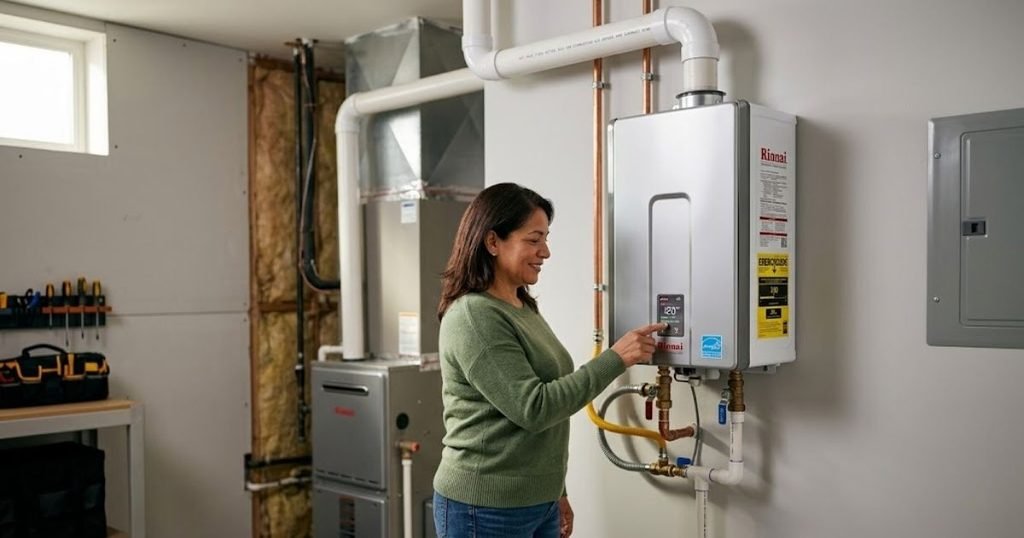
An energy-efficient tankless water heater often called an on-demand water heater heats water directly as it flows through the unit without storing it in a tank. When you turn on a hot water tap, cold water travels through a pipe into the unit. A gas burner or an electric heating element quickly heats the water to the precise temperature set on the digital display. Once you turn off the faucet, the unit shuts off automatically.
How Tankless Water Heaters Save Energy
Understanding why these units outperform traditional tanks comes down to basic thermodynamics.
- Eliminating Standby Heat Loss: Conventional tank water heaters consume energy 24 hours a day to keep a large body of water hot, even overnight or while you are away at work. Tankless models eliminate this waste entirely.
- On-Demand Operation: They fire up only when a hot water draw is detected, using energy strictly during active consumption.
- Advanced Heat Exchangers: Modern units utilize advanced copper or stainless-steel heat exchangers designed to transfer maximum thermal energy from combustion gases or electric elements directly into the water stream.
- Uniform Energy Factor (UEF): UEF is the official metric established by the U.S. Department of Energy to measure overall energy efficiency. Higher UEF ratings indicate better conversion of energy into usable hot water.
- Proper Sizing and Flow Rates: Maximizing efficiency requires matching the unit’s flow rate and BTU input to your home’s peak temperature rise (the difference between incoming groundwater temperature and your desired output temperature).
READ MORE: Best Tankless Water Heater — Top Picks, Costs & Buyer’s Guide
Best Energy-Efficient Tankless Water Heaters
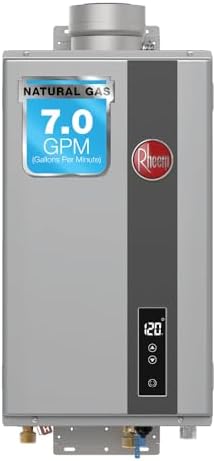
1. Rheem RTG Series 7.0 GPM Natural Gas Tankless Water Heater (RTG-70DVLN-3)
Key Specifications
| Feature | Detail |
| Fuel Type | Natural Gas |
| Max BTU Input | 199,900 BTU/h |
| Flow Rate (35°F Rise) | 7.0 GPM |
| Uniform Energy Factor | 0.82 UEF |
| Installation | Indoor |
| Design Type | Non-Condensing |
| Venting | 3″ x 5″ Concentric |
| Warranty | 15-Year Heat Exchanger / 5-Year Parts / 1-Year Labor |
What Makes It Energy Efficient?
The Rheem RTG-70DVLN-3 achieves a strong 0.82 UEF rating through an intelligent electronic control system that modulates gas combustion to match real-time water flow. It features an ultra-low NOx burner that optimizes combustion efficiency while complying with strict regional air quality standards.
Performance and Hot-Water Capacity
With a 7.0 GPM capacity at a 35°F temperature rise, this unit easily handles two to three simultaneous household water applications—such as running a shower while the kitchen dishwasher is cycling.
Installation Requirements
- Gas: Requires a standard 3/4-inch NPT gas connection.
- Electricity: Requires a standard 120V electrical outlet for the internal control board and igniter.
- Venting: Utilizes 3×5-inch concentric venting with up to a 43-foot straight pipe run allowance.
- Professional Installation: Recommended due to gas line sizing and venting safety codes.
Pros
- Compact, lightweight footprint allows for flexible one-person installation.
- Generous 15-year heat exchanger warranty.
- Consistent temperature modulation prevents sudden hot or cold surges.
- Low activation flow rate (0.4 GPM) triggers heating even with low-flow fixtures.
- SCAQMD Rule 1146.2 compliant for low NOx emissions.
Cons
- Non-condensing design requires specialized venting materials able to handle higher exhaust temperatures.
- Does not include built-in Wi-Fi tech out of the box on this specific sub-model variant.
- Performance drops in northern climates with very cold winter groundwater temperatures.
- Requires annual descaling maintenance in hard-water regions.
Best For
Mid-sized U.S. households looking for a reliable, brand-backed gas unit capable of supporting two active bathrooms simultaneously.
Things to Know Before Buying
Check your existing gas supply line diameter. While Rheem features side-to-side clearance flexibility, homes with older 1/2-inch gas lines running far from the meter may require a line upgrade to support the maximum 199,900 BTU input.
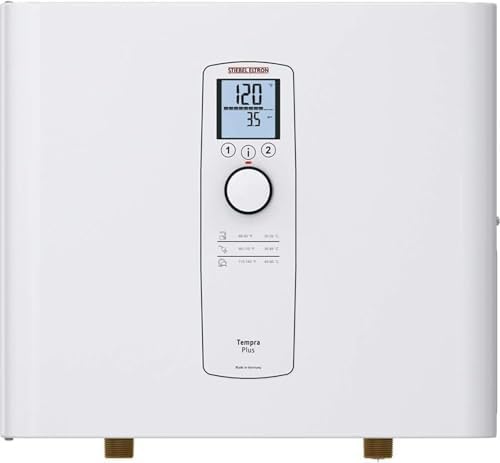
2. Stiebel Eltron Tempra 29 Plus Electric Tankless Water Heater
Key Specifications
| Feature | Detail |
| Fuel Type | Electric |
| Power Rating | 28.8 kW @ 240V (21.6 kW @ 208V) |
| Electrical Requirement | Three 40A breakers / Three 8/2 AWG copper wire runs |
| Maximum Amperage | 120 Amps |
| Activation Flow | ~0.35 GPM |
| Installation | Indoor Wall-Mounted |
| Venting | None Required |
| Warranty | 7-Year Leakage / 3-Year Parts |
What Makes It Energy Efficient?
Electric tankless water heaters convert electrical energy directly into heat through water-immersed heating elements with close to 99% thermal conversion efficiency. Because electric units do not lose heat through exhaust venting, every kilowatt-hour consumed goes directly into warming the water stream.
Performance and Hot-Water Capacity
The Tempra 29 Plus delivers steady temperature output using Advanced Power Control software, which modulates power to match flow rates. However, its whole-house capacity depends heavily on your incoming groundwater temperature. In colder northern U.S. climates, a 28.8 kW electric unit will support fewer simultaneous fixtures than in southern states because a larger temperature rise requires more electrical energy per gallon.
Installation Requirements
- Electricity: Heavy electrical service is mandatory. It requires three dedicated 40-amp single-pole breakers and three independent 8/2 AWG copper wire runs, demanding a robust 200-amp or 300-amp main electrical panel.
- Gas/Venting: Completely absent of gas lines or combustion venting, making it ideal for gas-free homes or tight interior spaces.
Pros
- 99% efficient direct thermal conversion with zero standby losses.
- No combustion exhaust or venting required, simplifying placement.
- Whisper-quiet operation compared to gas-fired burners.
- Precise electronic temperature control knob on the front cover.
- Compact wall-hung profile frees up utility closet floor space.
Cons
- High electrical demands often require expensive home electrical panel upgrades.
- Operating costs can be higher than natural gas depending on local regional electricity rates.
- Flow rate is constrained during peak winter conditions in cold climates.
- Sensitive to hard water scale buildup on heating elements.
Best For
All-electric homes, urban apartments without gas service, or homeowners looking to eliminate combustion appliances entirely.
Things to Know Before Buying
Consult a licensed electrician before purchasing. Ensuring your home electrical panel has sufficient capacity for a 120-amp draw is critical to avoid costly post-purchase surprises.
3. Ranein Natural Gas Tankless Water Heater (8.5 GPM / 80,000–100,000 BTU Indoor)
Key Specifications
| Feature | Detail |
| Fuel Type | Natural Gas |
| Max BTU Input | 80,000 to 100,000 BTU |
| Claimed Flow Rate | 3.6 to 4.3 GPM |
| Installation | Indoor |
| Heat Exchanger | Oxygen-Free Copper |
| Control System | ADRC 2.0 Adaptive Constant Temperature Algorithm |
| Venting | Included exhaust pipe kit |
What Makes It Energy Efficient?
The Ranein unit integrates a high-speed anti-backflow fan system and an oxygen-free copper heat exchanger designed to accelerate thermal transfer. Smart seasonal modes automatically adjust heating intensity based on ambient groundwater shifts, preventing unnecessary gas consumption during warmer months.
Performance and Hot-Water Capacity
Designed primarily as a compact solution, this model outputs between 3.6 and 4.3 GPM, comfortably supporting two to three active water fixtures simultaneously (such as a kitchen faucet and a single bathroom shower).
Installation Requirements
- Gas & Water: Standard 1/2-inch NPT connections for both water and gas inlets.
- Venting: Comes packaged with a dedicated vent pipe kit; must be installed in a well-ventilated indoor space.
- Altitude Restriction: Manufacturer documentation explicitly notes the unit is not recommended for high-altitude installations exceeding 2,000 feet without professional modification.
Pros
- Compact and lightweight (under 25 lbs), making wall mounting straightforward.
- Features smart pre-set modes (Dish, Infant, Elderly) via a clear HD digital display.
- Oxygen-free copper heat exchanger minimizes internal corrosion.
- Includes basic venting components in the box.
- Accessible price point for budget-conscious renovators.
Cons
- Lower BTU input (80,000–100,000) limits high-flow simultaneous whole-house use.
- Altitude limitations restrict usage in mountainous regions.
- Uses 1/2-inch gas fittings, which can bottleneck gas supply if improperly branched.
- Shorter manufacturer warranty coverage compared to premium legacy brands.
Best For
Smaller homes, guest houses, cabins, or apartments with modest, single-bath hot water demands.
Things to Know Before Buying
Verify your local elevation. If your home sits higher than 2,000 feet above sea level, look for a model specifically rated for high-altitude operation to prevent combustion errors.

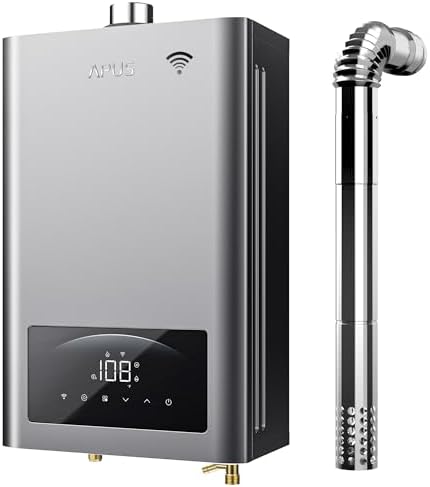
4. APUS Natural Gas Tankless Water Heater (140,000 BTU, Up to 6.8 GPM)
Key Specifications
| Feature | Detail |
| Fuel Type | Natural Gas |
| Max BTU Input | 140,000 BTU |
| Claimed Flow Rate | Up to 6.8 GPM (with built-in booster pump) |
| Installation | Indoor |
| Smart Tech | Wi-Fi App Control (Tuya App compatible) |
| Special Feature | Zero Cold Water Technology (Single-circulation loop) |
| Temperature Control | Smart Season Comfort Mode (±1°F precision) |
What Makes It Energy Efficient?
The APUS system utilizes a built-in recirculation cycle marketed as “Zero Cold Water Technology”. By pre-circulating water through the pipes on a 24/7 ECO smart cycle, it eliminates the gallons of cold water typically wasted down the drain while waiting for hot water to arrive at distant taps.
Performance and Hot-Water Capacity
Equipped with an internal booster pump, the unit increases water flow delivery up to 6.8 GPM. This enables it to support two showers and two sinks running concurrently without severe temperature drops.
Installation Requirements
- Electricity: Requires a standard 120V electrical outlet to power the internal pump, Wi-Fi module, and electronic igniter.
- Gas: Standard natural gas connection.
- Venting: Indoor combustion requires proper vertical or horizontal wall venting compliant with local gas codes.
Pros
- Built-in booster pump maintains strong water pressure across multiple fixtures.
- Zero Cold Water circulation eliminates water waste.
- Wi-Fi smartphone integration allows remote temperature scheduling and monitoring.
- Precise ±1°F temperature control prevents sudden scalding or cold bursts.
- Strong mid-tier flow rate capacity (6.8 GPM).
Cons
- Internal pump adds mechanical complexity and running noise compared to passive units.
- Recirculation loops can increase standby energy use if not programmed efficiently.
- Brand footprint is smaller in traditional plumbing supply houses, making local parts sourcing tougher.
- Professional installation required for electrical and gas hookups.
Best For
Homeowners dealing with long pipe runs from the water heater to bathrooms who want instant hot water without installing an external recirculation pump loop.
Things to Know Before Buying
If your home does not have a dedicated return line for recirculation, confirm whether the unit can utilize an existing cold-water line as a makeshift return path under manufacturer guidelines.
5. Rinnai RE199iN Non-Condensing Natural Gas Tankless Water Heater
Key Specifications
| Feature | Detail |
| Fuel Type | Natural Gas |
| Max BTU Input | 199,000 BTU (Min 10,400 BTU) |
| Claimed Flow Rate | Up to 8.5–9.8 GPM |
| Uniform Energy Factor | 0.82 UEF |
| Installation | Indoor |
| Design Type | Non-Condensing |
| Connectivity | Wi-Fi Capable |
| Recirculation | Capable |
What Makes It Energy Efficient?
Rinnai’s RE199iN achieves its 0.82 UEF efficiency through a modulating gas valve that scales down to 10,400 BTU during low-demand tasks (such as hand-washing dishes) and scales up to 199,000 BTU when multiple showers run. This prevents overheating and reduces fuel waste.
Performance and Hot-Water Capacity
As a high-capacity residential model, it delivers up to 8.5–9.8 GPM, making it well-suited for larger medium-to-large homes with multiple bathrooms operating simultaneously.
Installation Requirements
- Gas & Water: Standard 3/4-inch utility connections.
- Venting: Non-condensing design requires approved concentric or twin-pipe venting materials (such as Ubbink or Metal-Fab) capable of handling exhaust gas temperatures.
- Electrical: 120V AC power source required.
Pros
- Industry-leading brand reputation for reliability and longevity.
- Broad BTU modulation range (10,400 to 199,000 BTU) handles micro-flows and heavy loads equally well.
- Wi-Fi monitoring and recirculation pump compatibility.
- Compact suitcase-style footprint saves mechanical room space.
- Robust commercial-grade components adapted for residential use.
Cons
- Premium upfront price point compared to lesser-known direct-to-consumer alternatives.
- Non-condensing efficiency (0.82 UEF) falls slightly short of elite condensing units (which exceed 0.90 UEF).
- Requires professional installation to validate manufacturer warranties.
- Venting retrofits can be labor-intensive in older homes.
Best For
Homeowners seeking a proven, premium-grade, high-capacity gas tankless water heater backed by extensive industry support and parts availability.
Things to Know Before Buying
Rinnai offers robust warranty protection, but warranties are often contingent on professional installation and annual maintenance flushing. Keep your installer receipts on file.

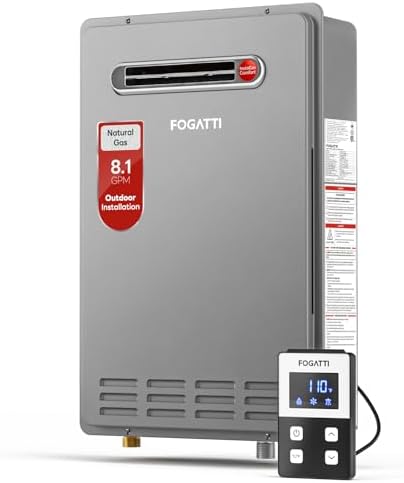
6. FOGATTI Natural Gas Outdoor Tankless Water Heater (120,000 BTU, 5.0–5.9 GPM)
Key Specifications
| Feature | Detail |
| Fuel Type | Natural Gas |
| Max BTU Input | 120,000 BTU |
| Claimed Flow Rate | 5.0 to 5.9 GPM |
| Installation | Outdoor |
| Certification | CSA Certified |
| Temperature Range | 95°F to 149°F |
| Activation Flow | 0.55 GPM |
What Makes It Energy Efficient?
Outdoor tankless water heaters eliminate the need for mechanical exhaust venting entirely. Because the unit mounts on an exterior wall, combustion gases vent directly into the open air. This avoids heat loss associated with indoor draft hoods and saves interior living space.
Performance and Hot-Water Capacity
Delivering around 5.0 to 5.9 GPM with a 120,000 BTU maximum input, this outdoor model handles standard hot water demands for homes with one to two active bathrooms in moderate climates.
Installation Requirements
- Outdoor Placement: Must be mounted on an exterior wall protected from heavy direct flooding, yet accessible for maintenance.
- Venting: Vent-free outdoor design eliminates roof or wall penetration costs.
- Freeze Protection: In freezing U.S. climates, outdoor units require built-in electric anti-freeze heaters and insulation jackets to prevent winter pipe bursts.
Pros
- Zero indoor venting requirements drastically simplify installation labor and cost.
- Frees up interior utility closet or basement space.
- CSA certified for safety and performance compliance in North America.
- Includes a digital wired controller for indoor temperature adjustments.
- Quiet outdoor operation keeps mechanical noise away from living areas.
Cons
- Subject to weather exposure, requiring protection against severe storms and freezing temperatures.
- Lower BTU output (120,000) limits performance in cold northern regions with icy incoming groundwater.
- Running utility lines (gas, water, power) through exterior walls requires weatherproof sealing.
- Not suitable for freezing climates unless rigorous freeze-protection protocols are maintained.
Best For
Homeowners living in mild southern or coastal U.S. climates looking to save indoor space and bypass complex indoor venting installations.
Things to Know Before Buying
If you experience hard freezes in your area, ensure the outdoor unit features an active anti-frost mechanism and remember to unplug or drain the unit if you leave the home unheated during winter vacation.
READ MORE: AO Smith vs. Rheem Water Heaters: Comparison & Expert Reviews
Quick Comparison of the 6 Tankless Water Heaters
| Product | Fuel | Max BTU/kW | Claimed Flow | Indoor/Outdoor | Condensing Type | Efficiency/UEF | Recirculation | Best Use |
| Rheem RTG-70DVLN-3 | Natural Gas | 199,900 BTU/h | 7.0 GPM | Indoor | Non-Condensing | 0.82 UEF | No | Medium households (2–4 baths) |
| Stiebel Eltron Tempra 29 Plus | Electric | 28.8 kW | Variable (~5–7 GPM) | Indoor | N/A (Electric) | High Direct Resistance | No | Electric-only whole-house setups |
| Ranein RH8K-NG | Natural Gas | 80,000 BTU | 3.6 GPM | Indoor | Non-Condensing | Not Indicated | No | Small apartments, 2–3 water points |
| APUS WHJSQ20GT-NG | Natural Gas | 140,000 BTU | Up to 6.8 GPM | Indoor | Non-Condensing | High Efficiency | Yes (Built-in cycle) | Homes with 2 simultaneous showers |
| Rinnai RE199iN | Natural Gas | 199,000 BTU | 8.5–9.8 GPM | Indoor | Non-Condensing | 0.82 UEF | Yes | Medium-to-large homes, remodels |
| FOGATTI Outdoor NG | Natural Gas | 120,000 BTU | 5.0–5.9 GPM | Outdoor | Non-Condensing | High Efficiency | No | Mild climates, space-saving installs |
What Is UEF on a Tankless Water Heater?
Uniform Energy Factor (UEF) is the standardized metric created by the U.S. Department of Energy to compare the energy efficiency of water heaters.
- What it measures: UEF measures how efficiently a unit converts gas or electricity into hot water over a simulated 24-hour standard usage test, factoring in recovery efficiency, standby losses, and cycling energy.
- Why it matters: Higher UEF numbers mean less wasted energy. Traditional tank gas water heaters hover around 0.60 UEF, whereas standard tankless gas units range from 0.80 to 0.85 UEF, and condensing tankless units can exceed 0.93 UEF.
- Comparing Gas vs. Electric: Comparing gas and electric units solely by UEF can be misleading. Electric resistance water heaters often show high conversion efficiencies on paper, but they draw massive amounts of electrical amperage. Gas units burn fossil fuel directly, which alters how household energy budgets experience the cost.
READ MORE: Best 7 Small Electric Tankless Water Heater | Review, Cost & Comparison
How to Choose the Right Tankless Water Heater Size
Selecting the correct size requires looking beyond simple square footage to evaluate peak household demand. Sizing calculations depend on:
- Number of bathrooms and simultaneous fixtures: How many showers or sinks might run at the exact same minute?
- Incoming groundwater temperature: Groundwater in northern Maine might enter the home at 40°F, while groundwater in Florida enters at 65°F. A larger temperature rise requires significantly more BTU input.
- Desired outlet temperature: Most households set their water heater to 120°F.
The Sizing Formula Concept
RequiredFlow(GPM)TemperatureRise(°F)=HeatingCapacityRequirement
For example, if two showers are running simultaneously, each consuming 2.5 GPM (total 5.0 GPM), and your incoming winter groundwater is 45°F while your target output is 120°F, you need a temperature rise of 75°F. Multiplying 5.0 GPM by a 75°F rise requires a robust gas unit capable of high BTU output. Choosing a unit that is too small will cause water temperature to drop or flow rate to throttle during peak hours.
Energy Costs and Potential Savings
Operating costs depend on several variables:
- Local utility rates for natural gas (measured in therms) or electricity (measured in kWh).
- Daily household hot water consumption volume.
- Seasonal groundwater temperature shifts.
- Whether you utilize a recirculation pump (which increases electrical and gas usage in exchange for instant hot water convenience).
- Routine maintenance habits (scale buildup forces heat exchangers to work harder, driving up energy consumption).
While switching from an old, inefficient tank heater to a tankless model routinely reduces annual water-heating energy consumption by 20% to 30%, exact dollar savings vary by household.
READ MORE: Best Rinnai Tankless Water Heater Reviews — Models, Specs & Prices
Tankless Water Heater Installation Cost
Replacing a standard tank water heater with a tankless system involves professional labor and infrastructural modifications. U.S. installation costs typically range between $1,200 and $3,500 total (including equipment and labor), broken down as follows:
- Unit Cost: $500 to $2,000 depending on fuel type and capacity.
- Labor: $300 to $1,500 depending on regional plumbing rates and project complexity.
- Gas-Line Upgrades: If upgrading from a small gas tank to a high-BTU tankless unit, upsizing the gas pipe from 1/2-inch to 3/4-inch can add $200 to $800.
- Electrical Upgrades: Electric tankless models requiring new 240V circuits and heavy breaker panels can add $300 to $1,000 in electrical work.
- Venting: Specialized stainless steel or concentric venting installation adds $150 to $500.
- Permits & Inspections: Local municipal building permits typically add $50 to $200.
Tankless Water Heater Maintenance
Tankless water heaters require routine annual maintenance to preserve their efficiency and lifespan.
- Annual Descaling (Flushing): Minerals like calcium and magnesium precipitate out of hard water when heated, coating the heat exchanger coils. Flushing the system with food-grade white vinegar using a descaling kit every 12 months prevents scale choke points.
- Inlet Water Filter Cleaning: Inspect and rinse the cold-water inlet sediment screen regularly to maintain proper flow pressure.
- Burner & Vent Inspection: Ensure gas combustion ports remain clean and exhaust venting stays unobstructed by debris or bird nests.
- Electrical & Gas Checks: Periodically inspect gas shut-off valves, water connections, and electrical grounding wires for secure integrity.
Common Buying Mistakes
- Choosing based only on maximum GPM: Ignoring how incoming water temperature impacts real-world flow output.
- Ignoring temperature rise: Failing to calculate winter groundwater temperatures against desired output.
- Forgetting gas-line or electrical requirements: Assuming existing infrastructure can handle high-BTU gas draws or heavy electrical amperages.
- Ignoring venting requirements: Overlooking local building code restrictions on vent termination clearances.
- Comparing efficiency ratings without understanding UEF: Relying solely on marketing percentages rather than standardized Department of Energy UEF data.
- Assuming tankless means zero maintenance: Neglecting annual descaling, which leads to premature heat exchanger failure.
- Buying an undersized unit: Trying to save money upfront by purchasing a point-of-use or small unit for a large, multi-bath family home.
READ MORE: Best Navien Tankless Water Heaters: Reviews & Pricing
Safety and Professional Installation
Installing a gas or high-voltage electric tankless water heater involves complex building codes, combustion safety, and carbon monoxide risks.
- Gas Connections & Combustion: Incorrect gas pipe sizing or faulty pipe sealing can result in gas leaks or improper combustion.
- Venting Integrity: Improperly sealed exhaust vents can leak lethal carbon monoxide into living spaces.
- Electrical Demands: High-amperage 240V circuits require precise wire sizing to prevent electrical fires.
- Building & Plumbing Codes: Local U.S. municipalities require specific permits, backflow preventers, and pressure relief valve (PRP) configurations.
Safety Note: Always hire a licensed, insured plumbing professional to install gas and high-voltage electrical tankless water systems to ensure safety, code compliance, and warranty validity.
Frequently Asked Questions
What is the most energy-efficient tankless water heater?
Condensing natural gas tankless water heaters are generally the most energy-efficient options available, often achieving UEF ratings above 0.90 by capturing heat from exhaust gases that would otherwise escape. Models like high-efficiency condensing units from leading manufacturers lead the category.
Are energy-efficient tankless water heaters worth it?
For most U.S. homeowners, tankless water heaters are well worth the investment due to their doubled lifespan (20+ years compared to 8–12 years for tanks) and elimination of standby heat loss. While initial purchase and installation costs are higher than standard tank units, the long-term energy savings and endless hot water supply offset the upfront expense over time.
Do tankless water heaters really save money on electricity or gas?
Yes, they reduce energy consumption by heating water strictly on demand rather than maintaining a hot reservoir 24/7. However, actual savings on your monthly utility bill depend on your household’s hot water usage patterns, local utility rates, and whether you previously used an aging, inefficient tank heater. Heavy hot water users see the most dramatic bill reductions.
What is the best tankless water heater for a large family?
Large families with high simultaneous hot water demand (such as running two showers and a dishwasher at the same time) require high-BTU gas tankless water heaters rated at 199,000 BTU with flow rates of 8.5 to 9.8 GPM, such as the Rinnai RE199iN or equivalent whole-house condensing systems. Electric units often struggle to maintain high simultaneous flow rates for large families in colder climates.
Is a gas or electric tankless water heater more energy efficient?
Electric tankless water heaters achieve close to 99% thermal efficiency because they convert electricity directly to heat without exhaust losses. Gas tankless units typically achieve 82% to 95% efficiency due to combustion exhaust. However, natural gas is priced lower than electricity in most parts of the U.S., meaning a gas unit often provides lower operating costs despite a slightly lower UEF rating.