Few things strike fear into the heart of a homeowner quite like hearing the phrase “slab leak.” Unlike a dripping kitchen faucet or a running toilet, a slab leak occurs out of sight beneath the concrete foundation of your home. Because the affected plumbing lines are encased in or buried directly under concrete, diagnosing and fixing the problem requires specialized equipment, skilled labor, and often a decision between multiple complex repair strategies.
If you suspect water is leaking beneath your foundation, your first question is almost certainly: How much is this going to cost?
Because every home’s plumbing layout, age, and foundation design are unique, there is no single guaranteed price for a slab leak. This comprehensive guide breaks down typical national costs, repair methods, insurance nuances, and practical steps you can take to manage your expenses and protect your home’s structural foundation. Lets deep dive into “Concrete Slab Leak Repair Cost: Price Guide for Homeowners”
READ MORE: How Much Does a Slab Leak Cost to Repair?
How Much Does Concrete Slab Leak Repair Cost?
When evaluating slab leak costs, it is vital to understand that fixing a leak under concrete is rarely a single-line item on an invoice. A complete repair project usually involves distinct phases: leak detection, plumbing repair, structural/concrete access, and surface restoration.
Here is a breakdown of typical national cost ranges across the various stages and service options for slab leak resolution:
| Slab Leak Service | Typical 2026 Cost Range | Average U.S. Cost | Notes & Scope |
| Slab Leak Detection | $150 – $600 | $350 | Specialized acoustic/thermal locate; rarely included in base repair. |
| Minor Pipe Repair (Direct Spot) | $630 – $2,500 | $1,400 | Localized spot repair in an easily accessible, non-finished area. |
| Direct Slab Access Repair | $1,500 – $4,500 | $2,800 | Includes jackhammering slab, spot pipe repair, and patching concrete. |
| Plumbing Reroute (Bypass) | $1,500 – $6,000+ | $3,200 | Bypasses slab by routing new lines through walls, attics, or ceilings. |
| Epoxy Pipe Lining (Trenchless) | $2,000 – $7,000 | $4,100 | Suitable for select clean, accessible drain lines or localized supply lines. |
| Concrete & Flooring Restoration | $500 – $5,000+ | $2,100 | Varies widely based on tile, hardwood, carpet, or cabinet removal/repair. |
| Water Damage Restoration | $1,000 – $8,000+ | $3,500 | Moisture extraction, drywall repair, mold remediation, and drying. |
| Whole-House Repiping | $4,000 – $15,000+ | $8,500 | Recommended for aging, severely corroded, or multiply-leaking systems. |
Disclaimer: These figures represent estimated national ranges compiled from 2026 U.S. industry cost databases, plumbing trade averages, and regional contractor data. Actual quotes vary significantly based on local labor rates, material costs, municipal permits, and site accessibility.
Why Cost Estimates Vary So Widely
If you receive estimates from three different contractors, you may see vastly different numbers. This discrepancy usually occurs because different plumbers propose different scopes of work. One contractor may quote purely for the plumbing fix via a wall reroute, leaving cosmetic drywall work to a general contractor. Another may quote a complete turn-key package that includes breaking the concrete, replacing the pipe, repatching the slab, and reinstalling high-end tile flooring.
When comparing bids, always ensure you are evaluating identical scopes of work.
Slab Leak Repair Cost at a Glance
- Typical Repair Range: $630 – $4,400 (plumbing repair only)
- Average National Project Cost: ~$2,300 for standard plumbing fixes; $5,000–$10,000+ for total restoration
- Electronic Leak Detection: $150 – $600 (frequently billed separately from repairs)
- Master Plumber Labor Rates: $75 – $200 per hour (varies by geographic region and emergency status)
- Concrete Demolition & Patching: $500 – $2,000
- Flooring Replacement/Restoration: $500 – $4,000+ depending on materials (hardwood, custom tile, luxury vinyl)
- Water Damage Clean-Up & Remediation: $1,000 – $5,000+ if moisture has saturated subfloors or walls
- Plumbing Reroute Cost: $1,500 – $6,000+
- Whole-House Repipe Range: $4,000 – $15,000+
READ MORE: Slab Leak Detection Cost
What Is a Concrete Slab Leak?
To understand why this repair can be costly, it helps to understand how your home was built. Many homes in the U.S. particularly in the Sunbelt, West Coast, and southern states are constructed on a monolithic or floating concrete slab foundation. During construction, workers pour a solid concrete pad directly over prepared soil.
Before or during this concrete pour, plumbers install the home’s main water supply lines and drain pipes beneath or directly embedded within the concrete. A slab leak occurs when one of these subterranean pressure lines or drain pipes develops a crack, pinhole leak, or loose joint.
Supply-Line Leaks vs. Drain-Line Leaks
- Hot or Cold Water Supply Lines: These pipes are under continuous city water pressure (typically 40 to 80 PSI). When a pressurized supply line fails, water streams out constantly—24 hours a day—until the water main is shut off. These leaks cause rapid water bill spikes, warm floor spots (if on the hot line), and swift soil erosion.
- Drain and Sewer Lines: These lines carry wastewater away using gravity. Leaks in drain pipes occur when water flows down a sink, shower, or toilet. While they leak less volume per minute than pressurized lines, undetected drain leaks under concrete can lead to severe soil shifting, foundation settling, and foul odors over time.
Because these lines are encased in aggregate, soil, and inches of steel-reinforced concrete, identifying the exact location of the break requires specialized equipment rather than simple visual inspection.
Signs You May Have a Slab Leak
Because plumbing underneath a foundation is invisible, slab leaks often go unnoticed until significant damage has occurred. Watch for these warning signs:
- Unexplained Increase in Water Bills: A sudden jump in your monthly utility bill without a change in household usage is often the first indicator of a continuous pressurized supply-line leak.
- Sound of Running Water: Hearing the sound of rushing or hissing water in walls or floors when every faucet, shower, and water-using appliance is turned off.
- Warm Spots on the Floor: If a hot water supply line ruptures beneath the slab, heat transfers upward through the concrete, creating a noticeably warm patch on your tile, laminate, or carpet.
- Damp, Buckling, or Discolored Flooring: Saturated carpet, warping hardwood planks, or damp tile grout lines indicate that water under the slab has saturated the concrete and traveled upward via capillary action.
- Low Water Pressure: A sudden, unexplained drop in home water pressure can mean a significant volume of water is escaping beneath the foundation.
- Cracks in Walls or Baseboards: As escaping water saturates the soil beneath the slab, expansive clay soils can swell or sandy soils can erode. This foundation movement creates diagonal cracks in interior drywall or exterior brickwork.
- Mold, Mildew, or Musty Odors: Damp concrete beneath carpets or behind baseboards creates an ideal environment for mold growth, leading to persistent musty smells.
- Water Meter Continuous Movement: If you turn off all water inside and outside the home and the small leak-indicator triangular dial on your water meter continues to spin, water is escaping somewhere in your system.
Note: Experiencing one of these signs does not automatically guarantee a slab leak—a leaking toilet flapper or broken irrigation valve can cause similar symptoms. Professional diagnostic testing is required to confirm the diagnosis.
READ MORE: What to Do When a Pipe Bursts: 10 Emergency Steps
What Causes Slab Leaks?
Slab leaks are rarely caused by a single isolated event. Instead, they result from long-term environmental, chemical, or physical factors acting on underground piping.
1. Corrosion
Older homes built with copper or galvanized steel pipes are particularly vulnerable to corrosion. Soil chemistry (pH levels) surrounding the pipe and aggressive water quality (either highly acidic or overly hard water) can react chemically with metal walls. Over years, this reaction creates microscopic “pitting corrosion,” eventually causing tiny pinhole leaks in copper lines.
2. Pipe Abrasion
As hot water flows through a pipe, the metal expands; as it cools, it contracts. If a plumber installed copper pipes directly against rough concrete, rebar, or gravel without protective plastic sleeving, this constant microscopic expansion and contraction causes the pipe to rub against abrasive surfaces. Over thousands of heating cycles, the pipe wall wears thin and leaks.
3. Soil Movement
In regions with expansive clay soils (such as parts of Texas, California, and the Southeast), soil swells dramatically when wet and shrinks when dry. This shifting ground puts immense mechanical stress on rigid plumbing lines under the slab. Ground movement can shear PVC joints, bend copper lines, or crack older cast-iron drain lines.
4. High Water Pressure
Water pressure consistently exceeding 80 PSI (pounds per square inch) subjects interior pipe walls and soldered joints to continuous stress. Over time, extreme pressure weakens vulnerable connection points, accelerating wear and causing sudden failures.
5. Poor Installation or Construction Defects
During initial home construction, pipes can be accidentally nicked, kinked, or bent too sharply by installers. Furthermore, if fittings were poorly soldered or if copper pipes were unreeled directly over sharp rocks before concrete was poured, failure becomes likely years down the road.
6. Aging Plumbing Systems
Plumbing materials have natural lifespans. Galvanized steel pipes generally last 40–50 years, copper lines average 50–70 years (depending on soil chemistry), and polybutylene piping common in 1980s homes is prone to early catastrophic failure. As materials reach the end of their operational lifespan, widespread failure becomes more likely.
Slab Leak Detection Cost
Plumbers rarely begin jackhammering floors based on a guess. Before executing any physical repairs, a qualified specialist must perform electronic leak detection to map the precise location of the failure under the concrete.
In 2026, professional slab leak detection typically costs between $150 and $600, with most homeowners paying around $350.
Methods Used in Slab Leak Detection
Plumbers utilize non-invasive technology to pinpoint leaks without damaging floors:
- Pressure Testing: Gauges are attached to the home’s plumbing manifold to confirm whether the system is holding pressure or losing water.
- Acoustic/Electronic Detection: Plumbers use ultra-sensitive ground microphones and listening discs to listen through concrete, amplifying the specific acoustic frequency of water escaping under pressure.
- Thermal Imaging Cameras: Infrared cameras detect heat patterns on the floor surface, mapping out hot-water plumes radiating beneath tile or wood flooring.
- Tracer Gas Testing: Safe, non-toxic helium or nitrogen/hydrogen gas mixtures are pumped into isolated lines. Technicians use gas detectors to spot where the gas escapes through the slab.
- Sewer Camera Inspections: For suspected drain or waste-line leaks, high-definition push-cameras are routed down cleanouts to visually locate cracks, root intrusions, or collapsed sections.
Detection Fee Credit Policy
Some plumbing companies advertise that they will credit the leak detection fee toward the final repair bill if you hire them to complete the work. However, this policy is not universal. Always clarify upfront whether the diagnostic charge is an independent fee or deductible from subsequent repairs.
READ MORE: Plumber Hourly Rate: What Do Plumbers Charge?
Slab Leak Repair Cost by Repair Method
Once the leak’s position is identified, you and your plumber must select a repair strategy. The four primary methods for addressing a slab leak carry vastly different costs, structural impacts, and long-term implications.
1. Direct Access or Spot Repair ($1,500 – $4,500)
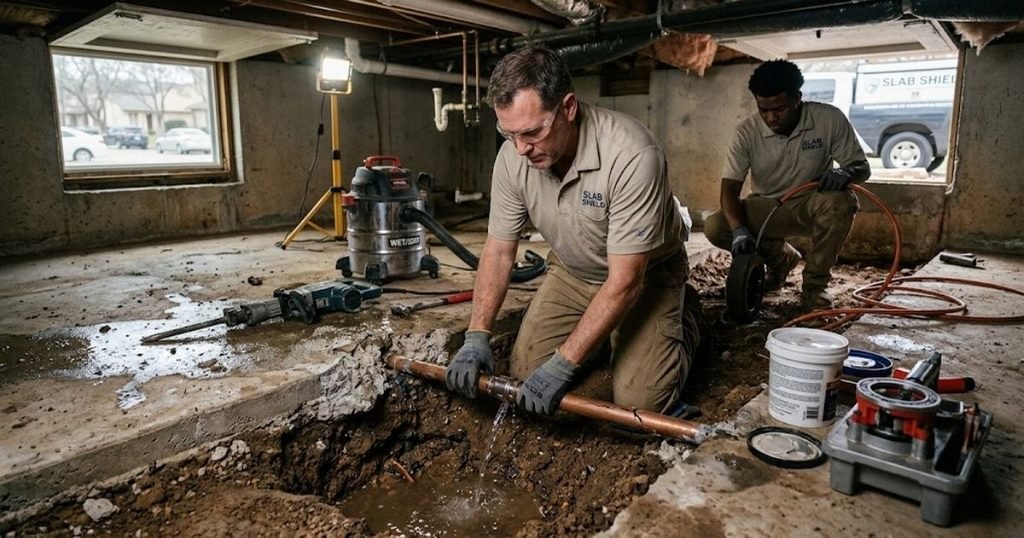
Direct access—commonly referred to as “jackhammering”—involves cutting through flooring, breaking open the concrete slab with a jackhammer, digging down to the damaged section of pipe, replacing or soldering the failed segment, and repatching the concrete.
- When it makes sense: Ideal for newer plumbing systems (under 15 years old) where the surrounding pipe is in excellent condition and the leak is located in an easily accessible, non-finished area (such as a garage, utility room, or bare carpeted floor).
- Pros: Directly addresses the damaged section without altering the rest of the home’s plumbing layout.
- Cons: Highly invasive, noisy, and messy. If the surrounding copper pipe is thin or corroded, fixing one spot may overstress adjacent metal, creating a new leak nearby months later.
- Cost Factor: Does not include replacing custom tile, hardwood, or cabinetry damaged during demolition.
2. Plumbing Reroute / Overhead Bypass ($1,500 – $6,000+)
Rather than breaking through the foundation, a plumber disconnects the damaged subterranean line at both ends, caps it off permanently in the concrete, and installs a brand-new PEX (cross-linked polyethylene) line that routes up through interior walls, across the attic or ceiling space, and back down to the fixture.
- When it makes sense: Preferred for older copper lines, highly finished interior rooms (such as high-end kitchens or custom bathrooms), or homes where breaking concrete risks structural engineering complications.
- Pros: Leaves the concrete slab untouched, eliminates the risk of future leaks on that line beneath the foundation, and is generally less disruptive to daily life.
- Cons: Requires opening drywall or ceiling access points. In multi-story homes or homes with flat roofs/vaulted ceilings, routing pipes can be complex.
- Cost Factor: Drywall repair, texturing, and painting costs are usually handled separately by a drywall contractor unless bundled into the plumber’s estimate.
3. Epoxy Pipe Lining / Trenchless Repair ($2,000 – $7,000)
Epoxy lining (in-place pipe restoration) involves cleaning the interior of the damaged pipe using pressurized air and abrasive media, then blowing a liquid epoxy resin liner through the line. The epoxy cures, creating a smooth, durable “pipe-within-a-pipe.”
- When it makes sense: Best suited for straight runs of drain lines or localized supply lines where opening concrete or tearing up walls is undesirable.
- Pros: Minimally invasive; requires no major concrete demolition or overhead wall chasing.
- Cons: Not suitable for crushed, severely collapsed, or heavily bellied lines. Epoxy lining requires specialized equipment, and improperly applied resin can fail prematurely.
- Cost Factor: Fewer contractors offer true potable-water epoxy lining compared to standard plumbing repairs.
4. Whole-House Repiping ($4,000 – $15,000+)
If an older home experiences a slab leak and inspection reveals advanced pitting corrosion, thin pipe walls, or a history of prior slab leaks, performing a localized spot repair is often a temporary fix. Whole-house repiping involves abandoning all under-slab supply plumbing and replacing the entire home’s distribution system with modern PEX or copper routed through walls and attics.
- When it makes sense: Highly recommended for homes over 40 years old, homes with polybutylene plumbing, or properties that have suffered multiple slab failures.
- Pros: Permanent, comprehensive solution that permanently removes all pressurized water lines from beneath the slab and includes extended warranties.
- Cons: High initial financial investment; requires drywall patching throughout the home.
READ MORE: Cost to Replace Toilet Flange: Price & DIY Guide
Cost to Repair the Concrete Slab and Finish Materials
Homeowners are often surprised to learn that the plumber’s bill covers only the plumbing work. Restoring your home to its pre-leak condition involves secondary trade costs that can equal or exceed the cost of the plumbing fix itself.
Concrete Removal and Patching ($300 – $1,500)
If direct access is chosen, removing a section of concrete slab, replacing the gravel sub-base, adding vapor barrier material, and pouring new high-strength concrete patches typically costs between $300 and $1,500, depending on hole size, slab thickness, and accessibility.
Flooring Restoration ($500 – $5,000+)
Restoring finished flooring over the repaired slab varies widely based on surface material:
- Carpet: $300 – $800 (easiest to pull back and reinstall if un-damaged).
- Luxury Vinyl Plank (LVP) or Laminate: $800 – $2,500.
- Hardwood Flooring: $1,500 – $4,500+ (requires matching, weaving in new planks, sanding, and refinishing).
- Ceramic or Porcelain Tile: $1,000 – $4,000+ (if spare matching tiles are unavailable, the entire room’s floor may require replacement).
Drywall and Surface Finish Repairs ($400 – $2,000)
If pipes were rerouted through interior walls, or if water wicked up drywall baseboards, drywall contractors must patch, tape, mud, texture, and paint affected wall sections.
Factors That Affect Concrete Slab Leak Repair Cost
No two slab leak repairs are identical. The following variables dictate where your final invoice will fall within the national cost spectrum:
- Geographic Location and Local Market Rates: Metropolitan regions with high costs of living (e.g., San Francisco, New York, Seattle) command master plumber rates of $120–$200+ per hour, whereas midwestern or rural markets may range from $75–$125 per hour.
- Accessibility and Depth: A leak located under 4 inches of un-reinforced concrete in an open garage floor is significantly faster to access than a leak buried beneath 8 inches of steel-reinforced structural concrete, radiant heating coils, or a load-bearing wall.
- Location Within the Floorplan: A leak occurring beneath a central kitchen island surrounded by custom cabinetry and granite countertops presents extreme physical access challenges compared to a leak near an perimeter wall.
- Pipe Material: PEX pipe is flexible, fast to install, and requires fewer fittings, keeping labor costs low. Older copper or cast-iron repairs require specialized soldering, brazing, or heavy-duty mechanical couplings.
- Extent of Water Damage and Mold: If a leak went undetected for months, water may have saturated sub-base soil, wicked into structural framing, or caused toxic mold growth requiring professional containment and environmental remediation.
- Permits and Local Municipal Building Codes: Most municipalities require building or plumbing permits for slab alterations or major repiping, adding $100 to $500 in administrative fees and requiring official city inspections.
- Emergency or After-Hours Service: Requesting emergency plumbing dispatches on weekends, holidays, or at 2:00 AM routinely incurs premium trip fees and labor surcharges of 50% to 100% over standard rates.
Labor Cost for Slab Leak Repair
Labor typically represents 50% to 70% of the total plumbing invoice on a slab leak project due to the specialized skills and heavy equipment required.
Because slab leak resolution spans multiple trades, homeowners may see separate labor rates on an itemized estimate:
- Plumbing Diagnostics & Repair: Licensed Journeyman or Master Plumbers ($75–$200/hr).
- Concrete Demolition & Masonry: Demolition laborers ($45–$85/hr).
- Restoration & Surface Trades: Tile setters, floor installers, and drywall specialists ($50–$100/hr).
Does Homeowners Insurance Cover Slab Leak Repair?
Insurance coverage for slab leaks is one of the most misunderstood aspects of home maintenance. Coverage depends entirely on your specific policy language, but standard homeowners policies (such as HO-3 policies) generally follow these principles:
The “Tear-Out and Water Damage” Rule
Most standard policies differentiate between the cause of the loss (the failed pipe) and the resulting damage:
- The Pipe Repair Itself: Insurance policy language often excludes coverage for the actual plumbing repair (e.g., a $50 copper fitting or pipe section). This is considered routine home maintenance.
- Tear-Out and Access: Most policies do cover the cost of tearing out the slab or opening walls to access the leaking pipe, provided the leak was “sudden and accidental.”
- Resulting Water Damage: Structural drying, damaged flooring replacement, baseboard restoration, and drywall repair caused by escaping water are typically covered, subject to your policy deductible.
Critical Insurance Exceptions
- Gradual vs. Sudden: If an insurance adjuster determines that a leak went unaddressed for months despite visible warning signs, the claim may be denied on the grounds of negligence or lack of maintenance.
- Regional Water Damage Endorsements: Some modern policies require specific optional policy endorsements for under-slab water coverage or mold remediation caps.
- Sewer and Drain Backups: Drain-line leaks beneath a slab often require an additional “Sewer and Drain Backup” rider for full coverage.
Recommendation: Contact your insurance agent immediately upon discovering a suspected slab leak. Take extensive photographs and videos of diagnostic readings, water levels, and floor removal before permanent repairs begin.
How Much Does It Cost to Reroute Plumbing for a Slab Leak?
Rerouting plumbing is frequently recommended over direct slab access. Nationally, plumbing reroutes for slab leaks average $1,500 to $6,000, with complex multi-fixture reroutes reaching $8,000+.
Advantages of Rerouting
- Eliminates Subterranean Risk: Permanently removes the pressurized line from beneath the foundation, ensuring that specific run can never leak under your slab again.
- Preserves Structural Slab: Avoids jackhammering heavy reinforced concrete, preserving foundation integrity.
- Faster Plumbing Execution: Experienced plumbers can often pull continuous, flexible PEX tubing through attics and interior wall cavities in a single day.
Disadvantages of Rerouting
- Secondary Wall Damage: Requires cutting access holes in sheetrock or ceilings at turn points.
- Attic Insulation Considerations: In freezing northern climates, pipes routed through unconditioned attic spaces must be heavily insulated to prevent winter freeze-ups.
Slab Leak Repair vs. Whole-House Repiping
When facing a slab leak on an older system, homeowners must choose between fixing the immediate leak or replacing the entire plumbing network:
| Comparison Factor | Isolated Slab Leak Repair / Reroute | Whole-House Repiping |
| Typical Cost Scope | $1,500 – $4,500 | $4,000 – $15,000+ |
| Project Timeframe | 1 to 2 Days | 3 to 7 Days |
| Concrete Disruption | Minimal (if rerouted) to localized | None (all new lines routed overhead/in walls) |
| Long-Term Risk | Medium; remaining under-slab lines may fail later | Low; completely removes under-slab pressure lines |
| Best Suited For | Homes under 20 years old with isolated pipe damage | Older homes (30+ years) with recurring pinhole leaks |
| Warranty Coverage | Typically 1-year warranty on patched section | Up to 10–25 year warranty on entire piping system |
Can You Repair a Slab Leak Without Breaking Concrete?
Yes. Modern plumbing technology offers non-destructive alternatives to breaking concrete slabs:
- Overhead PEX Rerouting: As detailed above, rerouting completely bypasses the concrete floor by installing flexible PEX piping through walls and attics.
- Epoxy Pipe Lining (In-Place Restoration): Epoxy resin can coat the interior of select copper or drain lines, sealing pinholes without excavation.
- Directional Boring / Tunneling: In select scenarios such as a leak near an exterior footing, plumbers can excavate a trench outside the foundation and tunnel underneath the slab horizontally to repair the pipe from below without cutting interior floors. Tunneling costs between $150 and $300 per linear foot.
Note: If a pipe is crushed, severely buckled, or located deep in a complex central layout where rerouting is physically impossible, direct slab access may remain the only viable option.
What Happens If You Ignore a Slab Leak?
Ignoring a suspected slab leak to avoid repair costs almost always results in far greater financial loss over time:
- Foundation Settlement and Structural Damage: Continuous water discharge under concrete washes away supporting soil or causes expansive clay to lift the foundation unevenly (“heaving”). Repairing a damaged foundation with steel piers or mudjacking costs between $5,000 and $25,000+.
- Black Mold Growth: Water migrating through porous concrete into interior subfloors, carpets, and drywall creates an environment for mold growth within 24 to 48 hours, posing health risks and requiring costly abatement.
- Escalating Water & Energy Bills: A pressurized hot water slab leak forces your water heater to run continuously, resulting in hundreds of dollars in wasted utility charges every month.
How to Save Money on Slab Leak Repair
While slab leak repairs are significant investments, you can take practical steps to control costs:
- Act Promptly: At the first sign of a leak, shut off your main water valve (or hot water heater supply valve for hot-line leaks) to prevent ongoing soil erosion and water damage.
- Hire an Independent Leak Detection Specialist: Consider hiring a dedicated leak detection firm to pinpoint the leak before bringing in repair plumbers. A precise location prevents unnecessary demolition.
- Obtain Itemized, Written Estimates: Ensure quotes clearly delineate leak detection, plumbing labor, concrete patching, drywall repair, and floor restoration.
- Compare Reroute vs. Direct Access Quotes: Ask contractors to bid both an overhead reroute and a direct slab repair to determine which approach offers better value for your home’s layout.
- Coordinate Trades Independently: Plumbers often sub-contract drywall and flooring restoration at a markup. Hiring your own drywall patcher or flooring contractor directly can save 15% to 25% on non-plumbing work.
- Review Insurance Coverage Proactively: File claims quickly, document all damage thoroughly with photos, and work with contractors experienced in insurance billing protocols.
- Avoid Cheap Unlicensed Labor: Foundation alterations and pressurized plumbing lines require licensed, insured master plumbers. Substandard work can compromise foundation integrity or lead to catastrophic secondary floods.
Questions to Ask a Slab Leak Repair Professional
Before signing a contract, ask prospective plumbing contractors these key questions:
- [ ] Are you licensed, bonded, and insured specifically for under-slab and structural plumbing work?
- [ ] How did you confirm the exact location of the leak, and what diagnostic tools were used?
- [ ] Is the diagnostic leak detection fee credited toward the total cost if I hire you for the repair?
- [ ] Will you be opening the slab, rerouting overhead, or lining the pipe, and why is that method best for my home?
- [ ] Does your estimate cover concrete repatching, drywall repair, and flooring restoration, or only the plumbing fix?
- [ ] Will this project require a municipal plumbing permit and official inspection?
- [ ] What written warranty do you provide on parts and labor for this repair?
- [ ] Will you provide itemized documentation and photos for my homeowners insurance claim?
Frequently Asked Questions
How much does it cost to repair a concrete slab leak?
Standard plumbing repairs for a concrete slab leak nationally cost between $630 and $4,400, with most homeowners paying approximately $2,300. However, total out-of-pocket project costs depend heavily on the chosen repair method. If the job requires concrete demolition, extensive flooring replacement, drywall repairs, or water damage remediation, total expenses routinely range from $3,000 to $10,000+.
Does homeowners insurance cover slab leak repair?
Most standard homeowners insurance policies cover the tear-out costs required to access the pipe (such as jackhammering concrete or opening walls) and the resulting water damage to flooring, baseboards, and walls, provided the leak was sudden and accidental. However, policies typically exclude coverage for the physical plumbing pipe repair itself, treating it as routine maintenance.
Can a slab leak be repaired without breaking concrete?
Yes. Plumbers frequently resolve slab leaks without touching the concrete foundation by performing an overhead plumbing reroute. This involves capping off the leaking under-slab pipe and routing a new flexible PEX supply line through interior walls, ceilings, or attic spaces. In select drain or sewer scenarios, trenchless epoxy pipe lining can also seal pipe interiors without excavation.
How long does it take to repair a slab leak?
An isolated plumbing repair or simple overhead reroute usually takes 1 to 2 days to complete once leak detection is finished. However, if the project involves concrete demolition, structural drying, mold remediation, concrete curing, drywall patching, and custom flooring reinstallation, the entire restoration process can take 5 to 10 business days across multiple trade specialists.
What are the earliest warning signs of a slab leak?
The earliest indicators of a slab leak include an unexplained increase in your monthly water bill, the sound of rushing or hissing water when all faucets are turned off, warm spots on ground-level floors, a water meter dial that spins continuously, damp carpet or discolored tile grout, persistent low water pressure, or musty odors along interior baseboards.
Final Takeaway
A concrete slab leak can be a stressful and costly home repair, but identifying the problem early prevents major structural damage and keeps costs manageable. Total expenses vary widely depending on whether your home requires a spot repair, an overhead PEX reroute, or a complete system repipe.
When faced with a suspected leak, avoid rushing into invasive slab demolition without a precise diagnosis. Hire a qualified, licensed plumbing professional to perform non-invasive electronic leak detection, obtain itemized quotes for both rerouting and direct access options, and consult your homeowners insurance provider promptly to understand your coverage.

