When a heat pump quits in the middle of a cold snap, or starts blowing cold air when it should be heating, panic can set in fast. The house gets uncomfortable. Sleep gets harder. And every minute feels longer than it should.
That is exactly why emergency heat pump repair matters. A heat pump is not just another appliance. It helps keep your home livable in both heating and cooling seasons. When it fails during extreme weather, you may need help right away, not next week.
The good news is that many heat pump repair signs are easy to spot early, and a few safe checks can help you avoid a bigger bill before a technician arrives. Heat pumps also respond well to regular care, especially clean filters and clear outdoor units. Lets deep dive into “Emergency Heat Pump Repair: Signs, Costs & What to Do”
READ MORE: Heat Pump Service Cost: 2026 Pricing Guide for U.S. Homeowners
What Counts as a Heat Pump Emergency?
Not every weird noise or minor performance dip requires an emergency service call. Most HVAC companies charge a premium for “after-hours” or “emergency” visits, so you want to be sure it is truly urgent before you pull the trigger.
So, what constitutes a real emergency?
- No Heat During a Deep Freeze: If the outdoor temperature is below freezing and your heat pump stops working entirely, your pipes are at risk of bursting, and your family is at risk of hypothermia. This is a primary emergency.
- Electrical Smells or Smoke: If you smell something burning like ozone, melting plastic, or “dirty socks” combined with smoke turn the system off at the breaker immediately. This is a fire hazard.
- Total Loss of Cooling in Extreme Heat: For elderly residents, young children, or those with certain medical conditions, a house that reaches 90+ degrees indoors is a health hazard.
- Rapidly Rising Indoor Temperatures: If your system is running but the temp is climbing (or falling) fast, the system has likely suffered a major component failure.
- Grinding or Screeching Noises: Metal-on-metal sounds usually mean a motor bearing has failed or a fan blade is loose. Running the system in this state can cause “collateral damage” to other expensive parts.
Signs You Need Immediate Help
If you notice any of the following heat pump repair signs, you should start looking for emergency HVAC service right away.
- No heating or cooling: The system simply won’t kick on, regardless of how you adjust the thermostat.
- Blowing cold air in heating mode: If your heat pump not heating is the main issue, it might be stuck in its cooling cycle or have a refrigerant problem.
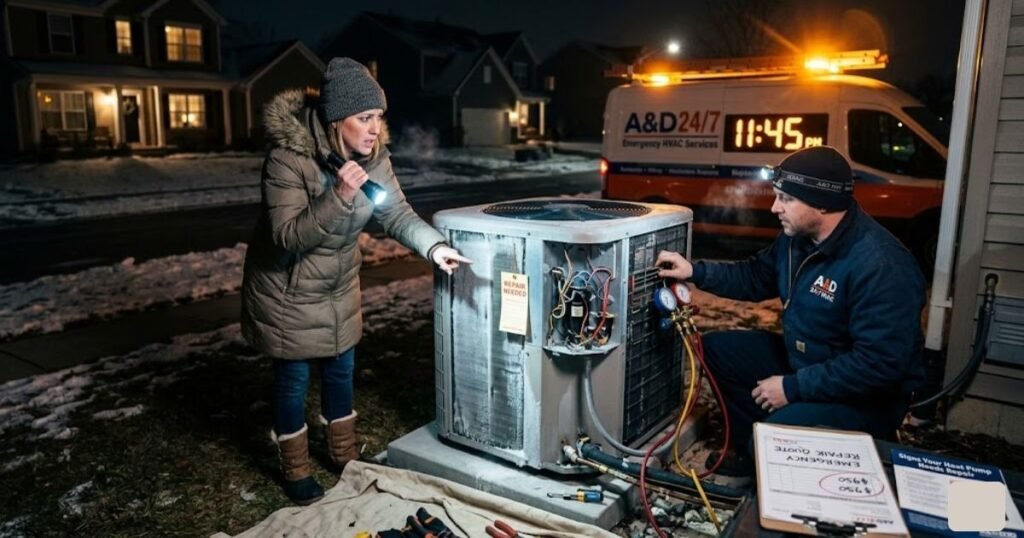
- Ice buildup on the outdoor unit: While a little frost is normal during a defrost cycle, a solid block of ice indicates a serious malfunction.
- Breaker keeps tripping: If you flip the switch at the electrical panel and it clicks back off immediately, do not force it. There is a short circuit somewhere.
- Strange sounds: Rattling, banging, or high-pitched whistling are all “cries for help” from your compressor or blower motor.
- Burning smell: This often indicates an electrical component is frying or the motor is overheating.
- System short-cycling: This is when the heat pump turns on and off every few minutes without ever reaching the desired temperature. It puts massive strain on the compressor.
- Emergency heat running too often: If your “Auxiliary Heat” or “Emergency Heat” light stays on for days, your heat pump isn’t doing its job, and your electric bill is about to skyrocket.
READ MORE: Heating and Air Conditioning Service Near Me: A Homeowner’s Guide
What Homeowners Should Check First
Before you search for “heat pump repair near me” and pay for a service call, perform these basic heat pump troubleshooting steps. You might find a simple fix that saves you the cost of a technician’s visit.
1. Check the Thermostat Setting
It sounds silly, but check it anyway. Make sure it is set to “Heat” (or “Cool”) and that the “Fan” is set to “Auto” rather than “On.” If the screen is blank, replace the batteries. A dead battery in a thermostat is one of the most common “false emergencies.”
2. Inspect the Breaker Panel
Go to your home’s main electrical panel. Look for the circuit labeled “HVAC” or “Heat Pump.” If it has tripped to the middle position, flip it all the way to “Off” and then back to “On.” If it trips again immediately, stop and call a pro.
3. Change the Air Filter
A clogged air filter is the number one cause of heat pump failure. If the filter is caked in dust, it restricts airflow. This can cause the indoor coils to freeze or the system to overheat and shut down as a safety precaution.
4. Clear the Outdoor Unit
In the winter, snow, ice, or fallen leaves can block the outdoor unit. In the summer, tall grass or weeds can do the same. Make sure there is at least two feet of clear space around the entire unit so it can “breathe.”
5. Check the Power Supply
Ensure the outdoor disconnect switch (the small box usually mounted on the wall near the unit) hasn’t been accidentally flipped off.
6. Verify the Emergency Heat Setting
If the outdoor unit is frozen or broken, you can manually switch your thermostat to “Emergency Heat.” This uses electric heat strips to warm your home. It is very expensive to run, but it will keep you warm until a technician arrives.
READ MORE: Why My Tankless Water Heater Shuts Off During Shower — Fixes & Costs
Common Causes of Emergency Heat Pump Failure
Why do these systems fail when we need them most? Usually, it’s because extreme weather pushes an aging or unmaintained component past its breaking point.
- Refrigerant Leak: Heat pumps don’t “use up” refrigerant like a car uses gas. If the level is low, there is a leak. Low refrigerant prevents the system from absorbing or releasing heat properly.
- Failed Capacitor: This small, cylindrical part acts like a battery to give the motors a “kick start.” They are notorious for failing during heatwaves.
- Blower Motor Problems: If the outdoor unit is humming but no air is coming out of your vents, the indoor blower motor has likely burned out.
- Reversing Valve Issues: This is the part that allows the heat pump to switch between heating and cooling. If it gets stuck, you might get AC in the middle of December.
- Dirty Coils: Dirt on the outdoor condenser coils or indoor evaporator coils acts like an unwanted blanket, preventing heat transfer and forcing the system to work twice as hard.
- Electrical Problems: Corroded wires, burnt contactors, or loose connections can shut the whole system down in an instant.
- Defrost Cycle Malfunction: Heat pumps naturally freeze up in winter and have a “defrost mode” to melt the ice. If the defrost board or sensor fails, the unit will become encased in ice.
What Emergency Heat Pump Repair Usually Costs
When you call for help outside of normal business hours, you should expect to pay a bit more for the convenience of immediate service.
A standard heat pump repair commonly averages about $161 to $660, with many homeowners paying around $409. However, these figures can fluctuate based on the specific part that failed and the time of day you call.
Typical Cost Breakdown:
- Standard Service Call Fee: Most HVAC companies charge between $70 and $200 just to show up and diagnose the problem.
- Emergency Surcharge: For calls made at night, on weekends, or during major holidays, companies often add an extra charge of $100+ on top of the standard diagnostic fee.
- Labor Rates: Emergency labor is often billed at “time and a half” or “double time,” meaning you could pay $150 to $300 per hour for the technician’s time.
Common Part Replacement Costs:
- Capacitor: $100 – $250
- Contactors: $150 – $300
- Thermostat: $150 – $500
- Reversing Valve: $500 – $1,200
- Blower Motor: $400 – $900
- Circuit Board: $300 – $700
- Compressor (The “Heart”): $1,500 – $3,500 (Often leads to system replacement)
Keep in mind that emergency heat pump repair cost is usually higher than a scheduled repair because of the immediate dispatch requirements. If you can wait until Monday morning, you might save $100 to $200 in fees.
READ MORE: Why Is My Water Heater Temperature Fluctuating? Causes & Fixes
Repair vs. Replacement: Making the Right Choice
When the technician hands you a quote for a $1,200 repair, you have to ask yourself: Is this worth it?
When Repair Makes Sense:
- The system is under 10 years old: Most heat pumps have a 10-year warranty on major parts. If you are still covered, repair is almost always the winner.
- The fix is minor: If it’s just a capacitor, a fan motor, or a clogged drain line, pay for the repair and keep moving.
- You plan on moving soon: If you aren’t staying in the home for more than a year or two, a repair is a more budget-friendly way to keep the lights on.
When Replacement is the Smarter Move:
- The “5,000 Rule”: Multiply the age of the unit by the cost of the repair. If the total is more than $5,000, replace it. (e.g., a 12-year-old unit needing a $600 repair = $7,200. Replace it!)
- The Compressor Failed: This is the most expensive part of the system. If the compressor goes on an out-of-warranty unit, it’s rarely worth fixing.
- Frequent Breakdowns: If you have called for emergency heat pump repair three times in the last two years, the system is telling you it’s tired.
- High Energy Bills: Modern heat pumps are significantly more efficient than those made 15 years ago. A new system could pay for itself in energy savings over several years.
How to Reduce the Risk of Another Heat Pump Emergency
The best way to handle an emergency is to prevent it from happening in the first place. Heat pumps are mechanical systems; they need attention to stay reliable.
- Replace filters regularly: Mark your calendar. Every 30 to 90 days, put in a fresh filter. This is the single best thing you can do for your HVAC system.
- Schedule seasonal maintenance: Have a pro look at your system twice a year once in the spring for the AC and once in the fall for the heat. They can often catch a failing capacitor or a small leak before it becomes a midnight emergency.
- Keep the outdoor unit clear: Don’t let bushes grow against it. Don’t stack firewood next to it. Clear off snow after a storm.
- Listen for unusual sounds: If you hear a new squeak or rattle, call for a standard service appointment. Ignoring a small noise today leads to a big repair bill tomorrow.
- Do not ignore small performance issues: If one room feels slightly warmer than the others, or the system seems to be running longer than usual, get it checked.
READ MORE: Trane Heat Pump Review 2026 — Comparison, Pros, Cons & Costs
What to Ask the HVAC Technician
When the technician arrives at your door, don’t just hand them the keys and walk away. Be an informed consumer by asking these questions:
- What exactly caused the failure? (Was it wear and tear, or a lack of maintenance?)
- Is this an urgent safety issue? (Are there electrical risks or refrigerant leaks?)
- Is the repair temporary or long-term? (Is this a “band-aid” fix to get through the night, or a permanent solution?)
- What is the full cost before work begins? (Ask for a written estimate including parts, labor, and fees.)
- Is the part under warranty? (Many homeowners pay for parts that were actually covered by the manufacturer.)
- Do you offer a guarantee on this repair? (Most reputable companies offer at least a 30- to 90-day warranty on their work.)
Conclusion
Facing a broken heat pump in the middle of extreme weather is stressful, but you don’t have to navigate it blindly. By understanding the signs of failure, performing basic checks yourself, and knowing what fair pricing looks like, you can take control of the situation.
Remember, emergency heat pump repair is about more than just comfort it’s about protecting your home and your family. If you see ice building up, smell smoke, or realize your home’s temperature is dropping fast, don’t wait. Make the call, ask the right questions, and get your home back to the sanctuary it’s supposed to be.
Frequently Asked Questions
How much does emergency heat pump repair cost?
A typical repair usually costs between $161 and $660, with an average of $409. However, for emergency or after-hours service, you should expect to pay a diagnostic fee ranging from $70 to $200, plus an additional emergency surcharge of $100 or more. Total costs depend on which specific parts failed and the local labor rates in your area.
What should I do if my heat pump stops working at night?
First, check your thermostat batteries and the circuit breaker. Ensure your air filter isn’t clogged and the outdoor unit isn’t blocked by snow or debris. If the temperature is dropping dangerously low, switch your thermostat to “Emergency Heat” (Aux Heat) and call an HVAC professional for emergency service to prevent frozen pipes or health risks.
Why is my heat pump blowing cold air in heat mode?
This is a common issue that could mean several things. Your system might be in its “defrost cycle,” which temporarily blows cold air while melting ice off the outdoor unit. However, if it continues for long periods, you may have a stuck reversing valve, low refrigerant levels, or a failed compressor that requires professional repair.
Is it safe to keep running a broken heat pump?
It depends on the symptom. If the system is making loud grinding noises, smelling like smoke, or tripping the breaker, you should shut it off immediately at the electrical panel. Running a damaged system can cause “collateral damage,” leading to much more expensive repairs or even an electrical fire.
When should I repair or replace my heat pump?
If your system is less than 10 years old and the repair is minor, fixing it is usually the best move. However, if the unit is over 12–15 years old, requires frequent repairs, or has a failed compressor, replacing it with a more energy-efficient modern model is often the smarter, more cost-effective long-term investment.