Investing in a central home cooling system is one of the most significant financial choices a property owner will make. When your existing system begins to short-cycle, leak, or cause your electric bills to climb, finding a brand that balances upfront affordability with long-term reliability becomes an immediate priority.
Among the leading options in the United States HVAC market, York has established a distinct position. Known for manufacturing rugged, American-assembled systems, York is a brand that frequently appears on the shortlists of budget-conscious homeowners and premium buyers alike.
This guide provides an exhaustive review of York air conditioners. We will break down their history, product lines, specific top-performing models, real-world installation costs, and proprietary technologies. We will also compare York directly to its major industry competitors to help you determine if a York system is the right fit for your home. Lets deep dive into “York Air Conditioner Review, Comparison & Buying Guide”
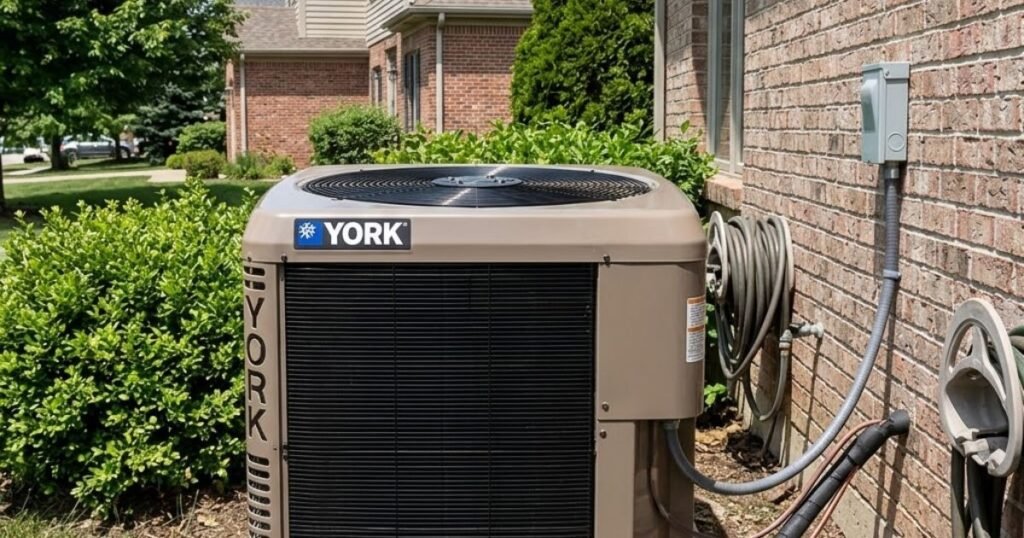
What Is York?
York is an absolute veteran of the American manufacturing landscape. Founded in 1874 in York, Pennsylvania, the company began as a manufacturer of ice-making machines before pioneering commercial refrigeration and air conditioning systems. Over its long history, York systems have cooled iconic structures ranging from the U.S. Capitol building to the Empire State Building.
In 2005, York was acquired by Johnson Controls (JCI), a global leader in smart buildings and operational technology. Today, York’s residential HVAC systems are designed, engineered, and assembled in North America, with a primary state-of-the-art manufacturing hub located in Wichita, Kansas.
Within the modern residential cooling industry, York is positioned as a high-value contender. It sits comfortably between entry-level budget brands and hyper-premium options, offering advanced engineering such as variable-speed inverter compressors and microchannel coils at prices that are often more competitive than its direct rivals.
READ MORE: Ultra Quietest Heat Pump for Your Home: Review, Comparison & Cost
Why Homeowners Choose York Air Conditioners
York cooling systems are a popular choice for residential HVAC replacements for several specific reasons:
- Exceptional Price-to-Performance Ratio: York systems consistently deliver efficiency ratings and technological features that match premium brands, but at a lower upfront equipment cost.
- Intensive Testing Protocols: York subjects its outdoor units to more than 250,000 hours of rigorous field and laboratory testing, including extreme weather simulations, to ensure structural and mechanical longevity.
- QuietDrive™ Technology: York prioritizes acoustic comfort by utilizing sound-dampening swept-wing fan blades, isolated compressor compartments, and composite base pans to lower outdoor noise levels.
- Space-Efficient Footprints: Many York models feature a compact cabinet design, making them an excellent solution for tight property lines, zero-lot-line residential developments, or compact utility pads.
- Strong Factory Support: When installed by certified contractors, premium York models carry some of the most comprehensive component warranties in the industry.
York Air Conditioner Product Line Overview
York organizes its residential air conditioning portfolio into structured series tiers, making it straightforward to match a system to your specific budget and climate goals.
The Affinity™ Series
This is York’s flagship premium tier. The Affinity series showcases the pinnacle of their engineering, offering variable-speed or advanced multi-stage compressors. These units are designed for homeowners who live in hot, humid climates where maximum energy efficiency and precise indoor humidity extraction are required. They feature the highest seasonal efficiency ratings and are compatible with smart, communicating thermostats.
The LX Series
The LX series represents York’s core mid-range workhorse lineup. These systems are optimized to provide an ideal balance of upfront affordability and reliable operational efficiency. Consisting primarily of single-stage and select two-stage models, the LX series is ideal for standard replacements where the homeowner wants an uncomplicated, durable system without paying a premium for advanced automation features.
The YXT and Value Tiers
Bridging specific design metrics across the product lines, these models focus on regional compliance and specific configuration needs. They include highly specialized configurations, such as space-saving side-discharge units designed for high-density neighborhoods, townhouse installations, or coastal locations subject to strict clearance codes.
READ MORE: Best 10,000 BTU Portable Air Conditioner: Reviews & Comparison
5 Best York Air Conditioners Reviewed
To understand how these systems perform in a residential setting, let’s examine five of the most widely installed York air conditioner models on the market today.
1. York Affinity™ YXV Variable Capacity Air Conditioner
The YXV stands as York’s top-tier, ultra-efficient flagship model. It represents the very best of their modern residential cooling design.
- Best For: Homeowners in extreme heat zones seeking maximum utility savings and precise, automated indoor climate control.
- SEER2 Rating: Up to 20 SEER2 (equivalent to older 21 SEER metrics).
- Compressor Type: Inverter-driven Variable-Capacity.
- Noise Level: As low as 53 dBA (roughly equivalent to a quiet conversation or a modern dishwasher).
- Main Features: Energy Star Most Efficient designation, Climate Set™ adaptive environmental tuning, Charge Assurance™ integrated monitoring for faster servicing, and built-in compatibility with the Hx™3 communicating thermostat system.
Pros & Cons
- Pros: Incredible energy bill reductions; nearly silent operation at low capacities; unparalleled indoor humidity removal.
- Cons: High initial capital investment; requires a proprietary communicating thermostat to unlock its full efficiency features.
Homeowner Recommendation: If you plan to stay in your home long-term and experience long, intensely hot summers, the YXV offers the highest performance and the most luxurious indoor comfort experience York provides.
2. York Affinity™ YV9S Variable-Speed Air Conditioner
The YV9S acts as an ultra-premium comfort companion system within York’s elite tier, designed to blend multi-stage flexibility with robust variable-speed modulation.
- Best For: Properties requiring advanced zoning capabilities and homeowners focused on eliminating indoor temperature swings.
- SEER2 Rating: Up to 19 SEER / 18 SEER2 class performance.
- Compressor Type: Modulating Variable-Speed Scroll.
- Noise Level: As low as 56 dBA.
- Main Features: Modulating capacity that adjusts in small, precise increments; heavy-duty automotive-grade powder coat finish; advanced system self-diagnostics to simplify technician troubleshooting.
Pros & Cons
- Pros: Outstanding continuous air filtration due to constant, low-speed operation; minimizes energy spikes; excellent structural cabinet protection.
- Cons: Demands precision installation; premium pricing compared to standard LX models.
Homeowner Recommendation: Excellent for multi-story homes or properties that suffer from stubborn hot and cold spots. The modulating design ensures continuous, gentle airflow that balances temperature variations across different rooms.
READ MORE: Best Ductless Mini Split Air Conditioner: Review, Comparison, Cost & Buying Guide
3. York Affinity™ YCG Air Conditioner
The YCG bridges the gap between premium design characteristics and straightforward mechanical operation.
- Best For: Homeowners wanting premium component construction and high efficiency without the complexity of a variable-speed compressor.
- SEER2 Rating: Up to 17.6 SEER2 (18.5 SEER legacy equivalent).
- Compressor Type: High-Efficiency Single-Stage.
- Noise Level: As low as 70 dBA.
- Main Features: Energy Star certified performance, advanced MicroChannel coil engineering, compact physical cabinet footprint, and robust steel-extruded louver coil guards.
Pros & Cons
- Pros: Lower electronic complexity means long-term repair costs are generally more affordable; eligible for localized utility rebates; highly compact footprint.
- Cons: As a single-stage unit, it runs at 100% capacity whenever it turns on, which provides less dehumidification than variable models.
Homeowner Recommendation: This is an outstanding option for property owners who want an energy-efficient, durable air conditioner but prefer the straightforward reliability and easier servicing of a traditional single-stage platform.
4. York LX Series YCS Air Conditioner
The YCS is a mid-tier, budget-focused single-stage cooling system engineered for reliable everyday operation.
- Best For: Budget-conscious buyers or landlords seeking a dependable system from a major manufacturer without a steep upfront price tag.
- SEER2 Rating: Evaluated at 16.75 SEER (approx. 15.2 SEER2 depending on matching air handler configuration).
- Compressor Type: Single-Stage Scroll.
- Noise Level: 70 to 76 dBA.
- Main Features: Rigid steel cabinet build, high-grade ball-bearing fan motors engineered for high ambient outdoor temperatures, and an accessible swing-out control box for swift diagnostic access.
Pros & Cons
- Pros: Highly economical purchase price; uncomplicated, widely available parts make out-of-warranty servicing simple for any certified technician.
- Cons: Not Energy Star certified; noticeably louder outdoor operational noise profile when running at peak load.
Homeowner Recommendation: The YCS is a practical, no-frills choice for moderate climates or properties where the air conditioner is not required to run continuously for months at a time.
READ MORE: Small Room Window Air Conditioner: Best 2026 Picks, Comparison, & Buying Guide
5. York LX Series YC2F Air Conditioner
The YC2F is an entry-level regional workhorse that delivers modern energy efficiency standards at an accessible price.
- Best For: Standard residential upgrades where meeting regional baseline efficiency regulations and securing local utility rebates is important.
- SEER2 Rating: 15.2 SEER2 (Up to 17.5 legacy SEER tiering).
- Compressor Type: Single-Stage Scroll (upgrades to an efficient Two-Stage compressor system on larger 3.5 to 5-ton capacities).
- Noise Level: As low as 72 dBA.
- Main Features: Full Energy Star certification compliance, specialized alloy MicroChannel coils, and an aerodynamic swept-wing fan blade design.
Pros & Cons
- Pros: Highly cost-effective; multi-stage options available on larger tonnage sizes; complies fully with modern Department of Energy regulatory minimums.
- Cons: Moderate sound levels can be noticeable if installed directly outside bedroom windows or active patios.
Homeowner Recommendation: This model represents one of the best overall values in the entire York portfolio for the average homeowner facing an unexpected HVAC replacement.
York Air Conditioner Comparison Table
| Model Name | Series | Max SEER2 Rating | Compressor Type | Noise Level (dBA) | Best For | Warranty (Registered) |
| Affinity YXV | Affinity | Up to 20.0 SEER2 | Variable-Capacity | 53 – 74 dBA | Ultimate Climate Precision | Lifetime Compressor / 10-Yr Parts |
| Affinity YV9S | Affinity | Up to 18.0 SEER2 | Variable Modulation | 56 – 75 dBA | Multi-Zone Home Comfort | Lifetime Compressor / 10-Yr Parts |
| Affinity YCG | Affinity | Up to 17.6 SEER2 | Single-Stage | 70 – 75 dBA | High-Efficiency Simplicity | 10-Yr Compressor / 10-Yr Parts |
| LX Series YCS | LX Series | Approx 15.2 SEER2 | Single-Stage | 70 – 76 dBA | Budget Replacements | 10-Yr Compressor / 10-Yr Parts |
| LX Series YC2F | LX Series | Up to 15.2 SEER2 | Single or Two-Stage | 72 – 76 dBA | Rebate Optimization | 10-Yr Compressor / 10-Yr Parts |
Value Class Breakdown
- Best overall value: YC2F. It gives you a strong blend of efficiency, noise control, and warranty without jumping all the way to premium pricing.
- Best energy efficiency: YXV. YORK positions it as the most advanced, most efficient model in the lineup.
- Best budget choice: YC2D. It is the lowest price tier in the current YORK lineup.
- Best for large homes: YXV, especially when paired with proper sizing and a matching indoor system.
- Best premium model: YXV. If you want the flagship YORK experience, that is the one.
READ MORE: Solar Powered Heat Pump Cost: USA Homeowner Guide to Savings
York Air Conditioner Feature Explained
Variable-Speed Technology:
YORK uses variable-capacity or two-stage technology in its higher models so the system can run at different output levels instead of just blasting on and off. That usually means steadier temperatures, better humidity control, and less noise.
Smart Thermostat Compatibility:
YORK says YXV and YXT can pair with Hx and Hx3 thermostats for communicating control. That matters if you want better scheduling, zoning, and remote-style comfort management.
Energy Efficiency:
YORK explains that SEER2 measures air conditioner cooling efficiency, and higher numbers mean better efficiency. In other words, a higher-SEER2 unit usually costs more upfront but may cost less to run.
QuietDrive Technology:
YORK uses QuietDrive on premium models to reduce vibration and sound through design details like the swept-wing fan and composite base. That is why the best models advertise very low dBA ratings.
Climate Set Controls:
YORK says Climate Set fine-tunes the system to indoor and outdoor conditions for better efficiency and comfort. For homeowners, that means a better chance of consistent cooling instead of big swings.
Advanced Coil Design:
YORK’s product pages and legacy literature emphasize microchannel coil technology and compact cabinet design in several models. That helps with installation flexibility and footprint size.
York Air Conditioner Installation Cost
When planning an air conditioning replacement, it is important to know that the physical equipment typically accounts for only one-third of the total invoice. The remainder of the investment covers professional labor, permits, system configuration, and specialized installation materials.
| System Profile | Typical Installed Price Range (U.S. National Averages) |
| Basic Entry Tiers (LX Series / Single-Stage) | $4,000 – $6,500 |
| Mid-Range Workhorses (Advanced LX / Two-Stage) | $5,000 – $8,500 |
| Premium High-Efficiency Systems (Affinity / Variable-Speed) | $7,500 – $12,500+ |
Primary Factors Driving Installation Costs
- System Capacity (Tonnage): “Tonnage” measures an air conditioner’s ability to remove heat from a structure, not its physical weight. A 5-ton system designed for a large home requires larger internal lines, a larger outdoor footprint, and more refrigerant than a 2-ton system for a smaller cottage, which increases the equipment cost.
- Existing Ductwork Structural Integrity: A high-efficiency modern air conditioner cannot perform correctly if connected to leaky, undersized, or collapsing ductwork. If your contractor needs to seal, insulate, or modify your existing ducts, it can add $1,500 to $4,500 to your total project cost.
- Regional Labor & Code Variations: Regulatory burdens, electrical permit fees, and labor rates vary significantly across the country. An installation in an expensive urban area or a coastal region with strict wind-tie down codes will naturally cost more than a straightforward installation in a rural area.
READ MORE: Best Swimming Pool Heat Pump 2026: Review, Comparison, and Buying Tips
York Air Conditioner Energy Efficiency & SEER2
In recent years, the U.S. Department of Energy updated its cooling efficiency metrics from standard SEER to SEER2 (Seasonal Energy Efficiency Ratio 2). This newer testing standard uses higher external static pressures to better replicate the real-world conditions of a typical residential duct system.
Old SEER Standard: Tested under idealized, low-resistance lab conditions.
New SEER2 Standard: Tested under realistic, high-resistance residential duct pressures.
Investing in a higher SEER2 rating reduces your monthly electric bill. To put this in perspective, let’s look at a typical cost-benefit analysis for an average 2,000-square-foot home in a warm climate zone:
- Replacing a failing 10-SEER legacy system with a new 15.2 SEER2 unit can reduce your cooling-related electricity consumption by roughly 30% to 35%.
- Upgrading to a 20-SEER2 variable-capacity model can slash that energy consumption by up to 50% or more.
Over a standard 15-year operational lifespan, those monthly utility savings can add up to thousands of dollars, helping to offset the higher upfront cost of a premium system.
York Air Conditioner Warranty Analysis
York provides competitive warranty protection, but unlocking its full benefits requires adhering to strict registration timelines.
- Base Warranty: If you fail to register your new equipment within 90 days of installation, York provides a standard 5-year limited parts warranty and a 5-year compressor warranty.
- Registered Extended Warranty: When registered online within the 90-day window, York upgrades the coverage to a 10-year limited parts warranty and a 10-year compressor warranty across the LX product line.
- Elite Flagship Protection: For premium Affinity Series models (such as the YXV and YV9S), registering within 90 days upgrades the compressor coverage to a Limited Lifetime Warranty. If the compressor fails at any point during your ownership of the home, York will provide a replacement compressor unit.
Critical Homeowner Note: These factory warranties cover the cost of replacement parts, but they do not cover the cost of the labor charged by an HVAC technician to diagnose and install those parts. For complete protection, ask your installing contractor about optional 5-year or 10-year extended labor warranties.
York vs. Other Popular Air Conditioner Brands
When shopping for an air conditioner, you will likely compare York to several other well-known brands. Here is how York stacks up against its main industry competitors.
York vs. Carrier
Carrier is often considered a premium standard-bearer in the HVAC industry, known for high reliability and an extensive dealer network.
| Brand Comparison | Price Position | Peak Efficiency Tier | Core Value Proposition |
| York | Accessible Mid-Tier | 20.0 SEER2 | Balanced technology with lower upfront costs |
| Carrier | Premium High-Tier | 24.0 SEER2 | Ultimate high-end refinement and advanced filtration |
York vs. Trane
Trane promotes its equipment heavily around structural durability and proprietary components, using the well-known slogan, “Nothing Stops a Trane.”
| Brand Comparison | Cabinet Structural Strength | Warranty Model | Initial Capital Expense |
| York | Compact Composite & Steel | Lifetime Compressor (Premium) | Economical to Moderate |
| Trane | Heavy-Duty Spine-Fin Spine Cage | 10-Year Component Cap | Moderate to Very High |
York vs. Lennox
Lennox focuses its brand identity almost entirely on ultra-high energy efficiency ratings and advanced indoor air quality accessories.
| Brand Comparison | Electronic Complexity | Space Constraints Efficiency | Cost-Benefit Weight |
| York | Standard to Communicating | Highly Compact Footprints | Fast Return on Investment |
| Lennox | Specialized Proprietary Boards | Larger Outdoor Cabinets | Premium Long-term Efficiency |
York vs. Goodman
Goodman is a well-known value brand that focuses on keeping equipment costs as low as possible for budget-conscious buyers.
| Brand Comparison | Factory Feature Availability | Base Build Protection | Intended Market Focus |
| York | Advanced Swept Fan / Climate Set | Rigid Extruded Louver Bars | Value to Premium Buyers |
| Goodman | Basic Single / Multi-Stage Controls | Wire Fan Grille Closures | Budget-First Projects |
How to Choose the Right York Air Conditioner
To select the perfect York model for your property, follow this step-by-step home assessment approach:
Step 1: Match Your Local Climate Demands
If you live in a northern state with short summers, an entry-level single-stage system like the York LX YCS will work perfectly. You don’t need to pay more for an ultra-high efficiency system because your cooling season is short. However, if you live in the South or Southwest where the AC runs daily for six months, upgrading to a variable-speed model like the Affinity YXV will quickly pay for itself in utility savings.
Step 2: Establish an Upfront vs. Long-Term Budget
Take a balanced look at your finances. A lower-priced single-stage unit saves you money on day one, but it will cost more to operate every month. A premium variable-capacity model requires a higher upfront investment but lowers your monthly electric bills for the next fifteen years.
Step 3: Check Local Utility Rebates and Tax Credits
Before signing a contract, check with your local electric utility provider and review federal energy-efficiency tax programs. High-efficiency, Energy Star-certified York models often qualify for substantial cash rebates and clean-energy tax credits, which can help bridge the price gap between a mid-tier and premium system.
Comprehensive Homeowner Buyer Checklist
- [ ] Have a contractor perform a proper manual calculation to determine the correct system size for your home.
- [ ] Inspect your existing ductwork for air leaks, proper insulation, and correct airflow sizing.
- [ ] Verify that your local contractor is fully licensed, insured, and certified as a York installer.
- [ ] Confirm whether your chosen model qualifies for local electric utility rebates or federal energy tax credits.
- [ ] Set a calendar reminder to register your new system online within 90 days to secure the extended 10-year or lifetime warranty protection.
READ MORE: Best Heat Pump Brands Comparison, Reviews, and Buying Guide
Maintenance Tips for York Air Conditioners
Regular maintenance keeps your system running efficiently, prevents unexpected breakdowns, and protects your warranty coverage.
- Change Indoor Air Filters Regularly: Check your indoor air filter every 30 to 90 days. A clogged, dusty filter restricts airflow, forcing the compressor to work harder and use more electricity. This extra strain can eventually cause the system to overheat and fail prematurely.
- Keep the Outdoor Condenser Clean: Maintain a clear, two-foot perimeter around your outdoor unit. Keep it clear of weeds, shrubs, long grass, and stacked wood. Periodically use a gentle garden hose to wash away grass clippings, leaves, and dirt from the outdoor aluminum fins.
- Never Block Indoor Supply Vents: Ensure that furniture, long drapes, and storage boxes are not blocking your indoor air registers. Restricting airflow disrupts the system’s balanced operation and can cause the indoor cooling coil to freeze over.
- Schedule Professional Pre-Season Tune-Ups: Have a licensed HVAC technician service your system once a year before the summer heat hits. A professional technician will check electrical connections, verify refrigerant levels, clean the condensate drain lines, and catch minor issues before they turn into costly repairs.
Common York Air Conditioner Problems and Solutions
Like any mechanical system, York units can occasionally run into operational issues. Knowing what to look for can help you decide when a problem is a simple DIY fix or when it’s time to call in a professional.
1. Frozen Indoor Evaporator Coils
- What it looks like: You notice ice forming on the outdoor refrigerant lines, or the indoor unit stops blowing cool air even though the fan is running.
- Common Causes: Restricted airflow due to a dirty air filter, blocked return vents, or low refrigerant levels.
- What to do: Turn the system completely off at the thermostat and switch the fan setting to “On” to let the ice melt. Change your air filter. If the coil freezes up again after turning the cooling back on, call a professional technician to check for a refrigerant leak.
2. Weak or Inadequate Airflow
- What it looks like: The system is running, but very little air is coming out of your home’s supply vents.
- Common Causes: A clogged indoor air filter, loose or slipping blower fan belts, or leaking, disconnected duct joints in the attic or crawlspace.
- What to do: Replace your air filter. If that doesn’t improve the airflow, have a professional inspect your indoor blower motor and check your ductwork for structural damage.
3. Frequent System Cycling (Short-Cycling)
- What it looks like: The air conditioner turns on and off every few minutes without ever running long enough to cool the house down completely.
- Common Causes: An improperly placed thermostat exposed to direct sunlight, a system that is oversized for the home, or a failing low-pressure safety switch.
- What to do: Ensure your thermostat isn’t located near a heat source like a lamp or a sunny window. If the thermostat is fine, a technician will need to check the system’s internal safety switches and electronics.
READ MORE: Rheem Heat Pump Buying Guide: 2026 Costs, Reviews & Brand Comparisons
Final Verdict: Is a York Air Conditioner Worth It?
York air conditioners are an excellent choice for homeowners looking for a reliable, well-engineered cooling system that doesn’t carry a premium price tag. Thanks to the backing of Johnson Controls, York successfully combines advanced climate technology like smooth variable-speed operation and durable MicroChannel coils with straightforward serviceability.
Who should buy a York system? It is an ideal fit for budget-conscious homeowners who want strong warranty protection, property owners dealing with tight space clearances, and long-term residents who want to lower their utility bills using premium variable-speed technology without paying premium brand prices.
Who might want to look elsewhere? If you want a system with the absolute lowest outdoor noise level across every single tier, or if you live in an area without an authorized York Certified Comfort Expert dealer network, you may want to look into premium alternatives like Carrier or Trane.
Top Recommendations:
- For a premium, top-of-the-line comfort upgrade, choose the York Affinity YXV.
- For an outstanding balance of modern efficiency, dependable engineering, and everyday affordability, the York LX Series YC2F is our top overall pick for the average American home.
FAQ Section
Is York a good air conditioner brand?
Yes, York is a highly reliable mid-to-high-tier HVAC brand with a strong reputation in the U.S. consumer market. Backed by its parent company, Johnson Controls, York designs and assembles its residential cooling lineup in Wichita, Kansas. York systems stand out for their strong balance of affordability and advanced technology.
How long do York air conditioners last?
A standard York air conditioner has an expected operational lifespan of 15 to 20 years, which aligns perfectly with the national average for the residential cooling industry. The true lifespan of your specific system depends heavily on three key factors: the quality of the initial installation, your local climate workload, and how consistently the system is maintained.
What is the average cost of a York air conditioner installed?
The total cost to install a new York air conditioner typically ranges from $4,200 to $12,500+, with the average U.S. homeowner paying around $7,500. This final investment varies based on the system size (tonnage) your home requires, the efficiency rating (SEER2) you choose, and any modifications needed for your existing ductwork.
Are York air conditioners energy efficient?
Yes, York offers a wide range of highly energy-efficient air conditioning options that fully comply with modern Department of Energy SEER2 standards.
Which York air conditioner model is best?
The ideal York model depends on your specific budget, local climate, and comfort priorities. If you are looking for maximum energy efficiency, precise temperature control, and nearly silent operation, the variable-capacity Affinity YXV is York’s best premium model.