Whether you’re trying to take the bite out of a drafty living room, warm up a chilly basement workspace, or find a quiet, safe heater for a child’s bedroom, choosing the right unit can feel overwhelming given the hundreds of options online.
In this comprehensive guide, we examine the six top electric tower heaters on the market today. We evaluate their real-world heating capabilities, safety controls, noise levels, and thermostat accuracy so you can make a smart, safe, and cost-effective decision for your home. Lets deep dive into “Top 6 Electric Tower Heaters for Home”
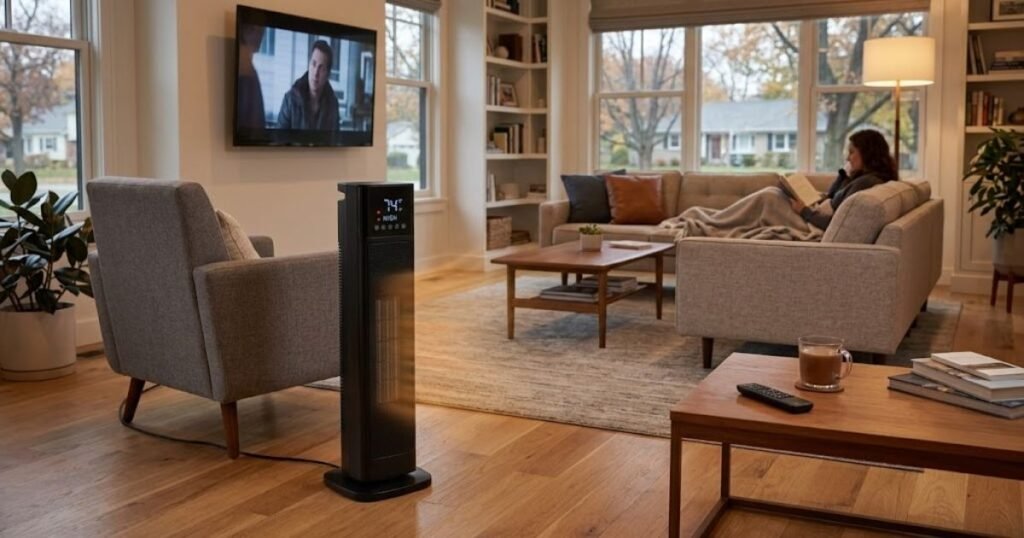
What Is a Tower Heater?
A tower heater is a tall, slender electric space heater designed to deliver fan-forced supplemental warmth while occupying a minimal floor footprint. Unlike traditional squat, boxy space heaters or heavy oil-filled radiators that sit low to the ground, a tower heater’s vertical architecture elevates its air intake and discharge vents.
Key Elements of a Modern Tower Heater
- Vertical Form Factor: Standing anywhere from 22 to 38 inches tall, tower heaters take up roughly less than one square foot of floor space.
- Elevated Air Delivery: Because heat naturally rises, discharging warm air from 10 to 30 inches above the floor warms your body faster when you’re seated at a desk, sitting on a sofa, or resting in bed.
- Internal Fan System: A cross-flow or centrifugal fan pulls ambient air through the back filter, passes it across the heating element, and pushes it steadily into the room.
- Oscillation Mechanism: Internal motorized gearing rotates the upper body back and forth (typically between 60° and 120°), spreading warm air across a wider arc rather than baking a single spot.
- Integrated Digital Controls: Modern units feature built-in electronic thermostats, countdown auto-off timers, digital LED readouts, and handheld remotes for effortless operation from across the room.
READ MORE: Portable Heat Pump With AC: Best Portable AC and Heating
How Does a Ceramic Tower Heater Work?
Inside a ceramic tower heater, electricity passes through a ceramic heating element (often a PTC positive temperature coefficient element), which warms up quickly. A fan draws room air across the hot element and pushes it back into the room. If the unit oscillates, a motor slowly rotates the housing so warm airflow sweeps a wider arc instead of blasting a single spot. A thermostat with a temperature sensor cycles the heating element on and off to hold your chosen setting.
Worth noting: “ceramic” is a heating-element material, not a magic efficiency upgrade. A 1,500W ceramic heater and a 1,500W heater using a different resistance technology both convert roughly the same electricity into heat differences that come down to airflow, noise, oscillation coverage, and thermostat precision, not an inherent energy-savings advantage of ceramic over other resistance designs.
Are Tower Heaters Good for Indoor Use?
For supplemental, single-room heating, yes with realistic expectations. Homeowners like them because they’re compact, portable, quick to warm up, and often include oscillation, thermostats, remotes, and timers. They’re a practical way to do “zone heating”: warming the room you’re actually using instead of paying to heat empty rooms.
Real limits to keep in mind:
- Still draws real electricity — commonly up to 1,500W — so long stretches of use add up.
- Heating range is limited to roughly one room, not a floor or house.
- Performance depends on your room’s insulation, ceiling height, and drafts.
- It supplements your HVAC system rather than replacing it.
- Some models run noticeably louder than others.
- Extension cords should generally be avoided unless the manual specifically allows it to plug directly into a wall outlet.
READ MORE: EdenPURE Heaters Review — Prices & Comparison
How We Chose the Six Tower Heaters
To select the top models for U.S. homeowners, we analyzed official manufacturer technical documentation, product user manuals, safety testing certifications (ETL/UL), and aggregated user feedback across major national retail platforms.
Our assessment evaluated every model against 12 core criteria:
- Heating Power & Output: Verified wattage tiers (e.g., High 1500W, Low 900W–1000W) and thermal circulation.
- Thermostat Precision: Evaluation of automatic cycling, digital readout clarity, and temperature increments.
- Oscillation Sweep: Angle of oscillation (75° to 120°) and smoothness of motor movement.
- Safety Engineering: Presence of tip-over switches, thermal overload cutoffs, cool-touch exteriors, and flame-retardant housings.
- Noise Performance: Operating sound levels across low, high, and fan-only modes.
- Control & Interface: Display visibility, remote control responsiveness, and interface intuitive design.
- Timer Functionality: Range of auto-shutoff scheduling (1 to 12 hours).
- Footprint & Height: Total height, base diameter, stability, and total weight.
- Portability: Built-in carry handle design and ease of movement between rooms.
- Special Features: Availability of all-season fan modes, ECO modes, and filter elements.
- Build Quality & Durability: Structural integrity, materials, and warranty backing.
- Value for Money: Balancing feature richness against retail price point.
READ MORE: DeLonghi Heater Reviews— Models, Prices & Buyer’s Guide
Top 6 Electric Tower Heaters for Home
1. Lasko All-Season Tower Fan & Space Heater in One (FHV820)
Overview
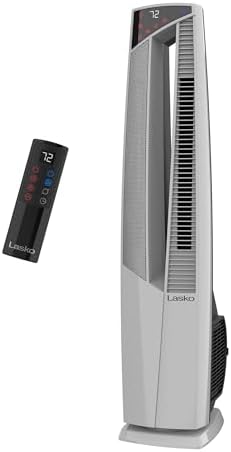
If you dislike storing seasonal appliances in closets or attics every spring and fall, the Lasko FHV820 offers a versatile solution. Standing 38 inches tall, this high-profile tower functions as a 1,500-watt ceramic space heater during winter and transforms into a high-powered cooling tower fan for hot summer months.
Key Specifications
- Power Output: 1,500 Watts (High), plus lower heat modes
- Height: 38 Inches
- Technology: Ceramic PTC Element / High-Velocity Fan
- Oscillation: Widespread internal oscillation
- Controls: Digital display with AutoEco Thermostat
- Timer: Up to 8 Hours
- Safety Certifications: ETL Listed
Features & Performance
The FHV820 uses Lasko’s AutoEco electronic thermostat, which automatically adjusts heating power to maintain room temperature while conserving electricity. With 3 heat settings and 4 fan speeds, it provides fine-tuned control over indoor airflow. Its 38-inch height makes it the tallest unit in our guide, placing air discharge directly at chest and head level when sitting on a couch or office chair.
Safety Engineering
Safety features include an automatic overheat protection sensor that cuts power if internal temperatures exceed safe limits, a cool-touch exterior housing, and an integrated tip-over safety switch that cuts power if the tall tower gets knocked over.
- Best For: Living rooms, primary bedrooms, and home offices where year-round temperature control is needed.
- Pros:
- True 2-in-1 design eliminates off-season storage needs.
- Tall 38-inch profile delivers air well above floor level.
- AutoEco thermostat balances comfort with energy efficiency.
- Cons:
- Larger base footprint than standard compact space heaters.
- Higher upfront investment compared to single-purpose heaters.
- Who Should Buy It: Homeowners wanting a single, sleek appliance that provides summer cooling airflow and winter supplemental warmth.
- Who Should Skip It: Anyone strictly seeking a low-cost, compact heater dedicated exclusively to winter spot-heating.
2. DREO 1,500W Space Heater for Indoor Use with Thermostat
Overview
DREO has quickly built a strong reputation in home comfort appliances by prioritizing whisper-quiet air delivery and fine-grained digital controls. The DREO 1,500W Ceramic Tower Space Heater combines rapid PTC heating with an advanced electronic thermostat designed to eliminate wide temperature swings in indoor spaces.
Key Specifications
- Power Output: 1,500 Watts (High), 1,000 Watts (Low), ECO Mode, Fan-Only
- Height: Approx. 24 Inches (varies slightly by sub-model variant)
- Technology: Fast-Heating PTC Ceramic
- Thermostat: Digital adjustable in 1°F increments (41°F to 95°F)
- Oscillation: 70° Widespread
- Timer: 1 to 12 Hours
- Safety Certifications: ETL Certified
Features & Performance
A standout feature of this DREO model is its precision thermostat. While basic space heaters cycle wildly between scorching hot and cold drafty states, DREO’s system allows users to dial in exact target temperatures. The unit’s ECO mode dynamically adjusts output power based on real-time ambient room temperature, maintaining consistent warmth without unnecessary electricity draw.
Noise Considerations
Utilizing an optimized centrifugal fan impeller and brushless motor technology, this heater operates quietly on low settings. This makes it an ideal option for light sleepers or professionals holding remote video meetings.
- Best For: Bedrooms, nursery rooms, and quiet home offices.
- Pros:
- Precise 1°F thermostat adjustments prevent overheating rooms.
- Exceptionally quiet fan operation on lower modes.
- Comprehensive safety suite including reinforced tip-over cutoff.
- Cons:
- Compact frame is ideal for small-to-medium rooms but less suited for expansive open spaces.
- Who Should Buy It: Sleepers sensitive to noise who want precise nighttime temperature control.
- Who Should Skip It: Buyers needing to heat high-ceiling, drafty double-car basements or large open floor plans.

3. Honeywell Slim Ceramic Tower Heater (HCE317B)
Overview
When floor space is at a premium, the Honeywell Slim Ceramic Tower Heater (HCE317B) offers a compact heating solution. Honeywell engineered this unit with a slender vertical profile that easily slips between desks, beside nightstands, or into tight apartment corners.
Key Specifications
- Power Output: 1,500 Watts (High), Low Heat setting
- Height: Approx. 21.6 Inches
- Technology: Ceramic Heating Element
- Oscillation: Wide-angle oscillation
- Timer: Preset auto-shutoff intervals (1, 2, 4, 8 hours)
- Safety Features: Overheat protection, 360-degree tip-over switch, cool-touch housing
Features & Controls
The HCE317B features a top-mounted digital control panel with clear LED indicators. Its simple interface makes setting heat levels, turning on oscillation, or scheduling auto-off timers effortless. It delivers rapid localized heat output, making it effective for spot-heating a workstation or warming up cold feet near a desk.
Safety Engineering
Honeywell places heavy emphasis on safety engineering. The HCE317B incorporates a heavy-duty tip-over switch that immediately cuts circuit power if the tower tilts off balance. Flame-resistant plastic housing and internal thermal fuse protection provide peace of mind during daily operation.
- Best For: Compact home offices, small bedrooms, dorm rooms, and craft spaces.
- Pros:
- Extremely space-efficient slim footprint.
- Straightforward top-mounted control panel.
- Trusted brand safety protections built-in.
- Cons:
- Shorter stature means air is discharged closer to floor level compared to 30″+ models.
- Who Should Buy It: Homeowners seeking a dependable, space-saving space heater from an established brand.
- Who Should Skip It: Those looking to circulate heat across expansive living rooms with vaulted ceilings.

4. PELONIS Oscillating Ceramic Tower Heater (PHF15RSAPH23)
Overview
The PELONIS PHF15RSAPH23 balances feature richness and budget accessibility. This 23-inch ceramic tower heater includes many high-end features such as precise digital temperature settings, a 12-hour timer, and a full-function remote at an approachable price point.
Key Specifications
- Power Output: 1,500 Watts (High), Low, ECO Mode, Fan Only
- Height: 23 Inches
- Oscillation: 75° Wide Angle
- Thermostat: Digital with 1°F adjustment increments
- Timer: Up to 12 Hours
- Noise Rating: Below 55 dB (manufacturer specification)
- Safety Features: Tip-over switch, overheat sensor, V-0 flame-retardant material
Performance & Usability
Equipped with a fast-heating ceramic core, the PHF15RSAPH23 warms air rapidly upon startup. Its 75° wide-angle oscillation sweeps warm air evenly across medium-sized bedrooms or offices (up to ~220 sq. ft. in typical insulated residential conditions). Touch-sensitive digital top controls and an included wireless remote allow effortless adjustments without getting out of bed or off the couch.
Safety Features
Built using UL94 V-0 flame-retardant materials, the PELONIS tower is designed for fire safety. An internal tip-over switch and thermal cutoff protection complete its safety system.
- Best For: Guest bedrooms, home offices, and budget-conscious shoppers who don’t want to compromise on digital features.
- Pros:
- Excellent value proposition with remote control, ECO mode, and 12-hour timer included.
- Flame-retardant construction and tip-over safety.
- Precise digital thermostat control.
- Cons:
- Compact 23-inch height delivers air lower than tall 30″+ models.
- Who Should Buy It: Anyone looking for a fully featured digital ceramic tower heater at a reasonable price point.
- Who Should Skip It: Homeowners needing maximum height air projection for elevated seating areas.

5. DREO Space Heater for Large Rooms – 30″ (120° Oscillation)
Overview
Heating larger rooms requires elevated air discharge and broad horizontal distribution. The DREO 30-Inch Large Room Tower Space Heater meets this challenge with a 30-inch housing and an extra-wide 120° oscillation angle doubling the coverage arc of standard 60° space heaters.
Key Specifications
- Power Output: 1,500 Watts (High), Low, ECO Mode, Fan Mode
- Height: 30 Inches
- Oscillation: 120° Extra-Wide Sweep
- Thermostat: Digital adjustable auto-thermostat
- Timer: 1 to 12 Hours
- Certifications: ETL Certified
Airflow & Large Room Performance
Because standard heaters blast air in a single narrow direction, they often create a hot zone in front of the heater while leaving the rest of the room chilly. DREO solves this with its 120° motorized oscillation. The warm air column covers a much wider arc, helping distribute heat across larger family rooms, basements, or open master suites.
Controls & Safety
Like DREO’s smaller units, this 30-inch model features a crisp digital display, remote control, and intelligent ECO mode. Safety is managed through an integrated tip-over sensor, thermal shutdown switch, and reinforced safety plug.
- Best For: Open-concept living rooms, basements, master bedroom suites, and high-traffic family areas.
- Pros:
- 120° oscillation provides broader heat coverage than standard towers.
- 30-inch elevated discharge pushes warm air over coffee tables and footstools.
- Smooth, quiet motor operation.
- Cons:
- Larger frame requires more floor clearance than slim desk heaters.
- Who Should Buy It: Anyone trying to heat a larger living space or open bedroom without creating uncomfortable hot spots.
- Who Should Skip It: Those shopping for a small heater to place under a office desk or inside a tiny bathroom.

6. Lasko Oscillating Digital Ceramic Tower Space Heater (29″ – Model 5586)
Overview
The Lasko 5586 is one of the most widely recognized and battle-tested tower heaters in North America. Standing 29 inches tall with an elongated ceramic heating element, it delivers strong thermal performance backed by Lasko’s 3-year limited warranty.
Key Specifications
- Power Output: 1,500 Watts (High), 900 Watts (Low)
- Height: 29 Inches
- Technology: Elongated Self-Regulating Ceramic Element
- Oscillation: Widespread internal oscillation
- Thermostat: Automatic Digital Thermostat Control
- Timer: Up to 8 Hours (1-hour increments)
- Certifications: ETL Listed | 3-Year Limited Warranty
Heating Performance
The defining feature of the Lasko 5586 is its elongated ceramic heating grid. By spreading the ceramic surface area across a taller vertical span, the interior fan pushes a larger volume of warm air into the room every minute. It operates smoothly on high or low heat settings, while its automatic thermostat cycles the heater to maintain set comfort levels.
Safety & Important Technical Note
The Lasko 5586 includes an internal automatic thermal overheat protection device that shuts the heater off if internal components overheat, along with cool-touch exterior plastic housing and a built-in carry handle.
- Critical Safety Note: Based on current manufacturer specifications, the Lasko Model 5586 does NOT feature an internal tip-over switch. It relies on a wide, weighted low-center-of-gravity base for physical stability. Homeowners with rambunctious pets or toddlers should keep this hardware specification in mind when placing the unit.
- Best For: Master bedrooms, home offices, den areas, and general residential supplemental heating.
- Pros:
- Elongated ceramic element delivers robust, satisfying warmth.
- Backed by a strong 3-year limited warranty.
- Widespread oscillation quickly fills rooms with warm air.
- Cons:
- Lacks an internal electronic tip-over shutoff switch (uses a wide weighted base instead).
- Aesthetics are classic/functional rather than modern.
- Who Should Buy It: Homeowners wanting a durable, long-lasting space heater with a proven track record and a 3-year warranty.
- Who Should Skip It: Homes with active toddlers or large pets where a tip-over switch is an absolute necessity.
READ MORE: Best Heater for Large Room: Top Picks, Reviews & Comparison

Comparison Table: Top 6 Electric Tower Heaters for Home
| Feature | Lasko FHV820 | DREO 1500W | Honeywell HCE317B | PELONIS PHF15RSAPH23 | DREO 30″ Large Room | Lasko 5586 |
| Heater Type | Ceramic (fan/heater combo) | PTC Ceramic | Ceramic | Ceramic | PTC Ceramic | Ceramic |
| Wattage | 1500W | 1500W | 1500W / 750W | 1500W | 1500W | 1500W |
| Height | 38″ | Not specified (compact) | 22″ | 23″ | 30″ | 29″ |
| Oscillation | Widespread | 70° (verify model) | Wide-range | 75° | 30°–120° | Widespread |
| Thermostat | AutoEco | Digital, 41–95°F | Programmable | 1°F adjustable | Adjustable | Auto mode |
| Heat Settings | 3 | Not specified | 2 | High/Low/ECO/Fan | 5 + ECO | High/Low/Auto |
| Fan Mode | 4 speeds | Yes | Not specified | Yes | 3 levels | Not specified |
| Remote | Yes | Yes | Not specified | Yes | Yes | Yes |
| Timer | 8-hr | 12-hr | Up to 8-hr | 12-hr | 1–12-hr | 8-hr |
| ECO Mode | Not specified | Yes | Not specified | Yes | Yes | Not specified |
| Safety Features | Tip-over switch, overheat protection | Tip-over detection, overheat protection, flame-retardant | Tip-over, dual overheat, cool-touch | Tip-over, overheat, flame-retardant | Tip-over, overheat, flame-retardant | Overheat protection, cool-touch (no tip-over switch listed) |
| Claimed Coverage | Not specified | Not specified | Not specified | Up to 220 sq. ft. | Up to 300 sq. ft. | Up to 300 sq. ft. |
| Best For | Fan + heater combo | Precise thermostat control | Slim footprint | Flexible modes | Widest oscillation | Simple whole-room heat |
| Warranty | Not specified | Not specified | 3-year limited | Not specified | Not specified | 3-year limited |
Tower Heater vs. Traditional Space Heater
| Feature | Tower Heater | Traditional Compact Space Heater |
| Footprint | Narrow, vertical | Wider, low-profile |
| Air Distribution | Often oscillating, spread across a room | Typically directional |
| Oscillation | Common | Less common |
| Portability | Usually includes carry handle | Varies |
| Room Coverage | Moderate to large, model-dependent | Typically smaller, spot heating |
| Controls | Often digital, thermostat, remote | Often basic dial controls |
| Bedroom Use | Generally well-suited (check noise) | Can work, less oscillation |
| Large-Room Use | Better with wide oscillation models | Often limited |
| Storage | Compact vertical footprint | Can be bulkier |
| Typical Features | Timer, remote, thermostat, digital display | Basic settings, lower cost |
READ MORE: Best Vornado Heaters: Reviews & Top Models Compared
How Much Does It Cost to Run a 1,500W Tower Heater?
The math is simple:
Energy used = watts ÷ 1,000 × hours used
A 1,500W heater running continuously for 5 hours uses:
1.5 kW × 5 hours = 7.5 kWh
Cost = kWh used × your electricity rate
As a purely illustrative example (not a national average), if your utility charged a hypothetical $0.16 per kWh, that 5-hour run would cost roughly $1.20. Actual cost depends on your state and utility rate, thermostat cycling, insulation, and runtime — check your own electric bill for your real per-kWh rate before estimating.
Are Tower Heaters Safe?
Modern tower heaters include several built-in protections, but none of them replace safe habits. Common safety features include tip-over protection (shuts the unit off if knocked over), overheat protection, cool-touch housing, flame-resistant housing materials, and safety certifications like UL or ETL listing.
Beyond the built-in features, follow these habits:
- Place the heater on a stable, level, hard surface.
- Keep it at least three feet from curtains, bedding, paper, furniture, and clothing.
- Plug it directly into a wall outlet — avoid extension cords and power strips unless the manual specifically allows it.
- Never overload a circuit shared with other high-draw appliances.
- Don’t use a heater with a damaged cord or plug.
- Never cover the heater, even briefly.
- Keep children and pets away from the unit.
- Use the timer for added peace of mind.
- Inspect the heater each fall before its first seasonal use.
Safety features reduce risk — they don’t eliminate the need for sensible placement and supervision.
READ MORE: Lasko Heater Reviews & Buying Guide — Best Models Compared
Can You Leave a Tower Heater Running Overnight?
Running any space heater unattended carries some added risk, so this deserves a careful answer rather than a blanket yes or no. A built-in timer or automatic overheat and tip-over shutoff can reduce that risk, but always follow the manufacturer’s specific instructions, keep the heater on a clear, stable surface away from bedding, and plug it directly into a wall outlet. If a manual doesn’t explicitly address overnight use, treat that as a reason for extra caution.
Can You Use a Tower Heater in a Bedroom?
Yes, with some considerations. Look for a reliable thermostat so it isn’t blasting heat all night, check the noise level if you’re a light sleeper, use the timer rather than running it for hours unattended, and confirm tip-over and overheat protection. Give it clearance from the bed and curtains, and use its own outlet rather than sharing a circuit with other high-draw devices. It comes down to matching noise tolerance, room size, and safety features to your own setup.
Common Mistakes to Avoid When Buying a Tower Heater
- Buying on wattage alone, since almost every model here is 1,500W.
- Assuming a “large room” rating means it can heat your whole house.
- Overlooking safety features to save a few dollars.
- Ignoring thermostat quality, which affects comfort and cost.
- Buying an oversized tower for a small bedroom.
- Skipping noise considerations for a unit that’ll run near your bed or desk.
- Forgetting to check cord length and outlet requirements.
- Assuming all ceramic heaters have identical features.
- Not verifying the exact model number, especially with brands that reuse similar names.
- Relying on outdated retailer listings instead of the manufacturer’s current page.
- Ignoring warranty length.
- Choosing strictly by lowest price.
Buying Guide: What Should You Look for in the Best Indoor Tower Heater?
Wattage: Most indoor tower heaters top out around 1,500W, the common limit for a standard 15-amp circuit. Wattage alone doesn’t determine suitability — airflow, oscillation, and insulation matter too.
Room Size: Manufacturer square-footage ratings are a starting point, not a guarantee. Insulation, ceiling height, and drafts affect real-world performance.
Thermostat: A responsive thermostat holds a steady temperature instead of letting the room swing hot and cold.
Oscillation: Wider angles generally spread heat more evenly than one direct blast.
Noise: Worth checking closely for bedrooms and offices; ratings vary between models.
Timer: Adds convenience and an extra layer of safety.
Remote Control: Convenient, not essential.
ECO Mode: Generally adjusts heat output to hold your set temperature more efficiently; avoid trusting specific savings percentages without verifying them.
Safety Features: Arguably the most important category — tip-over protection, overheat protection, and flame-resistant materials should be non-negotiable.
Portability: A carry handle and manageable weight make it easy to move room to room.
Warranty: Longer warranties (2–3 years is common here) suggest more manufacturer confidence.
FAQ
What is the best tower heater for indoor use?
There’s no single universal answer — the right pick depends on your room size, noise tolerance, whether you want thermostat precision or simple high/low controls, oscillation width, and budget. A small bedroom and a large living room call for different features, so match the model to your space.
Are tower heaters safe to use indoors?
Yes, when used correctly. Reputable models include tip-over protection, overheat protection, and cool-touch or flame-resistant housing. Still, plug directly into a wall outlet, keep the unit clear of bedding and curtains, place it on a stable surface, and never leave it unsupervised near children or pets.
Is a 1,500-watt tower heater enough to heat a room?
Often, yes, for supplemental heating in a room of typical size and insulation — but performance drops in larger or drafty spaces. A 1,500W heater isn’t designed to replace whole-home HVAC; it adds targeted warmth to the room you’re using.
Do tower heaters use a lot of electricity?
It depends on wattage, hours run, your local electricity rate, and how often the thermostat cycles on and off. Estimate with: kWh = watts ÷ 1,000 × hours, then multiply by your utility’s per-kWh rate.
Is a ceramic tower heater better than a regular space heater?
Not universally — ceramic heaters warm up quickly and pair well with oscillation for even coverage, but oil-filled radiators run quieter overnight, and infrared heaters offer faster spot heating. The best choice depends on whether you value speed, silence, or wide coverage.
Final Verdict
Tower heaters earn their popularity honestly: they’re compact, portable, and genuinely useful for warming up the one room you’re sitting in without running the furnace for the whole house. But “best” isn’t a fixed title — it depends on your room. A slim 22-inch Honeywell suits a small bedroom where floor space is tight; a 30-inch DREO with adjustable oscillation makes more sense in a larger living room; and a 2-in-1 Lasko earns its keep if you want one appliance for summer and winter.


Pingback: Best 6 Infrared Heater Indoor: Reviews, Cost & Compared - Plumbing Guider
Pingback: Safe Portable Heaters: 6 Reviews & Essential Safety Tips - Plumbing Guider
Pingback: Best Baseboard Heater: The U.S. Homeowner’s Complete Guide - Plumbing Guider