Working in freezing conditions isn’t just uncomfortable; it slows down productivity, makes adhesives and paints fail to cure properly, and turns even simple DIY tasks into frustrating chores. That is where a reliable job-site or workshop heater comes into play.
DEWALT is a household name for rugged power tools, and their line of portable heating equipment carries that same reputation for heavy-duty reliability. But choosing the right unit for your specific space requires looking past the brand name and examining raw output, power sources, ventilation requirements, and operating costs.
In this comprehensive review and comparison, we take an in-depth look at three distinct heating options from DEWALT. Lets deep dive into “Best DEWALT Propane Heater Review: 3 Models Compared”
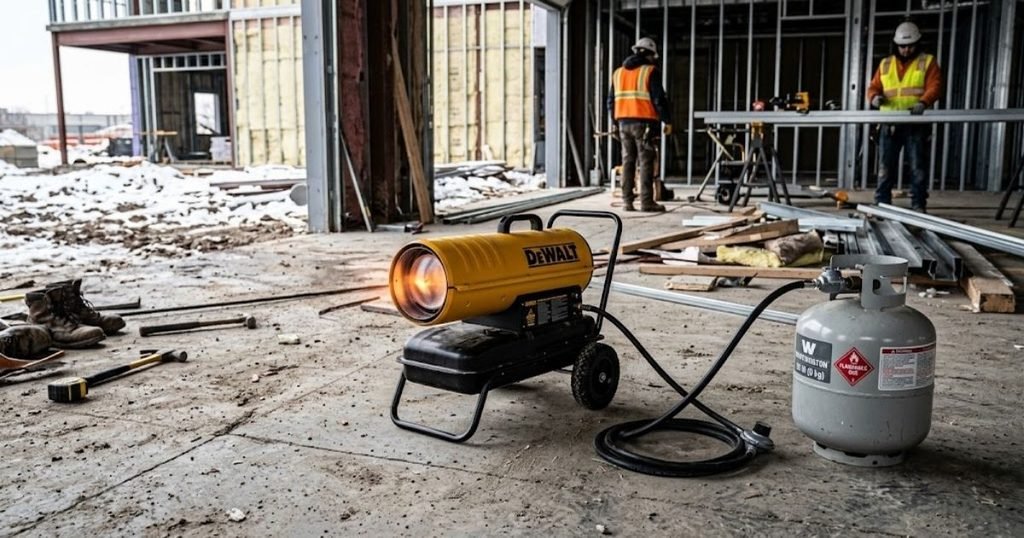
What Is a DEWALT Propane Heater?
Before diving into individual reviews, it helps to understand how these machines generate and distribute warmth. Portable forced-air heaters combine a fuel source (or electricity) with a motorized fan. The fan pulls in ambient air, forces it across a heating element or through a combustion chamber, and expels a steady stream of heated air into the workspace.
Propane Combustion vs. Electric Resistance
- Direct-Fired Propane Heaters: These units burn liquid propane to create heat. In “direct-fired” designs, the products of combustion including carbon dioxide, water vapor, and trace gases are discharged directly into the heated airstream along with the warm air. This makes them exceptionally efficient at transferring heat into a space, but it also means they consume oxygen and require active ventilation.
- Electric Construction Heaters: These units pass electrical current through heavy-duty resistance coils, warming them up while a fan blows air across them. They do not burn fuel at the point of use and therefore produce zero combustion exhaust, making them ideal for enclosed, properly wired indoor spaces where propane use might be restricted or undesirable.
Understanding BTU Ratings and Heating Capacity
A British Thermal Unit (BTU) measures the amount of thermal energy required to raise the temperature of one pound of water by one degree Fahrenheit. When looking at portable heaters, higher BTU ratings indicate greater heating capacity. However, a high BTU rating is not a guarantee of instant comfort.
The actual warmth you experience in a workshop or garage depends on several environmental variables:
- Insulation: Well-insulated walls and ceilings trap heat, while uninsulated metal pole barns bleed warmth rapidly.
- Ceiling Height: Tall ceilings mean a much larger volume of air to heat, requiring higher airflow and BTU output.
- Drafts and Air Leaks: Gaps around garage doors or windows allow cold air to infiltrate constantly.
- Outside Temperature: The greater the difference between outdoor and indoor temperatures, the harder your heater must work.
- Room Size: Always calculate the cubic footage of your workspace rather than just square footage when assessing heating needs.
Common applications for these heavy-duty heaters include open-sided construction framing, well-ventilated workshops, detached garages during active projects, and agricultural outbuildings.
READ MORE: EdenPURE Heaters Review— Prices & Comparison
Best DEWALT Propane Heater Review: 3 Models Compared
1. DEWALT 68,000 BTU Cordless Portable Forced Air Propane Heater
The DEWALT 68,000 BTU Cordless Portable Forced Air Propane Heater is designed for users who need robust, mobile warmth in areas where electrical outlets are scarce or nonexistent. By pairing propane fuel for heat with battery power for the internal fan and ignition system, this unit provides true cord-free placement on the job site.
Key Features and Specifications
- Rated BTU Output: Adjustable output ranging up to approximately 68,000 BTU per hour.
- Power Source: Compatible with DEWALT 20V MAX and FLEXVOLT battery systems to power the fan and electronic ignition. (Always verify specific model compatibility and whether corded AC adapters are supported out of the box).
- Fuel Connection: Designed to connect to standard liquid propane (LP) cylinders using the included high-pressure hose and regulator.
- Ignition & Safety: Features electronic ignition for reliable startups and an integrated high-temperature limit switch alongside thermoelectric safety valves to cut fuel supply if the flame goes out.
- Portability: Compact, lightweight steel chassis with an ergonomic handle for easy transport between vehicle and workspace.
- Warranty: Backed by a standard manufacturer limited warranty.
Heating Performance
With a maximum output of 68,000 BTU, this heater is well-suited for medium-to-large drafty work areas, detached two-car garages, and semi-enclosed construction sites. It delivers rapid directional heat, warming up cold zones quickly.
Manufacturers often provide rough square-footage estimates (such as up to 1,500 to 1,700 square feet under ideal conditions), but these figures are purely theoretical guidelines. In a drafty garage with poor insulation, the effective coverage area will be significantly smaller.
Cordless Convenience and Portability
The standout advantage of this model is its cordless operation. Traditional forced-air propane heaters require an extension cord to run the internal blower motor, which can create tripping hazards or limit placement to the reach of an outlet.
By utilizing rechargeable power tool batteries, this heater lets you set up warmth right where you are working—whether that is in the middle of a concrete driveway or deep inside a framing project with temporary power. The propane tank supplies the thermal energy, while your tool battery keeps the airflow moving.
Pros and Cons
Pros:
- Highly portable design with no reliance on AC wall outlets for the fan.
- Rapid, high-output directional heating for cold workspaces.
- Compatible with common power tool batteries already owned by many contractors and DIYers.
- Robust steel construction built for job-site durability.
- Integrated safety shutoffs for peace of mind.
Cons:
- Consumes liquid propane, requiring spare tank logistics and refilling.
- Direct-fired design introduces combustion byproducts, necessitating careful ventilation.
- Battery runtime varies based on battery amp-hour (Ah) capacity and ambient temperatures.
- Fan motor noise is present during operation, typical of forced-air units.
- Not suitable for enclosed residential living spaces or unventilated areas.
Who Should Buy It?
This heater is ideal for contractors, framers, agricultural workers, and DIYers who frequently work in unpowered spaces and already invest in the DEWALT battery ecosystem. Homeowners with large detached garages who want powerful, cord-free heat will also find it exceptionally convenient. Those working in small, tightly sealed indoor rooms should look toward electric or indirect-heating alternatives.

2. DEWALT Forced Air Electric Construction Heater (10/7 kW) Review
Shifting away from combustion-based warmth, the DEWALT Forced Air Electric Construction Heater (such as the model DXH1000TS series) offers a heavy-duty electric alternative designed for spaces with adequate electrical service.
Specifications and Electrical Requirements
- Power Output: Dual-wattage capability offering a robust 10,000 watts (10 kW) mode and a selectable 7,000-watt (7 kW) mode.
- Electrical Supply: Requires a dedicated 240-volt, single-phase electrical supply.
- Circuit Requirements: Typically requires a 50-amp or 30-amp breaker configuration depending on the wattage setting and local electrical codes.
- Controls: Built-in adjustable thermostat for maintaining consistent ambient temperatures.
- Portability: Heavy-duty frame equipped with wheels or sturdy handles for repositioning around a workshop.
- Warranty: Manufacturer warranty covering defects in materials and workmanship.
Crucial Note on Electrical Setup: This is not a plug-and-play appliance for a standard 120V household wall outlet. Running a 10 kW heater requires a heavy-duty 240V receptacle installed by a qualified electrician in accordance with the National Electrical Code (NEC).
Heating Performance and Everyday Use
Electric resistance heating delivers clean, odorless warmth without consuming oxygen or releasing combustion gases. When operating at the 10 kW setting, this heater pumps out substantial warmth, making it fantastic for well-insulated workshops, large basements under renovation, or commercial job sites with temporary 240V spider boxes.
Because it features an integrated thermostat, the heater cycles on and off to maintain a steady temperature rather than running continuously at full blast, helping moderate power usage over long work sessions.
Pros and Cons
Pros:
- Zero propane tanks, fuel hoses, or gas refills to manage.
- No combustion exhaust, making it safer for enclosed or semi-enclosed spaces with proper ventilation and electrical clearance.
- Built-in thermostatic control for consistent temperature regulation.
- Dual power settings (10 kW / 7 kW) to match available circuit capacity.
- Quiet, reliable operation compared to roaring combustion burners.
Cons:
- Demands a specialized 240V electrical installation; cannot be plugged into standard outlets.
- High electrical draw can significantly increase monthly utility bills if run continuously.
- Tethered to a power cord and outlet location, limiting mobility compared to cordless models.
- Purchase price and electrical installation costs can be higher than basic propane units.
Who Should Choose This Model?
This electric construction heater is the premier choice for woodworkers, mechanics, and workshop owners who have 240V electrical service installed in their garage or pole barn and want clean, set-it-and-forget-it heat without handling combustible fuels. It is also favored by contractors working on interior renovation phases where open flames or gas exhaust are prohibited.

3. DEWALT 150,000 BTU Forced Air Propane Quiet Burner Technology Job Site Heater Review
When standard portable heaters are simply not enough to combat freezing winter temperatures across massive workspaces, high-capacity industrial units step in. The DEWALT 150,000 BTU Forced Air Propane Quiet Burner Technology Job Site Heater represents the heavy artillery of temporary job-site heating.
Specifications and Heating Capacity
- Rated BTU Output: Massive maximum output rated around 150,000 BTU per hour.
- Adjustable Output: Variable control valves allowing users to dial back heat output for smaller demands or milder days.
- Fuel Requirements: Operates on standard liquid propane tanks, utilizing high-flow hoses and regulators.
- Ignition & Safety: Features heavy-duty electronic ignition and comprehensive safety systems including thermal overload protection and safety shutoffs.
- Technology: Incorporates Quiet Burner Technology to significantly reduce operational noise compared to traditional roaring industrial torpedo heaters.
- Portability: Heavy-gauge steel body with rugged wheels and extension handles for rolling across rough terrain and concrete floors.
Quiet Burner Technology and Job-Site Performance
Traditional high-BTU forced-air propane heaters are notoriously loud, often drowning out job-site communication, music, or conversation. DEWALT’s Quiet Burner Technology re-engineers the combustion chamber and burner plate to minimize turbulent noise while maintaining optimal heat transfer efficiency.
With 150,000 BTUs at your disposal, this heater is engineered for large-scale applications: uninsulated commercial warehouses, massive agricultural structures, bridge and highway construction projects, and expansive framing sites. However, immense power comes with immense fuel consumption. Running a 150K BTU heater at full tilt will drain standard 20-pound propane tanks very rapidly, making larger 100-pound tanks or multi-tank setups essential for extended operation.
Pros and Cons
Pros:
- Exceptional heating capacity capable of warming massive, drafty spaces.
- Quiet Burner Technology noticeably reduces disruptive operational noise.
- Adjustable output controls allow flexibility across changing weather conditions.
- Rugged, industrial-grade construction built to withstand harsh job-site abuse.
- Wheels and handles make positioning this heavy unit manageable.
Cons:
- High fuel consumption rate requires frequent tank changes or large bulk propane sources.
- Requires rigorous adherence to strict ventilation and clearance requirements due to high combustion output.
- Bulky footprint takes up valuable floor space in smaller areas.
- Overkill for typical residential garages or small DIY workshops.
Who Should Consider This Heater?
General contractors, commercial builders, agricultural operators, and professionals managing large, open-air or well-ventilated industrial spaces will find this heater indispensable. It is far too powerful for standard home garages and should be reserved for environments demanding serious thermal muscle.

READ MORE: Top 6 Electric Tower Heaters for Home
DEWALT Heater Comparison Table: 3 Models at a Glance
To help you compare your options side-by-side, the table below highlights key operational differences across all three DEWALT heaters reviewed in this article.
| Comparison factor | 68,000 BTU Cordless Propane Heater | 10/7 kW Electric Construction Heater | 150,000 BTU Propane Job-Site Heater |
| Energy Source | Liquid Propane + DEWALT 20V/FLEXVOLT Battery | Electricity (240V AC) | Liquid Propane |
| Heating Output | Up to 68,000 BTU/hr (Adjustable) | 10 kW (~34,121 BTU) / 7 kW (~23,885 BTU) | Up to 150,000 BTU/hr (Adjustable) |
| Portability | High (Cordless fan, lightweight frame) | Moderate (Wheeled/handle frame, corded) | Moderate-Low (Heavy chassis, large footprint) |
| Electrical Requirements | Tool battery for fan/ignition | 240V, single phase, 30A/50A dedicated circuit | Standard electrical connection for fan/ignition (model dependent) |
| Propane Tank Required | Yes (Standard LP tanks) | No | Yes (Large capacity LP tanks recommended) |
| Combustion Exhaust at Heater | Yes (Direct-fired) | No (Electric resistance) | Yes (Direct-fired) |
| Thermostat | Manual / Adjustable valve | Built-in adjustable thermostat | Manual / Adjustable valve |
| Ventilation Considerations | Essential; follow manual instructions | Follow standard electrical and placement clearances | Essential; rigorous ventilation required |
| Best Use Case | Unpowered job sites, detached garages, framing work | Powered workshops, garages with 240V service | Large warehouses, pole barns, open construction |
| Main Advantage | True cord-free fan operation | Clean, exhaust-free electric heat | Massive thermal output with noise reduction |
| Main Drawback | Propane consumption and ventilation needs | Requires specialized 240V electrical wiring | High fuel consumption and physical bulk |
| Warranty | Manufacturer Limited Warranty | Manufacturer Limited Warranty | Manufacturer Limited Warranty |
READ MORE: Best 6 Infrared Heater Indoor: Reviews, Cost & Compared
Which DEWALT Heater Is Best for Your Needs?
Selecting the right heater isn’t about buying the most expensive or powerful model on the shelf; it is about matching the equipment to your specific environment.
Best for Portable Heating Without Convenient Mains Power
If your workspace lacks electrical outlets such as a remote pole barn, a newly poured concrete slab, or an outdoor framing project the DEWALT 68,000 BTU Cordless Portable Forced Air Propane Heater is the clear winner. Its ability to run the fan via DEWALT power tool batteries gives you unmatched freedom of movement.
Best for Work Areas With Suitable Electrical Service
If you own a dedicated workshop or garage equipped with a 240V outlet and you prefer not to haul propane tanks or deal with combustion exhaust, the DEWALT 10/7 kW Electric Construction Heater provides clean, thermostatically controlled heat with minimal fuss.
Best for High-Demand Temporary Heating
For contractors and property owners facing massive spaces, severe sub-zero cold, and well-ventilated commercial environments, the DEWALT 150,000 BTU Quiet Burner Heater delivers the raw thermal power necessary to keep work moving.
Best for Occasional Homeowner Projects
For weekend DIYers working in a standard home garage occasionally, evaluate your garage’s insulation and power setup carefully. Always remember: none of these industrial construction heaters are approved for residential living spaces, bedrooms, or enclosed indoor rooms.
How Much Does a DEWALT Propane Heater Cost to Run?
Understanding the upfront purchase price is only half the battle; operating costs dictate long-term affordability.
Estimating Propane Operating Costs
Propane consumption is calculated based on BTU output. A general rule of thumb is that 1 gallon of liquid propane yields approximately 91,500 BTUs of energy.
- To estimate hourly fuel cost:
FuelCostperHour=OperatingBTUOutput91,500BTU/galLocalPriceperGallonofPropane
For example, running a 68,000 BTU heater at maximum output consumes roughly 0.74 gallons of propane per hour. If propane costs $\$3.00$ per gallon, your hourly fuel expense is approximately $\$2.22$. Running a 150,000 BTU monster at full blast will consume over 1.6 gallons per hour, pushing hourly fuel costs past $\$4.80$.
Estimating Electric Operating Costs
For the 10/7 kW electric model, operating costs depend entirely on local electricity rates per kilowatt-hour (kWh).
- To estimate hourly electricity cost:
ElectricityCostperHour=PowerConsumptioninkWElectricityPriceperkWh
If your electric utility charges $\$0.15$ per kWh, running the heater continuously on its 10 kW setting costs:
$$10 \text{ kW} \times \$0.15 = \$1.50 \text{ per hour}$$
Keep in mind that when the built-in thermostat cycles the electric heater on and off, actual hourly consumption will be lower than continuous maximum operation. Always check current local energy rates before finalizing your heating budget.
READ MORE: Best Envi Wall Heater: Review, Cost & Comparison
Propane Heater Safety Tips Every Homeowner Should Know
Portable heaters demand respect. Operating combustion or high-voltage equipment safely protects you, your property, and everyone on the job site.
Crucial Safety Notice: Always consult the U.S. Consumer Product Safety Commission (CPSC) and the National Fire Protection Association (NFPA) guidelines alongside your specific product manual before operating any temporary heater.
- Strictly Follow Manufacturer Guidelines: Use each heater only in applications and locations explicitly approved in the manual.
- Ventilation Is Mandatory: Direct-fired propane heaters release carbon monoxide and combustion exhaust into the air. Never assume cracking a window or leaving a garage door slightly open provides sufficient ventilation. Follow exact cubic-feet-per-minute (CFM) fresh air requirements specified in your manual.
- Never Use in Enclosed Residential Spaces: Do not operate direct-fired construction heaters in bedrooms, living areas, mobile homes, or unventilated occupied garages.
- Cylinder Placement: Keep propane cylinders upright at all times. Follow all instructions for connecting, storing, and handling LP tanks.
- Inspect Hoses and Fittings: Check gas hoses for cracking, wear, or leaks using soapy water before every use. Never use a heater with damaged fuel lines.
- Maintain Clearances: Keep combustibles such as cardboard, wood, paint thinners, and fabric far away from the heater according to the manufacturer’s clearance distances.
- Never Bypass Safety Switches: Tampering with thermocouples, tip-over switches, or high-limit thermostats creates severe fire and explosion hazards.
- Install Carbon Monoxide Alarms: Always maintain working, tested carbon monoxide detectors in any building where temporary heating equipment is used, keeping in mind that alarms supplement but never replace proper ventilation.
READ MORE: Best 5 Natural Gas Heater for Home: Review, Comparison & Buying Guide
What to Check Before Buying a DEWALT Heater
Before adding a heater to your cart or heading to the home improvement store, run through this quick homeowner checklist:
- Intended Location & Ventilation: Can you provide the required fresh air intake for a propane unit, or do you have the electrical service required for an electric model?
- Required Heating Output: Calculate the size and insulation quality of your workspace to avoid buying an undersized or excessively overpowered unit.
- Power Availability: Do you have 240V power, or do you need a cordless/propane solution?
- Accessory Inclusion: Verify whether regulators, hoses, or battery packs are included in the box or sold separately.
- Noise Tolerance: Consider whether a standard roaring torpedo heater will disrupt your workspace or if you need Quiet Burner technology.
- Warranty & Support: Review the manufacturer warranty terms and local service availability.
Frequently Asked Questions
Is a DEWALT propane heater safe to use in a garage?
Safety depends entirely on the exact model, the ventilation of the garage, and adherence to the manufacturer’s instructions. While a well-ventilated, detached workshop or garage can accommodate direct-fired propane heaters during active work projects, you should never run a direct-fired construction heater in an enclosed, unventilated, or attached residential garage where exhaust fumes can seep into living quarters.
How many square feet can a DEWALT 68,000 BTU heater heat?
Under ideal conditions, manufacturers may estimate coverage up to 1,500 square feet. However, actual heating capacity is heavily influenced by ambient outdoor temperature, ceiling height, insulation quality, and drafts. Treat square-footage numbers as rough guides rather than guarantees.
Can a DEWALT cordless propane heater run without a battery?
This depends entirely on the specific model specifications. While the propane tank supplies the thermal fuel, the internal fan and electronic ignition require electrical power. Always check the product manual to confirm whether your specific model supports an AC cord adapter or strictly relies on power tool batteries.
Is a DEWALT propane heater cheaper to run than an electric heater?
Not necessarily. Operating costs fluctuate based on local utility rates. If propane prices are high in your area, running a high-BTU propane heater can become expensive. Conversely, running a 10 kW electric heater continuously on high can drive up your electricity bill rapidly. Calculate your local cost per kWh and price per gallon of propane using the formulas outlined earlier to compare accurately.
What is the difference between a DEWALT 68,000 BTU heater and a 150,000 BTU heater?
The primary difference is raw thermal output and intended scale. A 68,000 BTU unit is tailored for medium-sized workspaces, garages, and localized job sites. A 150,000 BTU heater is an industrial-grade machine built for massive warehouses, framing sites, and extreme cold conditions, requiring significantly more fuel and strict ventilation.
Final Verdict
Choosing the right DEWALT heater comes down to balancing your workspace dimensions, available power sources, and ventilation capabilities.
- Choose the DEWALT 68,000 BTU Cordless Propane Heater if you need versatile, portable warmth in unpowered locations and appreciate the convenience of cordless fan operation.
- Choose the DEWALT 10/7 kW Electric Construction Heater if you have a 240V workshop and want clean, exhaust-free, thermostatically controlled heat.
- Choose the DEWALT 150,000 BTU Quiet Burner Heater if you are tackling massive, drafty commercial or agricultural spaces that demand heavy-duty thermal performance.
Always review the owner’s manual, verify your local utility and fuel costs, and prioritize safety and ventilation before turning on your new heater for the first time.