If you’ve started shopping for a new heating and cooling system, you’ve probably noticed that heat pumps are everywhere right now. Utility companies are promoting them. Contractors are recommending them. Your neighbor might already have one humming away outside their house.
But once you start digging into the details, you run into a fork in the road: should you go ductless (also called a mini-split) or ducted (a traditional central system)? Both heat and cool your home. Both use the same basic heat pump technology. Yet they work in very different ways, and the right choice depends on your home’s layout, your budget, and how you like to live.
This guide breaks down everything a homeowner actually needs to know cost, efficiency, comfort, installation, and long-term value so you can make a decision you’ll feel good about for the next 15 to 20 years. Lets deep dive into “Ductless vs. Ducted Heat Pumps: Which One Saves More for Your Home?”
Key Takeaways
- Ductless heat pumps skip ductwork entirely and use individual indoor units, making them ideal for homes without existing ducts.
- Ducted heat pumps distribute air through a network of ducts, delivering more uniform whole-house comfort.
- Ductless systems tend to be more energy efficient because they avoid duct losses, which can account for 20–30% of energy waste in a typical home.
- Ducted systems usually cost less per zone when ductwork already exists, but new duct installation can be expensive.
- Your best choice depends on your home’s age, layout, existing infrastructure, and comfort goals not just price tag.
READ MORE: Best MRCOOL Mini Split Air Conditioners and Heat Pumps: Review & Comparison
What Is a Heat Pump?
Before comparing ductless and ducted systems, it helps to understand what a heat pump actually does, since both options rely on the same core technology.
A heat pump doesn’t burn fuel or generate heat the way a furnace does. Instead, it moves heat from one place to another. In winter, it pulls heat from the outside air (yes, even cold air still holds usable heat) and moves it indoors. In summer, it reverses the process, pulling heat out of your home and releasing it outside essentially working like an air conditioner.
Think of it like a sponge soaking up water and wringing it out somewhere else. The heat pump isn’t creating anything new; it’s just relocating heat energy from where it’s unwanted to where it’s needed.
Because one system handles both heating and cooling, homeowners get:
- A single piece of equipment instead of a furnace plus an AC unit
- Lower energy use compared to electric resistance heating or older furnaces
- A path toward reducing reliance on fossil fuels like natural gas or oil
This dual-purpose design is a big reason heat pumps have become one of the fastest-growing HVAC categories in U.S. homes over the past few years.
Quick Takeaway Box A heat pump moves heat instead of making it. One system replaces both your furnace and your air conditioner and that’s true whether you choose a ductless or ducted version.
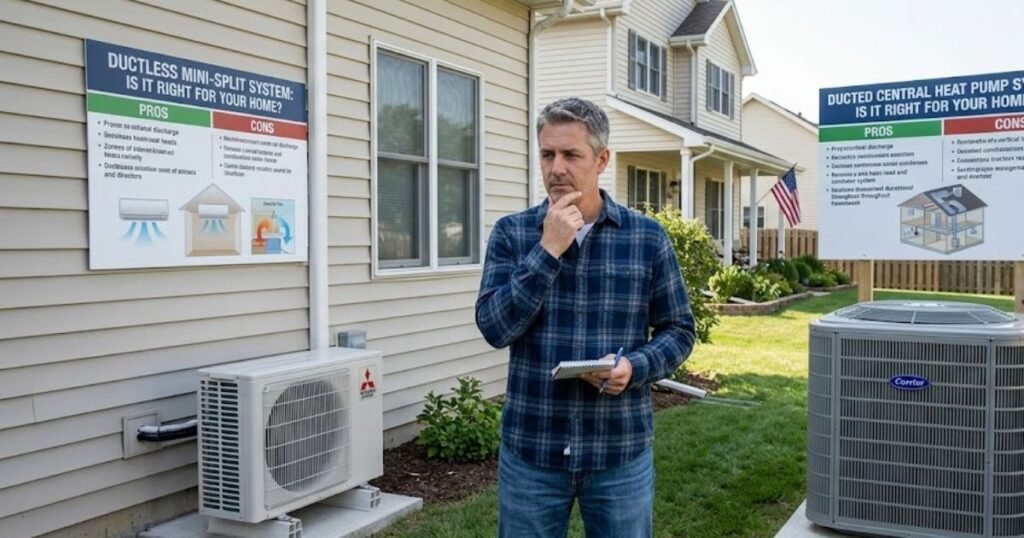
What Is a Ductless Heat Pump?
A ductless heat pump, often called a mini-split, skips ductwork altogether. Instead, it uses:
- One outdoor condenser/compressor unit, mounted on a pad or wall bracket outside
- One or more indoor air handlers, mounted on walls, ceilings, or floors in individual rooms
- A thin conduit (refrigerant line, power cable, and condensate drain) connecting the outdoor unit to each indoor unit
Each indoor unit can be controlled independently. That means the bedroom can be cooler at night while the living room stays warmer during the day true zone-by-zone temperature control without a single duct in sight.
Pros of Ductless Heat Pumps
- No ductwork required — ideal for older homes, additions, and converted spaces
- Better room-by-room control, so you’re not heating or cooling empty rooms
- Faster installation, often completed in a single day for a single zone
- Lower energy waste, since there’s no duct system to leak conditioned air
Cons of Ductless Heat Pumps
- Indoor wall-mounted units are visible and change the look of a room
- Outfitting a whole home with multiple zones can get expensive
- Multiple indoor units mean more individual filters and components to maintain
READ MORE: Carrier Heat Pump Reviews — Models, Costs, Pros & Cons
What Is a Ducted Heat Pump?
A ducted heat pump works like a traditional central heating and cooling system. A single indoor unit (often replacing or paired with an existing furnace or air handler) pushes conditioned air through a network of ducts hidden in your walls, floors, or attic, delivering it to every room through vents.
This is the setup most U.S. homeowners are already familiar with, since it mirrors how central air conditioning and forced-air furnaces have worked for decades.
Pros of Ducted Heat Pumps
- Clean appearance — no visible indoor units, just standard vents and a thermostat
- Even temperature distribution across the whole home from one central system
- Familiar operation, using a single thermostat the way most homeowners already expect
Cons of Ducted Heat Pumps
- Leaky or poorly insulated ducts can waste a significant share of conditioned air
- Retrofitting ductwork into a home that doesn’t have it is costly and invasive
- Installation is more complex, often requiring framing or attic work
Ductless vs. Ducted Heat Pumps: Side-by-Side Comparison Table
| Category | Ductless (Mini-Split) | Ducted (Central) |
| Installation | Fast, minimal construction; 1 day per zone | Slower; may require new ducts or framing |
| Upfront Cost | Lower for 1–2 zones; rises with more zones | Lower if ducts already exist; high if new |
| Operating Cost | Generally lower due to no duct losses | Higher if ducts are old, leaky, or uninsulated |
| Energy Efficiency | Very high; zoning avoids wasted conditioning | High, but duct losses reduce real-world efficiency |
| Appearance | Visible indoor wall/ceiling units | Discreet vents only, no visible equipment |
| Noise | Quiet indoor units; outdoor unit audible nearby | Quiet indoors; air handler may hum in a closet/attic |
| Comfort | Excellent zone control, some room-to-room variance | Even, whole-house temperature consistency |
| Zone Control | Built-in, room by room | Possible, but needs added zoning dampers |
| Maintenance | Multiple filters/units to clean regularly | Single system, but ducts need periodic cleaning |
| Best Home Type | No-duct homes, additions, older houses | Homes with existing, healthy ductwork |
| Resale Appeal | Growing acceptance; some buyers unfamiliar | Familiar to nearly all U.S. buyers |
| Lifespan | 15–20 years with good maintenance | 15–20 years; duct condition affects performance |
READ MORE: Goodman Heat Pump Review | Efficiency, Cost, Pros & Cons
Ductless vs. Ducted Heat Pumps: Installation Differences
Installation is often where the ductless-vs-ducted decision gets made in practice, since the process and disruption to your home looks very different for each.
Timeline: A single-zone ductless system can often be installed in a day. Multi-zone ductless setups take a few days. Ducted systems, especially ones requiring new ductwork, can take anywhere from a few days to over a week.
Indoor unit placement: Ductless indoor units need a clear wall or ceiling location with access to an exterior wall for the refrigerant line. Ducted systems need attic, basement, or crawlspace access to run ducts to every room.
Duct modifications: If you’re going ducted and already have ducts, your installer will inspect them for leaks, proper sizing, and insulation before connecting the new heat pump. Undersized or leaky ducts should be fixed first, or you’ll lose much of your efficiency gain.
Permits: Most municipalities require permits for both system types, especially for electrical work tied to the outdoor unit. Your contractor should handle this, but confirm it’s included in your quote.
Professional sizing matters most. An oversized or undersized heat pump ducted or ductless will run inefficiently, cycle too often, and struggle with humidity control. Insist on a Manual J load calculation rather than a rough estimate based on square footage.
Typical Installation Process
Ductless:
- Site assessment and zone planning
- Mounting indoor unit(s) and outdoor condenser
- Running refrigerant lines through a small wall penetration
- Electrical connection and system charge/test
Ducted:
- Load calculation and duct inspection (or design, if new)
- Installing or repairing ductwork
- Setting the outdoor unit and connecting the indoor air handler
- Sealing, insulating, and balancing the duct system
- Electrical connection and system commissioning
READ MORE: Best 3-Ton Heat Pumps: Reviews, Prices & Comparison
Ductless vs. Ducted Heat Pumps: Energy Efficiency
Both system types use efficient heat pump technology, but real-world efficiency depends heavily on how well the conditioned air actually reaches your living space.
Why duct losses matter: Ducts that run through unconditioned attics, crawlspaces, or garages can leak a meaningful share of heated or cooled air before it ever reaches a vent. Industry studies have long pointed to duct losses as a major source of HVAC energy waste in homes with older or poorly sealed duct systems.
Zoning benefits: Ductless systems let you avoid conditioning rooms you’re not using, a guest room, a home office on weekends, a basement you rarely visit. That selective control can meaningfully reduce energy use compared to a single-zone ducted system cooling the whole house uniformly.
SEER2 and HSPF2 basics: These are the efficiency ratings you’ll see on every modern heat pump.
- SEER2 measures cooling efficiency — higher numbers mean more cooling per dollar of electricity.
- HSPF2 measures heating efficiency — higher numbers mean more heat output per dollar of electricity.
Both ductless and ducted heat pumps are available in a wide range of SEER2/HSPF2 ratings, so the technology itself doesn’t automatically favor one type. The difference comes down to how much of that efficiency you actually realize once duct losses and zoning are factored in.
Real-World Homeowner Scenarios
- Scenario A — Older home, no ducts: A homeowner adds a 2-zone ductless system instead of installing brand-new ductwork. They avoid major duct losses entirely and gain independent control over their two most-used rooms.
- Scenario B — Newer home, healthy ducts: A homeowner replaces an aging furnace and AC with a ducted heat pump connected to existing, well-sealed ducts. They get whole-home comfort without sacrificing much efficiency, since the ducts were already in good shape.
- Scenario C — Mixed-use home: A homeowner keeps their existing ducted system for the main living areas but adds a single ductless unit in a converted garage that the ducts never reached.
READ MORE: Ultra Quietest Heat Pump for Your Home: Review, Comparison & Cost
Ductless vs. Ducted Heat Pumps: Cost Comparison
Costs vary by region, home size, brand, and installer, but here are typical U.S. ranges homeowners can use as a starting point for budgeting.
Ductless Heat Pump Costs
| Item | Typical Range |
| Single-zone equipment + install | $3,000–$6,000 |
| Each additional zone | $1,500–$3,500 |
| Whole-home multi-zone (4–5 zones) | $12,000–$25,000+ |
- Equipment: Outdoor condenser plus one indoor head per zone; costs rise with each additional zone.
- Installation: Generally faster and less invasive, which helps offset per-unit equipment costs.
- Multi-zone considerations: Going whole-home with ductless (one indoor unit per room) can approach or exceed ducted system costs, so it tends to make the most financial sense for homes with a handful of key zones rather than every single room.
Ducted Heat Pump Costs
| Item | Typical Range |
| Equipment + install (existing ducts) | $6,000–$12,500 |
| Equipment + install (new ductwork needed) | $12,000–$25,000+ |
| Duct repair/sealing (if needed) | $1,500–$5,000 |
- Equipment: A single outdoor unit and indoor air handler, generally similar in price to a high-efficiency central AC and furnace combination.
- Existing duct savings: If your ducts are in good condition, you can often reuse them, which significantly lowers total project cost.
- New ductwork expenses: Installing ducts from scratch is one of the most expensive parts of any HVAC retrofit, often rivaling the cost of the heat pump itself.
The 2026 Incentive Landscape: Tax Credits & Rebates
When planning your HVAC project budget, it is critical to look into state-level electrification programs, regional clean energy grants, and local utility rebates. Many regional electric providers offer direct cash-back incentives ranging from $500 to over $4,000 for installing certified high-efficiency heat pumps.
Additionally, state programs implementing the High-Efficiency Electric Home Rebate Act (HEEHRA) provide point-of-sale discounts of up to $8,000 for qualified lower-to-moderate-income households making energy-efficient upgrades. Always ask your prospective HVAC contractor for an itemized list of eligible local rebates before signing a final installation agreement.
READ MORE: Best Swimming Pool Heat Pump: Review, Comparison, and Buying Tips
Ductless vs. Ducted Heat Pumps: Comfort Comparison (Which Feels Better Day to Day?)
- Air distribution: Ducted systems spread air more evenly across the whole home in one continuous flow. Ductless systems deliver more targeted air directly into the room where the indoor unit is mounted.
- Temperature consistency: Ducted wins for whole-home evenness; ductless wins for tailoring temperature to how each room is actually used.
- Quiet operation: Both are quiet compared to older HVAC equipment. Ductless indoor units run at very low decibel levels; ducted air handlers are typically tucked away in a closet, attic, or basement, so you rarely hear them either.
- Humidity control: Both system types handle humidity well during cooling season, though correctly sized equipment matters more than system type here oversized units of either kind can leave a home feeling clammy.
- Personal comfort preferences: Some homeowners love the idea of dialing in each room separately. Others prefer “set it and forget it” with one thermostat for the whole house.
Comfort Winner: It’s a tie, but for different reasons. Ductless wins for personalized, room-specific comfort. Ducted wins for consistent, whole-house comfort with minimal day-to-day adjustment.
Which Homes Work Best for Ductless Systems?
Ductless heat pumps tend to be the better fit for:
- Older homes without existing ductwork, where adding ducts would mean major renovation
- Home additions that fall outside the reach of the main HVAC system
- Garage conversions turned into living space, offices, or guest suites
- Smaller houses or condos where a single or dual-zone setup covers the whole footprint
- Zoned comfort households, where family members have different temperature preferences
Which Homes Work Best for Ducted Systems?
Ducted heat pumps tend to be the better fit for:
- Homes with existing central HVAC and ducts already in good condition
- Large family homes where whole-house, even comfort is the priority
- Open floor plans, where a handful of well-placed vents can comfortably condition large connected spaces
- New construction, where ducts can be designed and installed efficiently from the start
Hybrid Option: Combining Ducted + Ductless
You don’t have to pick just one. Many homeowners run a hybrid system keeping ducted heating and cooling for the main living areas while adding one or more ductless units for spaces the ducts don’t reach well.
When hybrid systems make sense:
- Your main home is ducted, but a finished basement, sunroom, or addition was never connected
- One room (like a home office or nursery) consistently runs hotter or colder than the rest of the house
- You want to phase out a ducted system over time without replacing everything at once
Real homeowner example: A family with a ducted system covering the main floor adds a single ductless unit to a converted attic bedroom that was always too hot in summer and too cold in winter, solving the comfort gap without re-ducting the whole house.
Benefits: Targeted problem-solving, lower cost than a full duct extension, flexibility to expand later.
Drawbacks: Two systems to maintain, two types of equipment to learn, and potentially two different remote controls or thermostats to manage.
Common Mistakes Homeowners Make
- Choosing based only on price — the cheapest quote often skips load calculations, duct sealing, or proper sizing
- Ignoring duct condition when going ducted, which can erase most of the efficiency gains of a new heat pump
- Oversizing equipment, assuming bigger is better, which actually hurts efficiency and comfort
- Forgetting maintenance, especially filter cleaning on ductless indoor units, which directly affects performance
- Not comparing installer proposals, since pricing, equipment brands, and warranty terms can vary significantly between contractors
Ductless vs. Ducted Heat Pumps: Expert Decision Framework
Choose Ductless If:
- You don’t have existing ductwork and want to avoid major renovation
- You’re conditioning an addition, converted garage, or single problem room
- You want independent, room-by-room temperature control
- Your home is small to mid-sized with a manageable number of zones
- You want the fastest possible installation timeline
- You’re prioritizing maximum efficiency over a uniform, centralized look
Choose Ducted If:
- You already have ductwork in good, leak-free condition
- You want one thermostat controlling the whole home
- You’re replacing an aging furnace and AC in a larger home
- You prefer no visible indoor equipment
- You’re building new construction and can design ducts efficiently
- Whole-house, even comfort matters more to you than per-room control
Choose Hybrid If:
- Most of your home is ducted, but one or two spaces are consistently uncomfortable
- You’re adding a room or finishing a space the existing ducts can’t reach
- You want to upgrade gradually rather than replace your entire system at once
- You have a mix of well-used and rarely-used spaces with very different needs
Final Verdict: Ductless vs. Ducted Heat Pumps
- Best overall value: Ductless, for homes without existing ducts — you avoid the single biggest retrofit expense.
- Best efficiency scenario: Ductless with smart zoning, since there are no ducts to leak conditioned air.
- Best whole-home comfort scenario: Ducted, for larger homes where even, consistent temperature across every room matters most.
- Best retrofit scenario: Hybrid, for homes with a working ducted system that just needs help reaching one or two extra spaces.
There’s no universal winner here only the system that fits your home’s structure, your budget, and how your household actually lives day to day. Start with an honest look at your existing ductwork (if any), get load calculations and quotes from at least two or three licensed installers, and weigh upfront cost against the years of energy savings ahead of you.
Homeowner Checklist Before You Decide:
- [ ] Do I currently have ductwork, and is it in good condition?
- [ ] How many separate “zones” does my home realistically need?
- [ ] What’s my total budget, including any rebates or tax credits?
- [ ] Do I care more about whole-house consistency or room-by-room control?
- [ ] Have I gotten at least two professional load calculations and quotes?
Frequently Asked Questions
Is a ductless heat pump more efficient than a ducted heat pump?
In most cases, yes. Ductless systems avoid the energy losses that come from air leaking out of ducts, and their zoning capability means you’re not conditioning rooms you don’t use. Ducted systems can be nearly as efficient when the ductwork is well-sealed, properly insulated, and correctly sized.
How much does it cost to install a ducted vs ductless heat pump?
A single-zone ductless system typically runs $3,000–$6,000, with each added zone costing $1,500–$3,500 more. A ducted heat pump using existing ductwork typically costs $6,000–$12,500, while installing brand-new ductwork can push total costs to $12,000–$25,000 or more.
Can a ductless heat pump heat an entire house?
Yes, with enough indoor units placed throughout the home, a multi-zone ductless system can heat and cool an entire house. It works especially well in smaller to mid-sized homes, though whole-home ductless setups for larger houses can become costly compared to a single ducted system.
Are ducted heat pumps worth it if I already have ducts?
Generally, yes. If your existing ductwork is properly sized, sealed, and insulated, connecting a new ducted heat pump to it is usually more cost-effective than switching to a multi-zone ductless setup, since you avoid the cost of new indoor units in every room.
Which heat pump lasts longer: ducted or ductless?
Both ducted and ductless heat pumps typically last 15–20 years with regular maintenance. Lifespan depends more on usage, climate, and maintenance habits than on whether the system is ducted or ductless — though poorly maintained ductwork can shorten the effective performance life of a ducted system.