If you’ve looked at your energy bills or had an HVAC technician out to service your old air conditioner recently, you already know the truth: home climate control is getting expensive. Replacing a traditional furnace and AC system can easily cost thousands of dollars, leaving many families looking for a more affordable, energy-efficient path forward.
That is where heat pumps come in. By moving heat rather than creating it, these systems handle both heating and cooling while slashing monthly utility costs. But the upfront price tag for high-efficiency equipment can still trigger immediate sticker shock.
Fortunately, 2026 brings an extensive network of state, utility, and local assistance programs designed to ease that financial burden. The catch? The incentive landscape is shifting rapidly. What was available last year might not look the same today, and the exact amount you can save depends heavily on where you live, your household income, and your local power provider. This guide breaks down the 2026 heat pump rebate updates across the United States so you can claim every single dollar you deserve. Lets deep dive into “2026 Heat Pump Rebates & Incentives by State”
READ MORE: Carrier Heat Pump Reviews— Models, Costs, Pros & Cons
Heat Pump Rebates in 2026: What Changed?
Navigating clean energy incentives can feel like decoding a foreign language. To get the maximum amount of money back, you first need to understand the structural difference between the types of cost relief available.
- Tax Credits: These lower your federal or state tax liability when you file your returns. They are not point-of-sale discounts; instead, they reduce the total amount of tax you owe at the end of the fiscal year.
- Rebates: These are direct cash-back offers or instant point-of-sale discounts. They put money straight back into your pocket (or deduct it from your installer’s invoice) regardless of your tax situation.
In 2026, the way these programs are funded and distributed looks vastly different than in previous years. It is critical to note that federal incentive rules shifted significantly after 2025. Homeowners must now verify active federal and state statuses before signing an installation contract.
While some traditional paths have evolved, federal funding allocated to individual states has fueled localized programs. These state-administered energy initiatives (often referred to as the HOMES and HEAR programs) are actively rolling out or operating depending on state-level approval, localized budget caps, and specific launch timelines.
Quick Takeaways Box
- Potential Savings: From $500 up to $8,000+ depending on your state and income level.
- Where to Apply: Your state’s Department of Energy office, local electric utility portal, or through an authorized trade contractor.
- Typical Qualification Rules: Systems must meet updated SEER2 and HSPF2 efficiency standards, often requiring an ENERGY STAR certification. Many high-tier rebates require utilizing a pre-approved, program-certified contractor.
READ MORE: Heat Pump Water Heater Federal Tax Credit
Are Federal Heat Pump Incentives Still Available in 2026?
For the last several years, the baseline for any HVAC upgrade was the federal Energy Efficient Home Improvement Credit (commonly known as Section 25C). This program historically offered a non-refundable tax credit covering 30% of a qualifying heat pump’s installation cost, capped at $2,000 per year.
However, because federal guidelines and effective dates are subject to changing legislative terms, historical availability under previous core rules focused heavily on systems placed in service before the end of 2025. As a homeowner planning a project in 2026, you should actively verify current federal tax eligibility parameters and active effective dates with a certified tax professional before counting on a federal write-off.
Even as tax-credit parameters change, the primary federal focus has shifted toward state-administered programs funded by federal grants. These programs mandate strict equipment benchmarks—most notably demanding that any installed system meet top-tier ENERGY STAR efficiency requirements for your specific climate zone.
Federal vs. State Incentives Comparison
| Incentive Feature | Federal Programs (Tax Focus) | State & Utility Programs (Rebate Focus) |
| Primary Mechanism | Reductions on your annual tax liability. | Instant point-of-sale discounts or mail-in checks. |
| Income Requirements | Generally none; open to all tax-paying households. | Frequently tiered (Low-, Moderate-, and Market-rate limits). |
| Speed of Relief | Delayed until you file your annual tax returns. | Immediate or within a few weeks of system commissioning. |
| Equipment Criteria | Rigid national criteria (ENERGY STAR compliance). | Varies locally; some accept regional energy efficiency minimums. |
READ MORE: Ultra Quietest Heat Pump for Your Home: Review, Comparison & Cost
State-by-State Heat Pump Rebates & Incentives
Because the largest pools of direct savings are managed locally, your geographic location is the single biggest factor determining your final project cost.
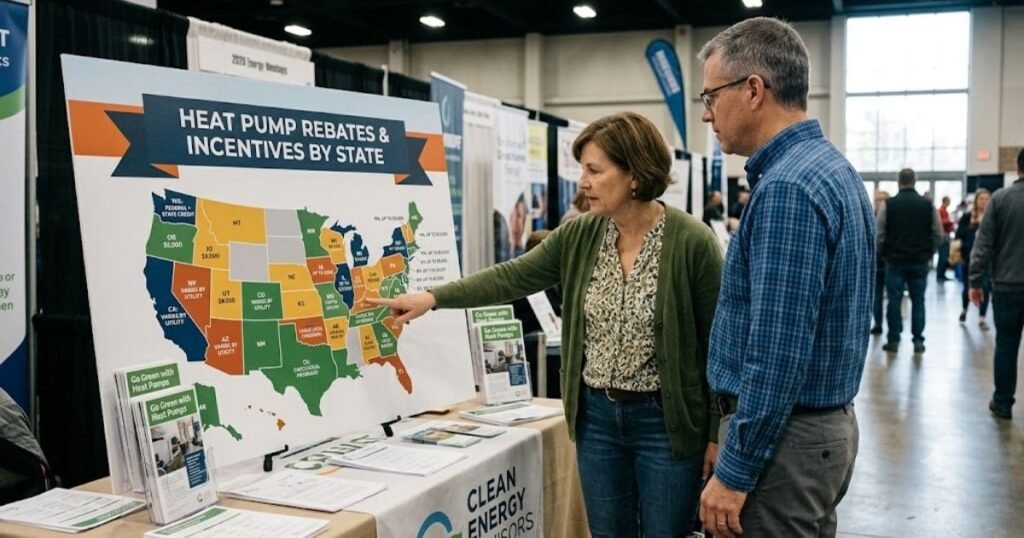
The comprehensive table below provides an overview of estimated heat pump incentives, administrative channels, and foundational requirements across all 50 states and Washington, D.C.
| State | Estimated Incentive | Administered Through | Key Eligibility | Notes |
| Alabama | $300 – $1,200 | Local Electric Utilities | Utility customer status | Focuses on electric-to-electric upgrades. |
| Alaska | Varies by Region | Alaska Housing Finance Corp. | Energy audit required | Tailored heavily for extreme cold-climate performance. |
| Arizona | $500 – $4,000 | State Energy Office & Utilities | Income-verified tiers | Major utility programs offer stackable incentives. |
| Arkansas | $250 – $1,000 | Electric Cooperatives & Entergy | Approved contractor list | Pre-approval needed for cooperative bonuses. |
| California | Up to $8,000 | TECH Clean California / CEC | Fully reserved (Waitlist) | State single-family funds are highly limited; check utility options. |
| Colorado | $1,500 – $6,000 | GEO & Xcel Energy | Qualified heat pump list | State tax exemptions stack with utility cash back. |
| Connecticut | $500 – $4,000 | Energize Connecticut | ENERGY STAR Certified | Enhanced bonuses for low-to-moderate income homes. |
| Delaware | $500 – $3,000 | Energize Delaware | Certified installer required | Check residential clean energy program guidelines. |
| Washington DC | $1,000 – $8,000 | DC Sustainable Energy Utility | Income-qualified limits | Focuses on fossil-fuel displacement. |
| Florida | $300 – $1,500 | FPL, Duke Energy, TECO | Residential account holder | Focuses heavily on high-SEER2 cooling metrics. |
| Georgia | $250 – $1,200 | Georgia Power & Co-ops | Specific SEER2 minimums | Mail-in rebates must be filed within 90 days. |
| Hawaii | $250 – $1,000 | Hawaii Energy | Residential electric account | Focuses primarily on split-system mini-splits. |
| Idaho | $400 – $1,200 | Idaho Power | All-electric heating status | Applies to qualified cold-climate air-source models. |
| Illinois | $500 – $3,500 | ComEd / Ameren Illinois | Approved HVAC network | Utility-driven instant discounts are widely available. |
| Indiana | $300 – $1,500 | Duke Energy / REMCs | Efficiency minimums | Dual-fuel configurations often carry distinct rules. |
| Iowa | $200 – $1,200 | MidAmerican & Alliant | Match local code standards | Standard utility rebates apply post-installation. |
| Kansas | $250 – $1,000 | Evergy & Local Co-ops | Residential customers | Focuses on replacing aging, inefficient central ACs. |
| Kentucky | $300 – $1,200 | KU / LG&E / Co-ops | AHRI-matched systems | Must submit itemized dealer invoices. |
| Louisiana | $200 – $800 | Entergy Louisiana / CLECO | Active residential status | Heavy focus on summer heat load mitigation. |
| Maine | Up to $3,000 | Efficiency Maine | Residential & income limits | Whole-home or supplemental options widely utilized. |
| Maryland | $500 – $5,000 | BGE / Pepco / EmPOWER MD | EmPOWER guidelines apply | Excellent stacking opportunities with local county funds. |
| Massachusetts | Up to $10,000 | Mass Save | Whole-home verification | Leading program for total oil/propane conversions. |
| Michigan | $400 – $2,500 | DTE Energy / Consumers Energy | Prescribed equipment list | Instant midstream incentives applied by contractors. |
| Minnesota | $500 – $4,000 | State Energy Office & Utilities | Cold-climate certification | Systems must maintain output at low temperatures. |
| Mississippi | $200 – $1,000 | Local Power Associations | Registered accounts only | Pre-approval heavily suggested before purchase. |
| Missouri | $300 – $1,500 | Ameren / Evergy / Spire | Active electric account | Rebates scale higher with improved SEER2 levels. |
| Montana | $400 – $2,000 | NorthWest Energy | Specific cold-rated models | Covers ducted and multi-zone mini-split layouts. |
| Nebraska | $300 – $1,200 | OPPD / NPPD | Utility program rules | Promotes transition away from baseboard resistance. |
| Nevada | $500 – $2,500 | NV Energy | Certified contractor | Instant rebates available through participating dealers. |
| New Hampshire | $500 – $3,000 | NHSaves Program | Program funding caps | Check seasonal budget status before starting work. |
| New Jersey | $1,000 – $5,000 | NJ Clean Energy / Utilities | Tiered efficiency levels | Excellent point-of-sale utility integration networks. |
| New Mexico | $300 – $2,000 | PNM / El Paso Electric | Match strict Tier guidelines | Enhanced incentives for rural or income-qualified areas. |
| New York | Up to $8,000 | NYSERDA / Clean Heat | NYS Clean Heat parameters | Substantial regional bonuses based on climate demands. |
| North Carolina | $300 – $1,500 | Duke Energy / Co-ops | Program application limits | Smart thermostat installation often required. |
| North Dakota | $200 – $1,000 | Local Electric Cooperatives | Cooperative member status | Focuses on secondary backup fuel integration. |
| Ohio | $300 – $1,800 | AEP Ohio / FirstEnergy | Authorized trade ally | Virtual home assessments are sometimes requested. |
| Oklahoma | $250 – $1,200 | PSO / OG&E | Homeowner verification | Focuses on summer peak load reduction targets. |
| Oregon | Up to $4,000 | Energy Trust of Oregon | Multi-tier income filters | Excellent options for ducted and ductless upgrades. |
| Pennsylvania | $400 – $2,000 | PECO / PPL / FirstEnergy | Act 129 compliance | Rebate applications must be filed swiftly. |
| Rhode Island | $500 – $4,500 | Rhode Island Energy | Prescribed equipment lists | Enhanced incentives for switching away from oil heat. |
| South Carolina | $300 – $1,200 | Duke Energy / Dominion | Residential rate codes | Invoices must separate labor and materials. |
| South Dakota | $200 – $1,000 | Black Hills Energy / Co-ops | Verified model numbers | Focuses on electric heat infrastructure growth. |
| Tennessee | $250 – $1,500 | TVA / Local Power Companies | eScore program frameworks | Requires inspection post-installation by TVA. |
| Texas | $300 – $2,500 | Local Utilities (Oncor, CenterPoint) | Planning phase for state | Rely heavily on regional utility promos for now. |
| Utah | $400 – $2,000 | Rocky Mountain Power | Wattsmart program guidelines | Requires qualifying heat pump components. |
| Vermont | $1,000 – $4,000 | Efficiency Vermont | Income-qualified scales | Strong focus on cold-climate mini-split units. |
| Virginia | $300 – $1,500 | Dominion Energy / APCO | Approved contractor list | Rebate portal submission required post-install. |
| Washington | Up to $6,000 | Department of Commerce / Utilities | Focus on fossil fuel switches | High local municipal incentives exist in Seattle. |
| West Virginia | $200 – $1,200 | FirstEnergy / APCO | Residential structures | Standard post-purchase mail-in programs. |
| Wisconsin | $500 – $3,000 | Focus on Energy | Focus on Energy network | Scaled incentives based on rural and urban lines. |
| Wyoming | $300 – $1,500 | Rocky Mountain Power | Wattsmart guidelines | Must confirm your unit is certified for cold zones. |
READ MORE: Goodman Heat Pump Review | Efficiency, Cost, Pros & Cons
Utility Company Heat Pump Rebates Homeowners Often Miss
While massive state programs get all the press, local utility companies are often the unsung heroes of home renovation savings. Power providers frequently run their own independent incentive cycles to reduce peak strain on the electrical grid.
These opportunities fall into three primary categories:
- Local Electric Utilities: Large investor-owned companies offering tiered mail-in rebate checks based on system efficiency scores.
- Municipal Utilities: City-owned energy departments that frequently provide flexible, localized financing or instant equipment discounts.
- Cooperative Utilities: Rural, member-owned electric cooperatives that often present substantial installation bonuses to help members transition away from propane.
Homeowner Action Checklist
- [ ] Contact your utility provider: Call or visit their website before requesting any HVAC quotes.
- [ ] Verify contractor requirements: Confirm whether your chosen technician must be part of the utility’s authorized trade network.
- [ ] Confirm the approved equipment list: Ensure the specific model number you are buying is explicitly listed on the utility’s active qualification sheet.
- [ ] Save all documentation: Keep copies of your itemized contractor invoices, load calculations, and equipment AHRI reference sheets.
- [ ] Track application deadlines: Many utilities require you to submit your final paperwork within 60 to 90 days of system commissioning.
READ MORE: Ductless vs. Ducted Heat Pumps: Which One Saves More for Your Home?
Income-Based Heat Pump Assistance Programs
If you are working with a tight budget, you may qualify for specialized income-contingent energy upgrade programs. Many states reserve their largest financial pools explicitly for low-to-moderate-income (LMI) households.
These programs often remove the financial barrier entirely by transitioning from traditional mail-in rewards to instant point-of-sale discounts. For households earning below 80% of their area’s median income (AMI), certain active state-level programs can cover up to 100% of the equipment purchase price, capped at $8,000 for space-heating heat pumps. Moderate-income households earning between 80% and 150% of their AMI frequently qualify for a 50% discount capped at $4,000.
Can I Combine Incentives?
In most cases, yes. This strategy is known as “incentive stacking.” While you cannot double-dip by claiming the exact same state-funded rebate twice for one piece of equipment, you can typically stack an instant manufacturer promotional credit with a local electric utility rebate and any active state clean-energy program. Always review each program’s fine print, as some state-administered funds explicitly bar stacking with other federally sourced grants.
How to Qualify for Heat Pump Incentives in 2026
Securing your rebate money requires following a precise, sequential process. Making a single procedural mistake can disqualify your application entirely.
- Step 1: Check State Eligibility. Use tools like DSIREusa.org or your state energy office website to verify active program funds before doing anything else.
- Step 2: Verify Approved Equipment. Ensure the proposed heat pump meets the required SEER2, EER2, and HSPF2 efficiency ratings.
- Step 3: Confirm Contractor Requirements. Many programs require utilizing an approved or certified trade ally.
- Step 4: Collect Documents. Gather your itemized receipts, proof of permit, contractor certifications, and old equipment disposal records.
- Step 5: Submit Applications. Complete the online portal registration or mail-in forms within the designated program timeline.
- Step 6: Track Payment Timeline. Monitor your submission status dashboard. Mail-in processing typically takes 6 to 12 weeks.
Common Mistakes Homeowners Make
- Skipping the Pre-Approval Phase: Failing to secure a mandatory program reservation prior to dismantling your old HVAC system.
- Hiring Uncertified Labor: Using a standard contractor when the program rules strictly require an authorized, program-trained installer.
- Mismatched Equipment Parts: Buying an outdoor condenser unit that is not officially certified by the AHRI to work with your indoor air handler, which voids efficiency scores.
READ MORE: Best Swimming Pool Heat Pump : Review, Comparison, and Buying Tips
Heat Pump Cost vs. Rebate Savings Calculator Examples
To see how these variables interact, let’s review three common residential installation scenarios.
Scenario A: Small Home or Condominium (Ductless Mini-Split Upgrade)
- Equipment Cost & Installation Estimate: $6,500
- Estimated State/Utility Incentive: $1,500
- Net Homeowner Cost: $5,000
Scenario B: Average Suburban Home (Full Ducted System Replacement)
- Equipment Cost & Installation Estimate: $13,500
- Estimated State/Utility Incentive: $3,000
- Net Homeowner Cost: $10,500
Scenario C: Large Home (Multi-Zone Cold-Climate Setup)
- Equipment Cost & Installation Estimate: $21,000
- Estimated State/Utility Incentive: $5,500
- Net Homeowner Cost: $15,500
Heat Pump Buying Tips Before You Apply
When investing in a heat pump, you aren’t just buying an appliance you are purchasing engineered home infrastructure. Keep these critical technical factors in mind:
- SEER2 and HSPF2 Ratings: These metrics represent updated, real-world testing standards for cooling (SEER2) and heating (HSPF2) efficiency. Older SEER/HSPF labels are outdated; ensure your contractor quotes reference the new “2” suffix metrics required by 2026 programs.
- Cold Climate Performance: If you live in an area where temperatures routinely drop below freezing, request an extended performance model optimized to deliver strong heat output down to -15°F without relying on inefficient backup electric heat strips.
- Installation Quality over Brand Name: A mid-tier heat pump installed perfectly will outperform a top-tier system installed poorly. Prioritize comprehensive load calculations over generic rule-of-thumb sizing estimates.
Questions to Ask Your HVAC Installer
- “Is this specific model combination listed on the active AHRI directory as a qualifying system for our local utility rebate program?”
- “Are you registered as an authorized trade ally or certified installer under our state’s active clean-energy programs?”
- “Will the rebate be applied directly to my invoice as an upfront discount, or do I need to file the mail-in paperwork myself?”
READ MORE: Solar Powered Heat Pump Cost: USA Homeowner Guide to Savings
Future Outlook for Heat Pump Incentives
Clean-energy funding cycles are inherently volatile. State legislatures continuously alter annual budget caps, and utility programs routinely close down early in the year once their designated green-fund allocations are exhausted.
Furthermore, shifting national and local energy policies introduce ongoing uncertainty regarding long-term program availability. If your current HVAC system is over 12 years old or showing signs of mechanical failure, acting while current 2026 funding pools remain active is highly recommended. Waiting until a total system breakdown occurs often robs you of the time required to navigate mandatory pre-approval and program matching processes.
Frequently Asked Questions
What states offer the best heat pump rebates in 2026?
States like Massachusetts, New York, and various Pacific Northwest territories offer some of the most comprehensive rebate programs in the nation. Through programs like Mass Save and the NYS Clean Heat network, whole-home conversions transitioning away from fossil fuels can capture thousands of dollars in direct cash incentives.
Is there a federal heat pump tax credit in 2026?
The historical availability of the baseline Section 25C federal tax credit focused primarily on systems installed before the end of 2025. Because federal rules changed after 2025, you should verify current active federal eligibility parameters with a licensed tax specialist before making a purchase decision.
Can I combine state rebates with utility incentives?
Yes, in many jurisdictions you can successfully stack local electric utility rebates with manufacturer promotional credits and regional state energy office incentives. However, rules vary by program. Certain state-administered federal grant systems restrict you from mixing multiple federally sourced funding channels for the exact same physical installation.
How much can homeowners save with heat pump rebates?
Typical residential savings range anywhere from $500 for simple supplemental utility upgrades up to $8,000 or more for comprehensive, income-verified whole-home conversions. The total savings amount depends directly on your household’s Area Median Income tier, your geographic location, and the efficiency rating of the equipment you select.
How do I apply for heat pump rebates in my state?
The application process starts by visiting your local electric utility portal or state energy office website to confirm active programs. From there, you must select an approved, program-registered contractor who will perform a proper load calculation, verify equipment eligibility, and assist you in securing any mandatory pre-approval reservations before the physical installation begins.
Conclusion
Upgrading to an electric heat pump is a reliable way to insulate your household from volatile energy prices while optimizing year-round home comfort. While navigating the maze of 2026 state frameworks, income limits, and utility timelines requires effort, the financial rewards make the research well worth your time.
Do not leave thousands of dollars on the table by rushing into an emergency purchase after your current system breaks down. Take control of your home utility costs by verifying your local options today.