If your Navien combi boiler has stopped delivering hot water, isn’t heating your home evenly, or is flashing an error code you don’t recognize, you’re not alone. Navien is one of the most widely installed combi boiler brands in American homes, prized for tucking a tankless water heater and a space-heating boiler into one compact, wall-mounted unit.
The good news: many Navien combi boiler issues can be diagnosed, and some even resolved, before you pick up the phone. Others are safety-critical and need a licensed technician, no exceptions.
This guide walks you through how your unit works, the most common problems homeowners run into, what your error code is actually telling you, which fixes are safe to try yourself, what repairs typically cost across the U.S.. Let’s get your heat and hot water back on track. Lets deep dive into “Navien Combi Boiler Repair: Troubleshooting, Error Codes & Costs”
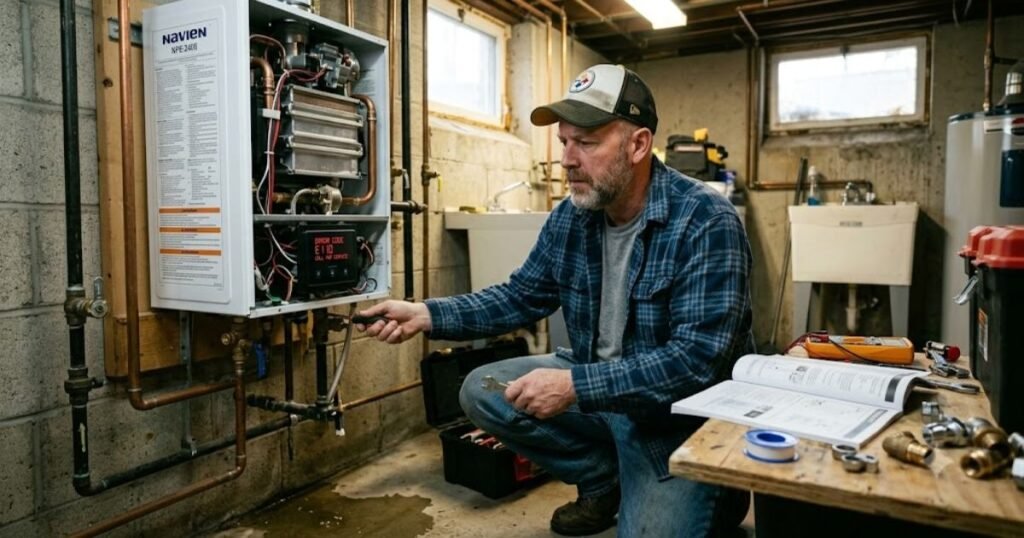
Navien Combi Boiler Quick Facts Box
| Average lifespan | 10–15 years under warranty; 15–20+ years with consistent annual maintenance |
| Recommended maintenance | Once per year, performed by a licensed technician |
| Typical repair cost range | $150–$1,200 for most single-component repairs |
| Efficiency rating | Roughly 90–95% AFUE on most residential combi models |
READ MORE: Best Natural Gas Boilers for Home Heating: Review & Comparison
Signs Your Navien Combi Boiler Needs Repair
Combi boilers rarely fail without warning. Usually there’s a pattern of small symptoms before a full breakdown. Watch for:
- No hot water at any fixture, or hot water that runs out almost immediately
- No heat, or heat in some rooms but not others
- Frequent shutdowns in the middle of a heating or hot water cycle
- Unusual noises — banging, kettling, gurgling, or a loud humming fan
- Visible water leaks around the base or fittings of the unit
- Low or fluctuating system pressure on the gauge or display
- Temperature swings where water goes from hot to lukewarm to cold
- An error code on the front panel display
Repair Now vs. Monitor Later
| Repair now | Monitor / schedule soon |
| Any smell of gas | Slightly lower-than-normal hot water pressure |
| No heat during cold weather | Minor, one-time pressure drop that self-corrects |
| Active water leak | Occasional short-cycling in mild weather |
| Repeated lockout on the same error code | A single error code cleared by one reset |
| Burning smell or scorch marks | Slight noise increase that isn’t worsening |
READ MORE: Weil‑McLain Boiler Reviews — Models, Costs, Pros & Cons
Most Common Navien Combi Boiler Problems (Detailed Troubleshooting)
1. Boiler Not Producing Hot Water
This is the single most common complaint with any combi boiler. Since hot water is generated on demand rather than stored, anything that interrupts flow or sensing shuts down output immediately.
- Flow restrictions: A clogged inlet water filter (most Navien units have a small accessible screen filter) or mineral scale buildup in the heat exchanger can choke water flow enough that the unit never triggers a hot water cycle.
- Sensor problems: The flow sensor or temperature sensor (thermistor) can fail or read incorrectly, so the boiler never “knows” you turned on the tap.
- Heat exchanger issues: Scale buildup on the plate heat exchanger especially common in hard-water regions reduces heat transfer and can eventually trigger a safety shutdown.
- Homeowner checks: Confirm the gas supply valve is fully open, check that the unit’s power switch is on, and look for an error code before assuming the worst.
2. Boiler Not Heating the House
- Thermostat settings: A dead thermostat battery, wrong mode setting, or a thermostat wired to the wrong terminal can leave the boiler idle even though it’s functioning correctly.
- Circulation problems: If the internal or external circulator pump has failed or is airlocked, water won’t move through your radiators or radiant loop even if the burner is firing.
- Zone configuration issues: Homes with multiple heating zones can lose heat to one area if a zone valve or zone control board fails, while other zones stay warm.
- Pressure issues: Low system pressure can prevent the heating side from operating even when domestic hot water works fine.
3. Ignition Failure
When the boiler tries repeatedly to light and can’t sustain a flame, it’s usually one of a few things:
- Gas supply: A partially closed gas valve, an empty propane tank, or low incoming gas pressure.
- Flame detection: A dirty or worn flame rod (the small sensor near the burner) can prevent the control board from confirming ignition, so it shuts the gas valve back off as a safety measure.
- Reset process: Most Navien panels allow a single reset via the front display or a dedicated reset button. If the same ignition-related code returns immediately after reset, stop trying and call a technician repeated ignition attempts without success can indicate a gas delivery or electrode problem that isn’t safe to keep testing on your own.
4. Boiler Keeps Turning Off
- Safety lockouts: Built-in protections shut the unit down if it senses overheating, flame loss, or abnormal pressure this is the system working as designed, not malfunctioning.
- Venting concerns: A partially blocked intake or exhaust vent (leaves, snow, a bird’s nest, or ice in winter) can trip a safety shutdown.
- Internal protection systems: Repeated short cycling often points to airflow, water flow, or a failing sensor rather than the burner itself.
5. Water Leaks Around the Unit
- Loose fittings: Vibration and thermal expansion over years of operation can loosen compression fittings or unions.
- Internal valve wear: A pressure relief valve that weeps periodically may simply need replacement, or it may be responding correctly to genuinely excessive pressure elsewhere in the system.
- Condensate concerns: Because these are condensing boilers, a cracked or clogged condensate line can cause water to back up and drip from the unit this is often mistaken for a “leak” but is really a drainage problem.
Safety note: If you see active water pooling near any gas connection or electrical component, shut off power to the unit at the switch and call a professional before doing anything else.
6. Low Pressure Problems
- Normal operating range: Most residential systems should read between roughly 12–15 psi (about 1–1.2 bar) when the system is cold, though your specific model’s manual is the final word.
- Repressurizing basics: Many Navien combi units have a filling loop or auto-feed valve that lets you top off pressure. If your pressure keeps dropping and needs regular refilling, that’s a sign of a slow leak somewhere in the system, not a one-time fix.
- Warning signs: A pressure gauge that climbs too high (over roughly 30 psi) is just as concerning as one that’s too low, and can point to a failed expansion tank or an overfilled system.
READ MORE: Electric Boiler Cost— Real Prices, Installation & Buying Guide
Navien Boiler Error Codes Explained
Navien’s diagnostic display is genuinely useful; it narrows down the problem before anyone opens a panel. Codes and exact numbering can vary slightly by model and generation, so always cross-check against your unit’s manual or data plate, but the following are the codes homeowners most commonly encounter.
| Error Code | Meaning | Possible Cause | DIY Friendly? | Call Technician? |
| 003 / E003 | Ignition failure | No/low gas supply, dirty flame rod, closed gas valve | Check gas valve is open | Yes, if it recurs after one reset |
| 012 | Flame loss during operation | Gas pressure drop, frozen condensate line, blocked flue | Thaw a visibly frozen condensate line | Yes, if it repeats |
| 016 | Heat exchanger overheating | Scale buildup, restricted hot water flow, sediment | Note if hot water cools quickly | Yes — always |
| 030 | Abnormal exhaust temperature | Blocked or restricted vent, poor combustion | Visually check vent termination for blockage | Yes — combustion issue |
| 109 | Fan error | Blocked intake/exhaust, failing fan motor | Clear visible debris from vent terminal | Yes, if it doesn’t clear |
| 110 | Exhaust blockage | Vent obstruction from snow, debris, or wildlife | Clear obvious external blockage | Yes, if code persists |
| 302 | Low system pressure | Leak, air in system, failed expansion tank | Repressurize via filling loop | Yes, if pressure keeps dropping |
| 352 | High system pressure | Overfilled system, faulty pressure sensor | Bleed a small amount of water if overfilled | Yes, if it recurs |
| 407 / 421 | Thermistor (sensor) fault | Failed or miscalibrated temperature sensor | Power-cycle the unit once | Yes — sensor replacement needs a multimeter check |
A note on resets: A single power cycle or front-panel reset is generally safe to try once. If the exact same code returns right away, resetting repeatedly won’t fix an underlying gas, combustion, or component failure and can mask a problem that needs professional attention.
READ MORE: Viessmann Boiler Review | Efficiency, Models, Pros & Cons
Safe DIY Navien Combi Boiler Repair Checklist
Before calling for service, these steps are safe for most homeowners to try:
- Power cycle/reset: Turn the unit off, wait several minutes, and turn it back on. Try the front panel reset once if the code persists.
- Check pressure: Look at the gauge or digital display and compare it to your system’s normal operating range.
- Inspect the visible vent termination: From outside, confirm the intake and exhaust pipes aren’t blocked by snow, leaves, or debris.
- Verify thermostat settings: Check batteries, mode (heat vs. off), and set temperature.
- Clean external, homeowner-accessible filters: Some models have an inlet water filter you can access without tools; consult your manual before removing anything.
- Check for leaks: Look around visible fittings and the base of the unit for pooling water or corrosion.
Stop immediately and call a professional if:
- You smell gas anywhere near the unit
- The unit shows scorch marks, soot, or a burning smell
- An error code returns immediately after a reset
- You see water near electrical components
- You’re not fully confident about what you’re looking at
Gas, high water pressure, and electrical components inside a combi boiler are not a place for guesswork. When in doubt, Navien’s own guidance is that end users can safely do only limited troubleshooting most issues should go to your original installer or a Navien Service Specialist, and Navien technical support (1-800-519-8794) can help route you to one if needed.
Repair Cost Guide for U.S. Homeowners
Actual pricing varies by region, labor rates, and whether you’re calling during normal hours or as an after-hours emergency, but these ranges reflect what U.S. homeowners typically see for residential combi boiler repairs.
| Repair Type | Typical Cost Range |
| Diagnostic visit | $90–$180 (often applied toward the repair) |
| Sensor replacement (flow, thermistor, etc.) | $150–$350 |
| Ignition repair (flame rod, ignitor) | $150–$400 |
| Circulation pump repair/replacement | $300–$800 |
| Heat exchanger repair | $1,000–$2,500+ |
| Control board replacement | $500–$1,200 |
| Full unit replacement (installed) | $5,000–$11,000+, depending on model, venting, and home size |
Money-saving maintenance tips
- Schedule your annual service in the off-season (spring or early fall) rather than during peak winter demand, when emergency rates apply.
- Keep your original installation paperwork and many repairs during the first year or two are still covered under labor warranty.
- Address small pressure drops and minor error codes right away; a $150 sensor fix now is a lot cheaper than the heat exchanger damage that can follow months of low water flow.
- Ask about water treatment if you’re in a hard-water area scale buildup is behind a large share of the most expensive repairs on this list.
READ MORE: New Boilers Buying Guide for Homes and Businesses
Annual Maintenance That Prevents Expensive Repairs
Most of the costly repairs above trace back to something a routine service visit would have caught. A yearly inspection typically includes:
- Annual inspection: A licensed technician checks combustion, venting, and overall operation against manufacturer specs.
- System flushing: Removes sediment and sludge that accumulate in the heating loop over time.
- Water quality management: Especially important in hard-water regions, where scale is the leading cause of heat exchanger problems.
- Condensate cleaning: Keeps the condensate trap and drain line clear, preventing the backups that cause flame-loss and overheating codes.
- Air intake inspection: Confirms the intake and exhaust vents are unobstructed and properly sealed.
- Pressure checks: Confirms the system is holding pressure correctly and isn’t slowly leaking.
Annual Maintenance Checklist
- [ ] Schedule professional inspection and service
- [ ] Flush the heating loop
- [ ] Clean or inspect the condensate trap
- [ ] Check inlet water filter
- [ ] Inspect vent terminations (inside and outside)
- [ ] Confirm system pressure is in normal range
- [ ] Test for unusual noise or vibration
- [ ] Review error code history with your technician
Real Homeowner Experiences & Lessons Learned
Analyzing discussions across online homeowner networks reveals distinct trends in real-world Navien operations.
The Problem with Short-Cycling
A common complaint involves boilers that constantly shut down and restart every few minutes, commonly referred to as “short-cycling.” Homeowners often think this indicates a broken control board, but technicians frequently discover the true cause is an oversized boiler paired with low-volume heating zones. If a small zone calls for heat, the boiler generates thermal energy faster than the small pipes can dissipate it, forcing a rapid safety shutdown. Adjusting the internal control board parameters to limit firing capacity frequently resolves this issue without requiring expensive replacement parts.
Flame Loss and Water Quality
Another common issue centers around unexpected “Flame Loss” error codes (Error 012). Homeowners often change out parts repeatedly only to find the error persists. The actual culprit is frequently a clogged condensate drain line backed up into the combustion box, which dampens the flame rod’s sensing capability. Keeping the condensate trap clear prevents this frustrating issue entirely.
Repair vs. Replace — When Does a Navien Boiler Stop Being Worth Fixing?
Not every problem is worth fixing on an aging unit. A few factors matter most:
- Age of the unit: Units past the 10–15 year mark are more likely to need major-component repairs, and parts availability can become an issue on older or discontinued models.
- Frequency of repairs: A unit that’s needed two or more significant repairs in the past year is trending toward replacement territory.
- Efficiency losses: Older units run less efficiently even when “working,” so a higher gas bill can be a hidden cost of delaying replacement.
- Warranty considerations: A repair on a unit still under parts or labor warranty is a very different financial decision than the same repair on an out-of-warranty unit.
Decision Table: Repair or Replace
| Situation | Recommendation |
| Unit under 8 years old, single-component failure | Repair |
| Unit 8–12 years old, moderate repair cost, good maintenance history | Repair, but plan ahead for eventual replacement |
| Unit over 12–15 years old, repair cost exceeds ~50% of a new installed unit | Replace |
| Cracked or badly scaled heat exchanger on an older unit | Replace |
| Multiple failures within 12 months | Replace |
| Unit still under labor/parts warranty | Repair |
Final Thoughts
Most Navien combi boiler problems fall into a handful of familiar categories flow and sensor issues, ignition trouble, pressure swings, and venting blockages and a good number of them can be narrowed down, if not resolved, before a technician ever arrives. The habits that matter most are the simple ones: check the error code, don’t ignore small pressure drops, and don’t skip your annual service. A maintenance-first approach costs far less over the life of your boiler than reactive, emergency repairs, and catching problems early is almost always the difference between a $150 fix and a $2,000 one. When something is beyond safe DIY territory gas smells, recurring lockouts, or anything involving the heat exchanger or gas valve a licensed technician or Navien Service Specialist is worth the call every time.
Frequently Asked Questions
Why is my Navien combi boiler not producing hot water?
The most common causes are a clogged inlet filter, mineral scale in the heat exchanger, or a faulty flow/temperature sensor. Start by checking for an error code and confirming the gas supply is on; if hot water doesn’t return after a reset, the heat exchanger or a sensor likely needs professional attention.
How do I reset a Navien combi boiler?
Use the front panel reset button or power-cycle the unit by turning it off, waiting a few minutes, then turning it back on. One reset attempt is safe; if the same error code returns immediately, stop resetting and call a technician.
What does Navien error code E003 mean?
E003 (or 003) indicates an ignition failure — the boiler tried to light but couldn’t establish a flame. Common causes include a closed or restricted gas valve, low gas pressure, or a dirty flame rod. If it repeats after one reset, it needs professional diagnosis.
How much does Navien boiler repair cost in the USA?
Most single-component repairs range from $150 to $1,200, depending on the part. Diagnostic visits typically run $90–$180, while major repairs like a heat exchanger or control board replacement can run $1,000–$2,500 or more.
Should I repair or replace my Navien combi boiler?
Repair units under 8–10 years old with a single, isolated failure. Consider replacement if the unit is older than 12–15 years, has had multiple failures in the past year, or the repair cost approaches half the price of a new installed unit.