When your water heater approaches the end of its lifespan, or when you are building or remodeling, you face a major decision: tankless water heater vs tank water heater.
I’ve walked into hundreds of basements, utility closets, and garages where homeowners were staring at a leaking, rusted tank, trying to decide in a panic what to replace it with. That’s not the ideal time to make this call. The best choice depends on your budget, your family size, how much hot water you actually use, your home’s existing gas and electrical setup, and how long you plan to stay in the house.
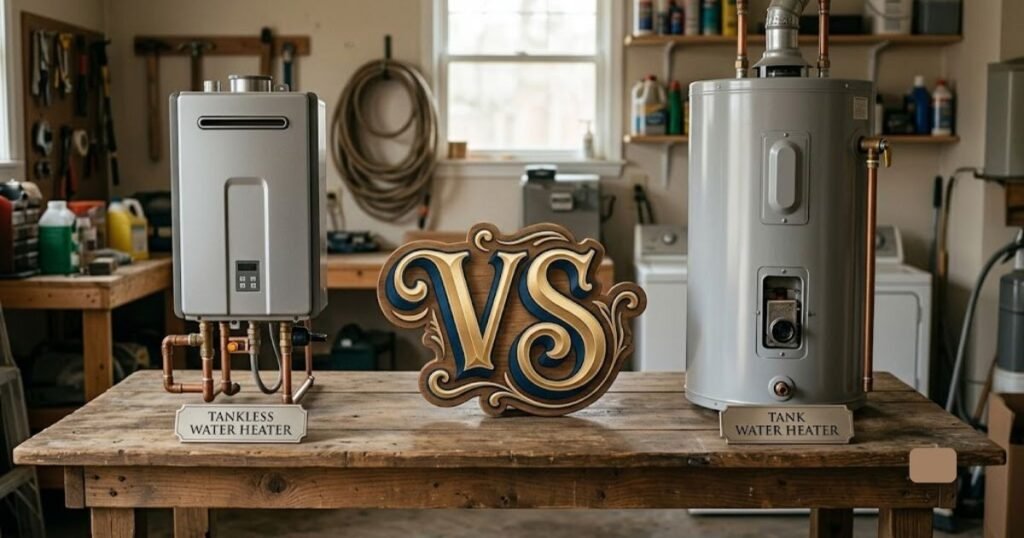
This guide breaks down everything — real costs, efficiency numbers, installation quirks, lifespan, maintenance, and the mistakes I see homeowners make over and over. By the end, you’ll know exactly which system fits your home. Lets deep dive into “Tankless Water Heater vs Tank Water Heater: Which Is Better?”
READ MORE: AO Smith vs. Rheem Water Heaters: Comparison & Expert Reviews
How Each Water Heater Works
What Is a Tank Water Heater?
A tank water heater is the classic setup most Americans grew up with: an insulated steel tank that holds anywhere from 30 to 80 gallons of water, kept hot around the clock.
How it works:
- Cold water enters the tank and is heated by a gas burner or electric heating element.
- The tank stores that hot water until you need it, keeping it at a set temperature (usually 120°F).
- When you turn on a faucet, hot water flows out from the top while cold water refills the bottom.
Key terms worth knowing:
- Recovery rate — how quickly the unit can reheat water after the tank runs low. Gas units generally recover faster than electric ones.
- Standby heat loss — the energy wasted keeping a full tank of water hot 24/7, even while you’re at work or asleep.
- Common capacities — 30-gallon (small households, apartments), 40-gallon (1–2 bathrooms), 50-gallon (families of 3–5), and 75–80-gallon (large households or high-demand homes).
Gas tank models heat faster and cost less to run in most regions, while electric tank models are cheaper to install and don’t require venting.
What Is a Tankless Water Heater?
A tankless (or “on-demand”) water heater skips the storage tank entirely. Instead, it heats water instantly as it flows through the unit.
How it works:
- Cold water enters the unit and passes over a heat exchanger.
- A gas burner or electric element rapidly heats the water as it flows through — no waiting for a tank to warm up.
- Hot water comes out continuously for as long as the tap stays open, within the unit’s flow-rate limits.
Key terms worth knowing:
- Heat exchanger — the core component that transfers heat directly into flowing water.
- Whole-house units — sized to serve every fixture in the home at once.
- Point-of-use units — smaller units installed near a single fixture, like a guest bathroom or outdoor shower.
Because there’s no tank to keep hot, standby energy loss is nearly eliminated. That’s the single biggest advantage tankless systems bring to the table.
Tankless Water Heater vs Tank Water Heater: Which Is Better?
| Feature | Tank Water Heater | Tankless Water Heater |
| Upfront Cost | Lower ($400–$2,100 for the unit) | Higher ($450–$4,000 for the unit) |
| Installation Cost | $600–$2,500 total, typical | $1,400–$5,600 total, typical |
| Operating Cost | Higher (standby losses) | Lower (10–34% less energy use) |
| Energy Efficiency | UEF 0.55–0.70 typical | UEF 0.80–0.99 typical |
| Lifespan | 8–12 years | 15–20+ years |
| Maintenance | Annual flush, anode rod checks | Annual descaling, filter cleaning |
| Space Required | Large floor footprint | Compact, wall-mounted |
| Hot Water Supply | Limited by tank size | Continuous, limited by flow rate |
| Best Household Size | 1–5 people (size-dependent) | Any size (properly sized unit) |
| Recovery Time | 20–60+ minutes | Instant, no recovery needed |
| Flow Rate | High (whole tank available) | Fixed max GPM per unit |
| Utility Savings | Baseline | $70–$180+ per year, typical |
| Warranty | 6–12 years, typical | 10–15 years, typical |
| Environmental Impact | Higher energy waste | Lower carbon footprint |
| Long-Term Value | Lower over 15–20 years | Higher over 15–20 years |
Did You Know? A standard 50-gallon tank water heater loses heat to the surrounding air even when nobody’s home — that “standby loss” alone can account for a meaningful chunk of your water heating bill every single month.
READ MORE: Best Tankless Electric Water Heaters: Top 5 Models for U.S. Homes
Initial Water Heater Purchase Cost
Sticker price is where most homeowners start, and it’s also where tank water heaters win, hands down.
Tank water heaters (U.S. averages):
- Equipment only: $400–$2,100, depending on capacity and efficiency
- Installed, standard replacement: $600–$3,100
- Gas tank units typically run a bit more than electric due to venting requirements
Tankless water heaters (U.S. averages):
- Equipment only: $450–$4,000, depending on fuel type and capacity
- Electric whole-house units installed: roughly $1,400–$3,000
- Gas whole-house units installed: roughly $2,100–$5,600
- Most homeowners nationally land around $2,600–$3,000 for a complete tankless installation
What drives installation cost higher:
- Venting — condensing tankless gas units need specific PVC venting; non-condensing units need stainless steel
- Gas line upgrades — tankless units often demand a larger gas line than your existing tank used
- Electrical upgrades — electric tankless units can require a dedicated 240-volt circuit or even a panel upgrade
- Additional plumbing — relocating the unit or adding a recirculation loop
- Permits — most municipalities require one, typically $50–$300
- Labor — a straightforward tank swap takes 1–3 hours; a tank-to-tankless conversion can take a full day or more
Expert Tip: Get at least three quotes, and ask each contractor to break out equipment cost, labor, and any “upgrade” line items separately. That’s the easiest way to spot inflated pricing.
Water Heater Operating Costs
This is where tankless earns back its higher price tag over time.
- Standby loss on a tank system runs continuously, even overnight or while you’re on vacation.
- Tankless systems only use energy when water is actually flowing, which is why the U.S. Department of Energy has long identified on-demand heating as one of the more effective ways to cut water heating energy use in typical homes.
- Households using 41 gallons of hot water or less per day can see meaningfully lower energy use with tankless — often in the range of 25–35% less than an equivalent tank system.
- Larger households running multiple showers and appliances back-to-back see smaller but still real savings, generally in the 10–15% range.
- Fuel type matters as much as tank style. Natural gas is usually the cheapest fuel to operate on a monthly basis, followed by propane and then electricity, though this varies heavily by region and local utility rates.
- Annual operating cost differences between tank and tankless typically fall between $70 and $180 per year for an average family, though hard-water regions and high-usage households can shift that number.
Regional differences worth noting:
- Colder climates require more energy to raise incoming water to a usable temperature, which affects both systems but tends to hit tankless flow rates harder.
- States with high electricity costs but cheap natural gas often see the biggest gap between electric tank and gas tankless operating costs.
READ MORE: Best Rinnai Tankless Water Heater Reviews — Models, Specs & Prices
Water Heater Energy Efficiency Comparison
Efficiency for water heaters is measured using the Uniform Energy Factor (UEF), the metric the Department of Energy adopted to replace the older Energy Factor rating. UEF represents how efficiently a unit converts energy into usable hot water higher is always better.
- Standard tank water heaters typically carry a UEF between 0.55 and 0.70.
- High-efficiency and condensing tank models can reach into the 0.80s.
- Standard tankless units typically range from UEF 0.80 to 0.99.
- Heat pump (hybrid) tank water heaters, a different category altogether can post UEF ratings well above 3.0, since they move heat rather than generate it, though they come with their own space and climate requirements.
ENERGY STAR certification is available on both tank and tankless models and signals a unit that outperforms federal minimum efficiency standards. Look for the label if lowering your utility bill is a top priority.
Where DOE standards come in: the Department of Energy periodically raises minimum efficiency requirements for water heaters sold in the U.S. New commercial and light-duty commercial equipment standards are being phased in through 2026 and 2027, and updated standards for residential-class storage water heaters are scheduled to take effect later in the decade. The practical effect for homeowners: expect gas storage tank units, in particular, to require more advanced (often condensing) technology going forward, which can narrow but not eliminate — the efficiency gap with tankless.
Installation Differences
Tank Installation
Tank installations are generally straightforward, especially when replacing an existing tank in the same location:
- Standard venting (for gas models) using existing flue connections
- Simple electrical hookup for 240-volt electric models
- Water line connections to existing plumbing
- Typical job time: 1–3 hours for a like-for-like swap
Tankless Installation
Tankless installations involve more variables:
- Venting — condensing units use PVC intake/exhaust venting; non-condensing units require stainless steel venting rated for higher temperatures
- Gas line sizing — many homes need a larger diameter gas line to deliver enough fuel volume for a tankless unit’s higher BTU demand
- Electrical service — electric tankless units often need a dedicated high-amperage circuit, sometimes prompting a panel upgrade
- Water line modifications — may be needed depending on unit placement
- Condensate drain — required for condensing gas units, since they produce acidic condensation that needs a proper drain
- Recirculation systems — an optional add-on that keeps hot water available near-instantly at distant fixtures, at some cost to energy efficiency
A same-fuel, same-location tankless replacement is the cheapest scenario. Switching fuel types (electric to gas, or vice versa) or relocating the unit adds real cost.
READ MORE: Cheapest 50-Gallon Electric Water Heater — Quick Buyer’s Guide
Lifespan Comparison
| System | Typical Lifespan |
| Tank water heater | 8–12 years |
| Tankless water heater | 15–20+ years |
Tankless units often double the service life of a tank system, largely because they aren’t holding standing water against a metal tank wall 24/7, which is the main driver of tank corrosion and failure.
What shortens lifespan on either system:
- Hard water — mineral-heavy water accelerates sediment buildup in tanks and scale buildup on tankless heat exchangers
- Skipped maintenance — both systems need periodic attention to hit their full expected lifespan
- Corrosion — tanks rely on a sacrificial anode rod that must be checked and replaced periodically to prevent the tank itself from rusting through
- Poor installation — incorrect sizing, venting, or water pressure settings can shorten either system’s life
Maintenance Requirements
Tank Water Heater Maintenance
- Annual tank flushing to remove sediment buildup from the bottom of the tank
- Anode rod inspection every 2–3 years, with replacement as needed to prevent tank corrosion
- Pressure relief valve testing once a year for safety
- Typical annual maintenance cost: $80–$150 if hiring a professional
Tankless Water Heater Maintenance
- Annual descaling (flushing the heat exchanger with a vinegar or descaling solution) — especially important in hard-water regions
- Inlet water filter cleaning, usually a quick DIY task
- Professional heat exchanger inspection every year or two
- Typical annual maintenance cost: $100–$350, higher in hard-water areas
Maintenance Checklist (both systems):
- [ ] Test the pressure relief valve annually
- [ ] Flush or descale according to manufacturer schedule
- [ ] Check for leaks, corrosion, or unusual noises
- [ ] Install a water softener if you’re in a hard-water region
- [ ] Keep the area around the unit clear for ventilation and access
- [ ] Schedule a professional inspection every 1–2 years
Hot Water Performance
- Tank systems deliver hot water instantly from the moment you turn on the tap, but supply is finite — run two showers and a dishwasher at once, and you can outpace what’s stored.
- Tankless systems deliver truly continuous hot water, but output is capped by the unit’s flow rate (measured in gallons per minute, or GPM). Undersized units can struggle when multiple fixtures run simultaneously.
- Peak demand is the real test: a family running a shower, the dishwasher, and the washing machine at the same time needs either a large tank or a properly sized, high-GPM tankless unit — sometimes even two tankless units installed in tandem for larger homes.
- Bathtub filling can also expose undersized tankless units, since large soaking tubs demand high flow rates in a short window.
Expert Tip: If you’re going tankless, ask your installer to calculate your home’s peak simultaneous GPM demand — not just your average daily usage — before recommending a unit size.
READ MORE: Carrier Heat Pump Reviews — Models, Costs, Pros & Cons
Space Requirements
- Tank water heaters need a dedicated floor footprint, typically 2–3 square feet plus clearance, in a basement, utility closet, or garage.
- Tankless water heaters mount on a wall and take up a fraction of the space — a real advantage in condos, tiny homes, and small utility closets where floor space is at a premium.
- Wall-mounted installation also opens up options in homes without a basement or dedicated utility room.
Advantages of Tank Water Heaters
- Lower upfront purchase and installation cost
- Simple, well-understood technology that most plumbers can service quickly
- No flow-rate limitations — hot water use isn’t capped the way tankless is
- Faster, cheaper repairs in most cases
- Works well for smaller households with predictable hot water demand
Disadvantages of Tank Water Heaters
- Shorter lifespan (8–12 years)
- Higher standby energy loss and operating costs
- Can run out of hot water during high-demand periods
- Larger footprint takes up valuable floor space
- Tank failure can cause water damage if not caught early
Advantages of Tankless Water Heaters
- Continuous, on-demand hot water supply
- Lower operating costs over time
- Significantly longer lifespan (15–20+ years)
- Compact, wall-mounted design saves space
- Reduced standby energy loss and smaller carbon footprint
Disadvantages of Tankless Water Heaters
- Higher upfront and installation costs
- Flow rate limits can be an issue in larger households without proper sizing
- May require gas line or electrical upgrades
- Requires more specialized installation and service technicians
- Annual descaling is essential, especially with hard water
Which Water Heater Is Best For…
| Household Type | Better Choice | Why |
| Single homeowner | Tank or small tankless | Low demand; either works well |
| Couple | Tank (40-gal) or electric tankless | Moderate, predictable demand |
| Family of 4 | Tankless (gas) or 50-gal tank | Depends on budget and simultaneous use |
| Large family (5+) | Tankless (properly sized) or 75–80-gal tank | High peak demand needs strong flow or capacity |
| Vacation home | Tank | Lower upfront cost for occasional use |
| Rental property | Tank | Lower cost, simpler repairs for tenants |
| Luxury home | Tankless (possibly dual units) | Endless hot water, premium feel, space savings |
| Small condo | Tankless | Saves valuable floor space |
| Tiny home | Point-of-use tankless | Minimal footprint, efficient for low usage |
| Energy-conscious homeowner | Tankless or heat pump tank | Lower operating footprint |
| Budget-conscious homeowner | Tank | Lowest upfront investment |
| Long-term homeowner (10+ years) | Tankless | Lower lifetime cost, fewer replacements |
READ MORE: Gas vs Electric Water Heater Running Costs
Common Mistakes Homeowners Make
- Buying too small — sizing a tank or tankless unit based on the old unit rather than actual household demand
- Ignoring flow rate — installing a tankless unit without confirming it can handle peak simultaneous usage
- Skipping maintenance — both systems fail early without regular flushing or descaling
- Choosing based only on purchase price — ignoring installation complexity and long-term operating costs
- Hiring inexperienced installers — tankless systems in particular require specialized knowledge of venting and gas sizing
- Not considering gas or electrical upgrades — getting a surprise bill mid-installation because the home’s infrastructure wasn’t ready
- Overlooking water quality — installing either system in a hard-water area without a water softener or a maintenance plan
Money-Saving Tips
- Get at least three itemized quotes before committing to an installer.
- Ask about rebates from your local utility company — many offer incentives for high-efficiency models.
- Choose a same-fuel, same-location replacement when possible to avoid costly upgrades.
- Install a water softener in hard-water areas to extend the life of either system.
- Set your thermostat to 120°F — hotter settings waste energy and increase scalding risk.
- Insulate exposed hot water pipes to reduce heat loss between the heater and your faucets.
- Flush or descale your unit on schedule — deferred maintenance leads to costly early failure.
- Consider a heat pump (hybrid) tank model if you want tank-style storage with dramatically better efficiency.
- Bundle water heater replacement with other plumbing work to save on labor costs.
- Ask your installer about ENERGY STAR certified models eligible for local or state incentives.
- If going tankless, avoid oversizing — a unit that’s bigger than you need costs more without added benefit.
- Check current federal, state, and utility incentive programs before purchasing, since eligibility and credit amounts change year to year.
- Schedule installation during off-peak seasons (spring or fall) when contractors may offer better pricing.
- Compare warranty length carefully — a longer warranty can offset a higher upfront price.
- If your existing tank still works but is aging, plan a replacement proactively rather than waiting for an emergency failure and rushed decision.
Final Verdict
Choose a tank water heater if: you want the lowest upfront cost, have straightforward hot water needs, live in the home short-term, or want the simplest possible repairs.
Choose a tankless water heater if: you want long-term savings, endless hot water, a smaller footprint, and you plan to stay in your home long enough to benefit from the higher lifespan and lower operating costs.
- Best value overall: Tankless, for homeowners staying 7+ years
- Best long-term investment: Tankless (gas, whole-house)
- Best budget choice: Standard tank water heater
- Best energy-efficient option: Heat pump tank or tankless
Conclusion
There’s no universal right answer here only the right answer for your household. A tank water heater still makes sense for plenty of homes, especially where upfront budget is the deciding factor. A tankless system earns its higher price tag through lower bills, a longer lifespan, and hot water that never runs out.
Before you buy, weigh the upfront cost against your household’s actual hot water demand, your home’s existing gas and electrical setup, and how long you plan to stay put. Get a few contractor quotes, ask about rebates, and don’t skip the maintenance plan whichever system you choose will only perform as well as it’s cared for.
Frequently Asked Questions
Is a tankless water heater better than a traditional tank water heater?
Neither option is universally “better” — a tankless system tends to win on long-term value, while a tank system wins on affordability and simplicity. The right choice comes down to your household’s hot water demand, budget, and how long you plan to stay in your home.
Does a tankless water heater really save money?
Yes, over time. Tankless units use less energy because they don’t keep a large volume of water hot around the clock, which eliminates most standby heat loss. Many households see annual utility savings in the range of $70 to $180 compared to a similar tank system, with bigger savings for lower-usage homes.
How long does a tankless water heater last compared to a tank model?
Tankless water heaters typically last 15 to 20 years or more with proper maintenance, roughly double the 8 to 12 years you can expect from a standard tank water heater.
Can a tankless water heater supply hot water for the whole house?
Yes, whole-house tankless water heaters are specifically designed to supply every fixture in a home, as long as the unit is properly sized for your household’s peak simultaneous hot water demand. This means accounting for how many showers, faucets, and appliances might run hot water at the same time, not just your average daily usage.
Which water heater is best for a family of four?
Families with tighter budgets or lower simultaneous usage often lean tank; families prioritizing convenience and long-term savings, and planning to stay in the home for years, often find tankless the better fit.